

Best Way To Study For Axis ANVE Exam Brilliant ANVE Exam Questions PDF
Updated Verified Pass ANVE Exam - Real Questions and Answers
Axis ANVE Certification Exam covers a wide range of topics including network video technology, video management software, network design, and security. It is a rigorous exam that tests your understanding of various concepts related to network video technology. ANVE exam consists of multiple-choice questions and simulations that assess your ability to apply your knowledge to real-world scenarios.
Axis ANVE Certification Exam is ideal for security professionals, system integrators, installers, and consultants who work with Axis network video solutions. ANVE exam consists of multiple-choice questions and covers a range of Axis products and technologies, including IP cameras, video encoders, network video recorders, and video management software. Successful completion of the exam demonstrates a high level of proficiency in the design, installation, and operation of Axis network video systems.
Axis ANVE Exam is a globally recognized certification program that is highly valued by employers in the security and surveillance industry. It is a rigorous examination that requires candidates to have a deep understanding of the technical aspects of network video surveillance. Professionals who earn this certification can differentiate themselves from their peers and demonstrate their commitment to professional development and excellence in their field.
NEW QUESTION # 106
Match the protocol to its default port number. Drag each gray box from the left column to the matching blue box in the right column.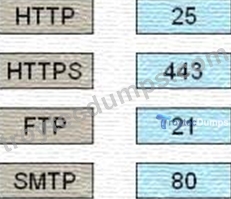
Answer:
Explanation: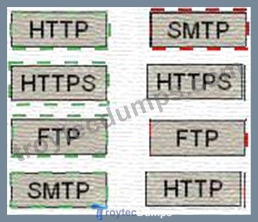
eference: http://en.wikipedia.org/wiki/List_of_TCP_and_UDP_port_numbers
NEW QUESTION # 107
For which purposes would a thermal network camera be a viable alternative to a standard network camera? (Choose three)
- A. Detection in smoke and light fog conditions
- B. Detection at daylight
- C. License Plate Recognition
- D. Identification of a person
- E. Detection at night
Answer: A,B,E
NEW QUESTION # 108
Which are focus technologies offered by Axis cameras? (Select two)
- A. Action focus
- B. Focus recall
- C. Laser focus
- D. Macro focus
- E. Focus pinpoint
Answer: B,E
Explanation:
Axis cameras offer several advanced focus technologies to enhance image clarity and ease of use. Focus Pinpoint allows for precise manual focus adjustments, ensuring sharpness in critical areas. Focus Recall enables cameras to remember and quickly return to pre-set focus positions, which is useful for surveillance scenarios where the camera frequently moves between different points of interest. According to Axis documentation, these technologies are designed to improve the accuracy and efficiency of camera setup and operation.
NEW QUESTION # 109
Which conditions would lead the system designer to choose a camera with good low light performance over a thermal camera? (Choose two)
- A. The camera is going to employ trip line detection looking down a fence line
- B. The camera is going in a primarily dark area, such as a subway or parking garage
- C. The camera is going to be placed in a parking lot for facial identification
- D. The camera is going to be placed inside looking out through a window
- E. The camera is going to be placed on a roof line looking down at an empty field
Answer: C,D
NEW QUESTION # 110
Two cameras are streaming 6 Mbit/s each. Approximately how much storage is required to record one hour of video from both streams?
- A. 2.6 GB
- B. 11.4 GB
- C. 24.2 GB
- D. 5.4 GB
Answer: D
Explanation:
To calculate the storage required to record one hour of video from two cameras streaming at 6 Mbit/s each, we use the following steps:
* Total bitrate for both cameras: 6 Mbit/s×2=12 Mbit/s6 \text{ Mbit/s} \times 2 = 12 \text{ Mbit/s}6 Mbit
/s×2=12 Mbit/s
* Convert Mbit/s to Mbyte/s: 12 Mbit/s÷8=1.5 Mbyte/s12 \text{ Mbit/s} \div 8 = 1.5 \text{ Mbyte/s}
12 Mbit/s÷8=1.5 Mbyte/s
* Calculate the total data for one hour: 1.5 Mbyte/s×3600 seconds=5400 Mbytes1.5 \text{ Mbyte/s}
\times 3600 \text{ seconds} = 5400 \text{ Mbytes}1.5 Mbyte/s×3600 seconds=5400 Mbytes
* Convert Mbytes to Gbytes: 5400 Mbytes÷1024=5.27 Gbytes5400 \text{ Mbytes} \div 1024 = 5.27 \text { Gbytes}5400 Mbytes÷1024=5.27 Gbytes
Approximately, the storage required is 5.4 GB.
Reference: Axis Communications. "Calculating storage requirements." Axis Storage Calculation.
NEW QUESTION # 111
A varifocal lens
- A. Makes it possible to adjust the focal length like a zoom lens, but requires refocusing after adjusting the focal length.
- B. Allows the depth of field to be adjusted, making it possible to blur out the background for privacy protection or reducing distraction.
- C. Is a lens where the focus can be adjusted, as opposed to a fixed focus lens, making it possible to focus on objects close to the camera.
- D. Can rapidly change focus between a set of predefined positions, making it easy to move between different points of interest in the scene.
Answer: A
NEW QUESTION # 112
To get the best accuracy for a people counting application for customers entering a store, the camera should be mounted
- A. Directly above the entrance.
- B. Facing the entrance at eye level.
- C. Facing the entrance.
- D. Facing away from the entrance.
Answer: A
Explanation:
For the best accuracy in a people counting application, the camera should be mounted directly above the entrance. This overhead position provides a clear view of the individuals entering and ensures accurate counting by minimizing obstructions and capturing each person as they cross the threshold. Axis's guidelines for people counting applications recommend this mounting position to achieve the highest accuracy and reliability in the data collected.
NEW QUESTION # 113
What is the maximum power level at the powered device for PoE class 2?
- A. 15W
- B. 12.95 W
- C. 6.49 W
- D. 30 W
Answer: C
Explanation:
The maximum power level at the powered device for PoE class 2 is 6.49 W. Power over Ethernet (PoE) class 2 devices are designed to consume between 3.84 W and 6.49 W. This classification helps ensure that network devices receive the appropriate power levels required for their operation.
Reference: Axis Communications. "Power over Ethernet (PoE) standards and classifications." Axis PoE Standards.
NEW QUESTION # 114
An installer needs a camera to monitor a hallway in an office complex. The hallway is 2.5 m (8 ft 2 in) wide.
The customer wants to be able to identify people (80 pixels per face). What is the minimum resolution needed to meet this requirement?
- A. 1920x1024
- B. 1024x768
- C. 1280x720
- D. 800 x 600
Answer: C
NEW QUESTION # 115
Attackers may try to deceive system owners into installing altered firmware which may include malicious code. Axis helps prevent this by using
- A. HTTPS downloads.
- B. signed firmware.
- C. IEEE 802.1AR.
- D. TPM module.
Answer: B
Explanation:
Axis helps prevent attackers from deceiving system owners into installing altered firmware by using signed firmware. Signed firmware ensures that only authentic and unaltered firmware can be installed on the device.
This process involves cryptographic signatures that verify the integrity and authenticity of the firmware, thus preventing malicious code from being introduced into the system.
Reference: Axis Communications. "Firmware security and updates." Axis Signed Firmware.
NEW QUESTION # 116
A Privacy mask added to Live View (Choose two)
- A. Restricts access to the camera.
- B. Lowers the bandwidth usage.
- C. Can be made into any shape.
- D. Hides parts of the scene.
- E. Can be removed from recorded video.
Answer: C,D
Explanation:
A privacy mask in Live View is used to hide parts of the scene from being viewed or recorded, ensuring privacy in specific areas of the surveillance footage. These masks can be configured in various shapes to cover the required sections effectively. Privacy masks are particularly useful in environments where certain areas need to be excluded from monitoring to comply with privacy laws and regulations. [Reference: Axis Communications - Privacy Masking Features] Top of Form Bottom of Form
NEW QUESTION # 117
In order to comply with SMPTE standards of HDTV, the camera must meet the following:
- A. Light sensitivity, aspect ratio, resolution, color fidelity
- B. Aspect ratio, resolution, light sensitivity, frame rate
- C. Light sensitivity, color fidelity, frame rate, aspect ratio
- D. Frame rate, aspect ratio, resolution, color fidelity
Answer: D
Explanation:
To comply with SMPTE (Society of Motion Picture and Television Engineers) standards for HDTV, the camera must meet specific criteria including frame rate, aspect ratio, resolution, and color fidelity. These standards ensure high-quality video suitable for professional broadcast and security applications. Axis cameras designed for HDTV compliance adhere to these standards, providing high-definition video quality.
For detailed standards, refer to Axis Communications' documentation on HDTV compliance.
NEW QUESTION # 118
When initiating a surveillance project with a customer, which of the following should be considered first?
- A. Understand the legal aspects for the installation
- B. Understand which camera models to use
- C. Understand the customer's goals and requirements
- D. Understand the customer's technical knowledge
Answer: C
Explanation:
When initiating a surveillance project, the first and most critical step is to understand the customer's goals and requirements. This involves gathering detailed information about what the customer aims to achieve with the surveillance system, the specific areas they need to monitor, and any unique challenges or constraints they might have. This understanding helps in designing a tailored solution that meets the customer's expectations and operational needs. [Reference: Axis Communications - Surveillance Installation and Configuration Guide]
NEW QUESTION # 119
The advantage of using multicast in the network is that
- A. Many cameras can share the same network connection.
- B. The video stream reaches every computer in the network simultaneously.
- C. The video stream only needs to be sent once, even though there are multiple viewers.
- D. The video stream is rerouted in case of network dropout.
Answer: C
Explanation:
Multicast is a method of data transmission in which a single stream of data is sent from a source to multiple destinations simultaneously. This technique is especially useful in video surveillance because it allows multiple viewers to receive the same video stream without duplicating the data sent across the network. In other words, the video stream only needs to be sent once from the camera, even though there are multiple viewers, reducing network bandwidth usage. This makes option C correct. For more detailed information, refer to Axis Communications' official documentation on network video fundamentals and multicast usage.
NEW QUESTION # 120
If using H.264 compression, in theory, what could a video containing no l-frames look like?
- A. The first P-frame is visible during the whole video
- B. All non-moving objects will be visible
- C. All moving objects will be visible
- D. A black image is visible during the whole video
Answer: D
Explanation:
H).264 compression uses I-frames (intra-coded frames) as reference points, with P-frames (predictive frames) and B-frames (bi-directional frames) encoding only the changes from the previous frames. If a video contained no I-frames, there would be no reference frame for decoding, resulting in an inability to display any image. This would theoretically result in a black image being visible during the whole video. Therefore, the correct answer is B. For more detailed information, refer to Axis Communications' technical notes on video compression.
NEW QUESTION # 121
What is the human range for the visible spectrum of light?
- A. 450-900 nm
- B. 400-850 nm
- C. 400-700 nm
- D. 350-700 nm
Answer: C
Explanation:
"The human eye can detect light in the 400-700 nm range. Below 400 nm is ultraviolet, above 700 nm is infrared."
- Axis Communications Academy, Network Video Fundamentals, 2022
"Visible spectrum: 400-700 nm."
- Axis Technology Overview: Light and Imaging
References:
Axis Communications Academy, Network Video Fundamentals, 2022 (p. 17)
Axis Light and Imaging Overview
NEW QUESTION # 122
Using AXIS Camera Management, which of the following can be performed? (Choose two)
- A. Set motion detection windows
- B. Configure crossline detection
- C. Upgrade firmware
- D. View recorded video
- E. Apply templates to devices
Answer: C,E
Explanation:
AXIS Camera Management (ACM) is a powerful tool for managing multiple Axis network devices efficiently.
With ACM, administrators can apply templates to devices, which streamlines the configuration process by allowing predefined settings to be distributed across multiple devices. Additionally, ACM facilitates the upgrading of firmware on Axis devices, ensuring that all cameras and encoders are up-to-date with the latest features and security patches. Axis Network Video documentation highlights these capabilities as key features of ACM, enhancing the overall management and maintenance of surveillance systems.
NEW QUESTION # 123
What component blocks visible light, only permitting infrared light to reach the sensor?
- A. IR LED light
- B. OptimizedIR
- C. IR-pass filter
- D. IR-cut filter
Answer: C
Explanation:
"An IR-pass filter blocks visible light and allows only infrared light to reach the camera sensor. This is commonly used for dedicated infrared imaging applications."
- Axis IR Filter Technologies
"An IR-cut filter, by contrast, blocks infrared light and lets visible light through."
- Axis Communications Academy, Network Video Fundamentals, 2022
References:
Axis IR Filter Technologies
Axis Communications Academy, Network Video Fundamentals, 2022 (p. 19)
NEW QUESTION # 124
What type of lens does a fixed box camera typically use?
- A. A CS-mount lens
- B. A C-mount lens
- C. An M12 lens
- D. ATA-lens
Answer: A
NEW QUESTION # 125
Match the best choice of camera to each scenario described. Drag each gray box from the left column to the matching blue box in the right column.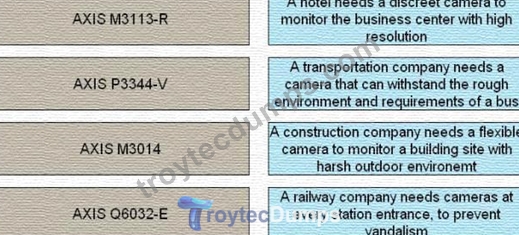
Answer:
Explanation: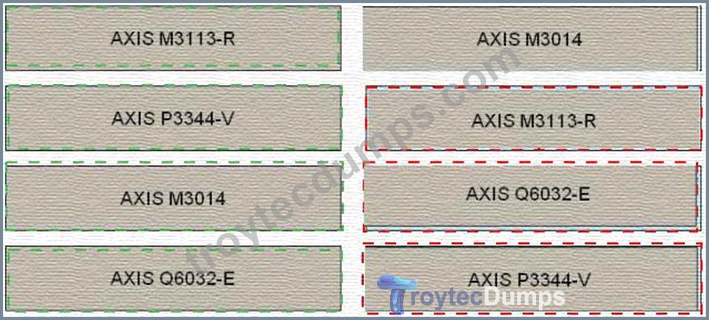
Explanation: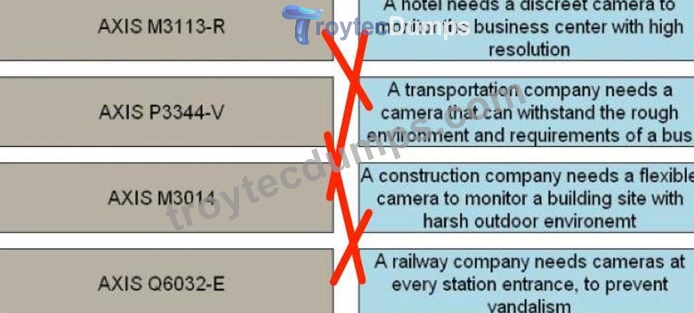
Reference: http://www.axis.com/products/video/camera/index.htm
http://www.axis.com/products/cam_q6032e/
NEW QUESTION # 126
A convenience store needs a camera to cover the entrance. Identification is needed at 80 pixels per face. Given that the scene is 2 m (6 ft 7 in) wide, which of these resolutions is the minimum one needed?
- A. 1920 X 1080
- B. 640X480
- C. 800 X 600
- D. 1280 X 720
Answer: D
Explanation:
To achieve identification at 80 pixels per face for a scene that is 2 meters (6 feet 7 inches) wide, a minimum resolution of 1280 x 720 is needed. This calculation ensures that each face captured in the frame meets the pixel density requirement for clear identification purposes.
NEW QUESTION # 127
Working with a retailer on a site survey, they ask if there's any way to get more of the aisle and less of the shelves on the short sides in the shot. An AXIS M3204 camera is being used. Which would be the best suggestion to the retailer?
- A. Adjusting the varifocal lens from 2.8 mm to 10 mm
- B. Using Axis' Corridor Format
- C. Switching the camera to a 16:9 view
- D. Adjusting the varifocal lens from 2.8 mm to 4 mm
Answer: B
Explanation:
Axis' Corridor Format is designed to provide a vertically oriented video stream, which is ideal for monitoring narrow areas such as aisles. This format minimizes wasted space in the field of view and focuses on the desired area. For a retailer wanting to capture more of the aisle and less of the shelves, enabling Corridor Format on the AXIS M3204 camera would be the best solution. Detailed setup instructions can be found in Axis Communications' user manuals and configuration guides for Corridor Format.
NEW QUESTION # 128
Which setting would best adjust a hard yellow tint as shown in the pictures below?
- A. Color saturation
- B. White balance
- C. Image contrast
- D. Image brightness
Answer: B
Explanation:
The setting that would best adjust a hard yellow tint in the images is the white balance. Adjusting the white balance corrects color casts by accounting for the color temperature of the light source, thereby producing more natural colors in the image. In the example images, modifying the white balance would neutralize the yellow tint and restore accurate colors. Axis cameras have white balance settings that can be adjusted manually or set to automatic for optimal color representation. Further details can be found in Axis Communications' camera setup and image optimization documentation.
NEW QUESTION # 129
......
Updated PDF (New 2025) Actual Axis ANVE Exam Questions: https://www.troytecdumps.com/ANVE-troytec-exam-dumps.html
Dumps Moneyack Guarantee - ANVE Dumps Approved Dumps: https://drive.google.com/open?id=1eM1xX-fU9jPRpqx65xvQ6j3zy9iy22VE