

2026 Updated AgilePM-Practitioner Tests Engine pdf - All Free Dumps Guaranteed!
Latest AgilePM AgilePM-Practitioner Actual Free Exam Questions
APMG-International AgilePM-Practitioner Exam Syllabus Topics:
| Topic | Details |
|---|---|
| Topic 1 |
|
| Topic 2 |
|
| Topic 3 |
|
| Topic 4 |
|
NEW QUESTION # 107
Which 2 statements represent appropriate entries for the Development
Approach Definition?
- A. Once deployed, the number of policies sold through traditional telephone sales will be compared with the number of sales processed online through the website.
- B. The Finance Director has requested a detailed report be produced after 12 weeks, showing costs to date and forecast cost to complete.
- C. Accessibility and performance of the new online quotation area is to be tested using a tool called Sitebeam.
- D. An easy to use web development tool called 'WebMatrix' is to be used to develop and maintain the website extension.
- E. The Sales Manager will introduce an awards or bonus scheme, designed to create competition between the sales assistants.
Answer: C,D
Explanation:
For the XAN Insurance Company Web Project, the Development Approach Definition document should outline the methodologies, tools, and techniques to be used during the development process of the project. It focuses on how the project will be executed in terms of technical and management practices.
Selected Statements for the Development Approach Definition:
C: An easy to use web development tool called 'WebMatrix' is to be used to develop and maintain the website extension.
E: Accessibility and performance of the new online quotation area is to be tested using a tool called Sitebeam.
C: This statement directly specifies a tool (WebMatrix) that will be used for web development and maintenance in the project. It is a clear choice regarding the technical approach and infrastructure, making it suitable for inclusion in the Development Approach Definition.
E: Mentioning Sitebeam as a tool for testing accessibility and performance outlines specific methods for ensuring quality and usability in the development process. It provides actionable information on how testing will be conducted, fitting the criteria for the Development Approach Definition.
Why Other Statements Are Excluded:
A: Introducing an awards or bonus scheme to create competition among sales assistants pertains more to internal sales team management and motivation strategies rather than the technical or methodological approach to developing the project.
B: Comparing traditional telephone sales with online sales is related to the project's performance measurement and post-implementation review, not the development approach or methodology used during the project.
D; The request from the Finance Director for a detailed cost report is related to project financial management and monitoring. While important, it does not detail the technical or methodological approach to developing the project's deliverables.
NEW QUESTION # 108
To ensure that the UniCo change programme is successful, the Chief Executive Officer (CEO) knows that correctly assigning the key change roles will be essential.
Which 2 statements BEST explain why the IT Support Manager is appropriate for the role of change agent for the change programme?
- A. Wants to gain experience in change management to improve future implementations of IT systems.
- B. Is well-positioned to bring together other line leaders facing similar change situations.
- C. Has a strong network due to supporting all staff at all levels organization-wide.
- D. Has direct line authority over the staff who will be changing internal IT systems.
- E. Is good at quietly implementing directions without challenging decisions at every step.
Answer: B,C
Explanation:
Comprehensive and Detailed Step-by-Step Explanation
A Change Agent plays a pivotal role in ensuring the success of a change initiative. Their responsibilities typically include fostering collaboration, addressing resistance, and facilitating the implementation of the change. The IT Support Manager is a suitable choice for this role because of their network across the organization and their ability to connect different leaders and departments.
1. Why B (Bringing Leaders Together) is Correct
* The IT Support Manager, through their role, is positioned to work across multiple departments.
* They are likely familiar with similar challenges faced by other line leaders due to their experience in supporting IT systems and processes organization-wide.
* This ability to act as a connector between leaders makes them well-suited to facilitate collaboration and ensure alignment across the organization during the change initiative.
2. Why C (Strong Network Organization-Wide) is Correct
* By supporting staff at all levels of the organization, the IT Support Manager has built a robust network.
* This network enables them to influence and communicate effectively with individuals across various teams, which is crucial for overcoming resistance and promoting the change program.
* Their established relationships can also help them gather feedback and identify concerns early, making them an effective change agent.
3. Analysis of Incorrect Options
* Option A:
* Quietly implementing directions without challenging decisions does not align with the proactive and collaborative nature of a change agent's role. Change agents must actively engage with stakeholders and advocate for the change, rather than passively implementing instructions.
* Eliminate.
* Option D:
* While direct authority can be useful, the change agent's role is more focused on influence and collaboration across the organization, rather than control over specific teams.
* The IT Support Manager's authority over IT staff is secondary to their ability to work across organizational boundaries.
* Eliminate.
* Option E:
* Wanting to gain experience in change management is not a key qualification for being a change agent. The role requires demonstrated skills in influence, collaboration, and facilitating change rather than a desire to learn.
* Eliminate.
4. Practical Implications
* A strong network and the ability to connect leaders are critical for fostering alignment during a change program.
* The IT Support Manager's role and experience position them to address cross-departmental challenges and encourage collaboration, making them an ideal choice for the change agent role.
NEW QUESTION # 109
A three-month timeframe has been specified to catch the seasonal sales window.
Which Agile principle MOST influences this course of action?
- A. Focus on the business need.
- B. Develop iteratively.
- C. Never compromise quality.
- D. Build incrementally from firm foundations.
Answer: A
NEW QUESTION # 110
Which 2 statements represent appropriate entries for the Prioritised
Requirements List?
- A. The Business Visionary will provide a formal acceptance of the coffee shop insurance product.
- B. All correspondence sent to coffee shop owners by the new system should contain the XAN logo in the top left hand corner of the page.
- C. Further website developments to allow existing customers to access
services online are NOT to be included within the scope of this project. - D. Creation of a new coffee shop insurance product on the existing website is expected to increase the insurance company ' s revenues by up to 10% per week.
- E. An assessment will be made of the effectiveness of the techniques used on the project, in line with the principles of Agile Project Management.
Answer: B,C
Explanation:
Topic 1, XAN Insurance Company Web Project
XAN Insurance Company Web Project
(Note:
Xan is a medium-sized insurance company with a worldwide
customer base and a strong presence on the internet. Its website
has been in operation for fifteen years. It operates from one location
- a large, open-plan office in the centre of a city. It is a friendly
company with no separate private offices for individual managers.
Staff members prefer to wander around the office space and have
one-to-one chats rather than use email or have lots of meetings.
The Marketing Director is considering a project to develop a new
area on the current web site to sell a new type of insurance directly
to the proprietors of coffee bars, insuring them against minor
accidents to staff and customers. The targeted coffee bars are
privately-owned franchises and are mostly situated in railway
stations, airports and shopping centres.
The Marketing Director has not yet decided whether the system will
just provide information about insurance policies online and give
quotations, the policies then being set up later by normal mailing
and telephone contact. Alternatively, it may be possible for the
system to provide the complete set-up and sale of an insurance
policy online. In this case the system would need to enable the
online capture and processing of credit card details and the issue of
an insurance policy.
The Finance Director has budgetary control over all projects in the
company and is reluctant to release finance for projects where the
outcome, timeframe and benefits are not clear.
Because of the uncertainty about the amount of development and
the length of time it may take, it is difficult to set a timeframe on this project. The Sales Manager, who reports to the Marketing Director, has insisted that the website extensions needed for this project must be operational within 12 weeks. The Sales Manager has a You have been brought in to give advice on how an Agile Project Management approach can be used to keep control of this project and to ensure that it delivers something useful to the business within 12 weeks.
After a brief feasibility assessment, conducted by the Sales
Manager, the Finance Director has decided to authorise a 12-week
project with the objective of producing a prototype system for
insurance for coffee bars, with a release at the end of that time. Six
selected coffee bars have agreed to complete an insurance
application form online, to trial the released website.
NEW QUESTION # 111
Which is the BEST reason to remind learners of related knowledge or skill they already possess?
- A. Enables learners to understand how they learn.
- B. Helps learners plan to use immediately what they learn.
- C. Increases learners' understanding of what the new learning will enable them to do.
- D. Reduces learners' concerns about new learning.
Answer: C
Explanation:
Comprehensive and Detailed Explanation:
This question refers to Gagne's Nine Events of Instruction, a model for designing effective learning activities. One of the steps in this model is to activate learners' prior knowledge, which serves as a foundation for new learning. Here's why C is the best answer:
1. Activating Prior Knowledge in Gagne's Model:
* In Gagne's Nine Events of Instruction, reminding learners of related knowledge or skills is part of the event "Stimulating recall of prior learning."
* This step is crucial as it helps learners connect what they already know to the new content, making the learning process smoother and more meaningful.
2. Why Option C is Correct:
* Reminding learners of related knowledge or skills increases their understanding of what the new learning will enable them to do by providing context and relevance.
* It helps bridge the gap between existing knowledge and new concepts, allowing learners to see the practical value and application of the new material.
3. Analysis of Other Options:
* Option A: Enables learners to understand how they learn.
* While activating prior knowledge might give some insight into learning processes, this is not the primary reason for reminding learners of what they already know.
* Option B: Helps learners plan to use immediately what they learn.
* Planning for immediate application is a valid outcome of effective learning but not the primary reason for recalling prior knowledge.
* Option D: Reduces learners' concerns about new learning.
* While recalling prior knowledge may ease anxiety, this is not the main purpose in Gagne's model. The focus is on understanding and connecting prior knowledge to new concepts.
4. Practical Example:
* If a learner is being introduced to a new software tool, reminding them of their previous experience with similar tools helps them relate to the new content and understand how the new tool will expand their capabilities.
5. Reference to Gagne's Model:
* Event 3: Stimulate Recall of Prior Learning
* This step facilitates the integration of prior knowledge with new material, which enhances comprehension and retention.
NEW QUESTION # 112
Midway through Project Increment 4, a joint Sprint Retrospective is held with Developers from both Delivery Teams.
Some members from Marketing and IT, based in India, join via video conferencing.
Issues raised:
. Dependency management challenges
Concerns about AgilePM principle ' Demonstrate Control '
To address this, Mira Bachar and the Developers invite Hira and Sukra Aroon to help Delivery Teams understand the issues, assess the consequences, and collaborate on solutions that align with AgilePM and Scrum.
In addition to the Developers, the teams include: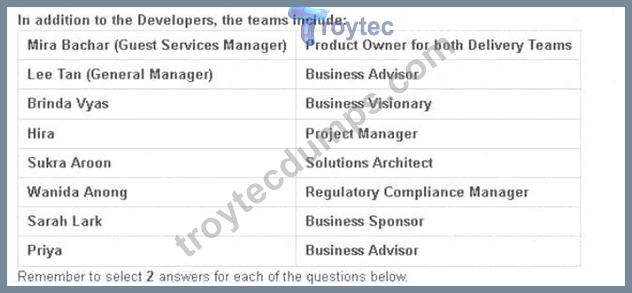
(Developers in the Infrastructure Team report integration issues between climate control and lighting systems, leading to an excessive energy demand beyond the capacity of the solar panels.
Which 2 of the following actions align with the AgilePM guidance on addressing risk?)
- A. Include explicit integration test scenarios in the Sprint Backlog.
- B. Schedule integration workshops at the end of the all Sprints to address any integration concerns.
- C. Document all integration risks and have Sukra Aroon decide appropriate mitigation actions.
- D. Add integration testing to acceptance criteria for relevant Backlog items.
- E. Extend the length of the Sprint to allow time to resolve integration issues.
Answer: A,D
Explanation:
The best answers are C and D .
C is correct because AgilePM promotes building quality and risk control into the work itself. Adding integration testing to acceptance criteria ensures that relevant items are not considered complete unless the integration risk has been addressed.
D is also correct because including explicit integration test scenarios in the Sprint Backlog makes the risk visible, actionable, and part of planned delivery rather than something left vague or deferred.
Why the others are weaker:
* A is not AgilePM-aligned because timeboxes should not be casually extended.
* B is too centralized; Sukra's input matters, but risk handling should be collaborative and embedded in delivery.
* E is too late and reactive; integration concerns should be addressed continuously, not saved for the end.
So the correct answers are C, D .
NEW QUESTION # 113
(At a Sprint Review, Brinda Vyas realized that guest luxury has been prioritized over sustainability, creating misalignment with the project vision.)
- A. Approach-based, because Brinda Vyas ' expectations should be clearly communicated, captured and clarified in the Foundations phase.
- B. Approach-based, because the Delivery Team should have continuously validated assumptions about Brinda Vyas ' expectations.
- C. VUCA-based, because Agile embraces change, so deviations are normal.
- D. VUCA-based, because customer expectations change in dynamic and unpredictable environments.
Answer: B
Explanation:
The correct answer is B .
This is an approach-based risk , not a VUCA-based one, because the issue comes from how the team interpreted and validated the vision during delivery, rather than from an external unpredictable force.
The problem described is that the team prioritized guest luxury over sustainability , which caused a misalignment with the project vision. In AgilePM, that kind of misalignment usually points to a failure in:
* ongoing collaboration,
* validation of assumptions,
* frequent feedback loops,
* and continuous alignment with the Business Visionary.
Why B is correct:
AgilePM does not treat vision alignment as a one-time event only handled in Foundations. Even if the vision is initially clear, the Delivery Team must continue to:
* validate their understanding,
* test assumptions,
* gather feedback,
* and confirm they are still delivering in line with business priorities.
Since Brinda only recognized the misalignment at the Sprint Review, it suggests that the team had been operating on assumptions that were not checked often enough. AgilePM strongly encourages regular inspection and collaboration precisely to prevent this kind of drift.
So this is approach-based because the issue arises from the way the team worked and communicated, not from the external environment.
Why the other options are incorrect:
A). Approach-based, because Brinda Vyas ' expectations should be clearly communicated, captured and clarified in the Foundations phase.
This is partly true, but it is not the best answer. Foundations is important, but AgilePM does not rely only on early clarification. The stronger AgilePM point is that alignment must be maintained continuously throughout delivery, not assumed after Foundations.
C). VUCA-based, because customer expectations change in dynamic and unpredictable environments.
This is incorrect because the scenario is not about changing customer expectations. It is about misalignment with Brinda's existing project vision . The issue is internal interpretation and validation, not environmental uncertainty.
D). VUCA-based, because Agile embraces change, so deviations are normal.
This is incorrect. Agile accepting change does not mean any deviation from the project vision is simply normal or classified as VUCA. A deviation caused by weak alignment is still an approach issue.
AgilePM perspective:
AgilePM depends on:
* clear business vision,
* active business involvement,
* iterative validation,
* and continuous communication between business and delivery roles.
When delivery drifts away from the intended balance of value dimensions-here, luxury and sustainability
-that usually indicates the team did not sufficiently validate its understanding as work progressed.
Therefore, the best answer is B .
NEW QUESTION # 114
During the Foundations phase for Project Increment 4, Sukra Aroon held a meeting with Hira, Mira Bachar, andWanida Anong, to ensure alignment and compliance with EPR company policies, local regulations, and international standards. The meeting also clarified how financial and investment decisions would be made for Project Increment 4, ensuring alignment with EPR business priorities, and how this information will be tracked, controlled and evidenced.
Wanida Anong, who works across multiple sites worldwide, attended the meeting in person but has limited availability throughout the Project Increment.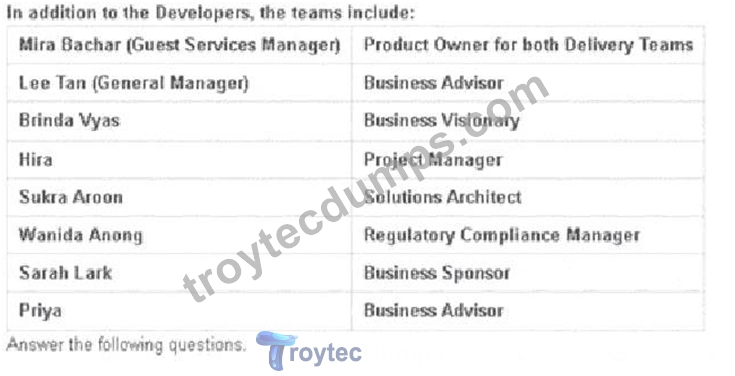
(During the meeting, Hira shared concern that the fixed end date for Project Increment 4, aligned with the start of next season, creates a risk as elements of the Eco-spa may not be ready in time. Based on AgilePM guidance, which of the following is an appropriate response to managing this risk?)
- A. Use MoSCoW prioritization to ensure that Must Have features are delivered first, while lower-priority features can be deferred or adjusted if time runs out.
- B. Increase Delivery Team capacity by hiring additional temporary resources to ensure all planned features are completed before the deadline.
- C. Focus first on completing all compliance-related work to avoid late-stage regulatory issues, deferring guest experience features if necessary.
- D. Extend the Project Increment deadline beyond the start of next season if necessary, ensuring that all planned deliverables meet the original quality expectations.
Answer: A
Explanation:
The correct answer is B .
In AgilePM, when the end date is fixed , the primary control mechanism is not to move time, but to manage scope intelligently . That is exactly what MoSCoW prioritization is for.
Why B is correct:
* AgilePM protects delivery dates by ensuring that Must Have requirements are delivered first.
* Lower-priority items such as Should Have and Could Have can be deferred, reduced, or reshaped if time becomes constrained.
* This preserves business viability while maintaining control.
Why the other options are weaker:
* A is too narrow. Compliance may be critical, but AgilePM would not automatically prioritize all compliance work ahead of everything else without using agreed prioritization logic.
* C is not the primary AgilePM response. Adding temporary resources is not always effective and may introduce more complexity.
* D conflicts with the principle of protecting time. AgilePM generally fixes time and cost, flexing scope where needed.
So the most appropriate AgilePM response is B .
NEW QUESTION # 115
As Sprint 5 comes to an end, the Infrastructure Delivery Team is facing delays due to:
. Heavy rainfall affecting the Wellness Garden.
. Local supplier issues causing material delivery delays.
Dependency on external contractors for hydrotherapy equipment.
The Operations Delivery Team is unable to finalize details of the hydrotherapy treatments without testing them in the context of the facilities being constructed. The marketing materials cannot be generated until this work is complete.
In addition to the Developers, the teams include: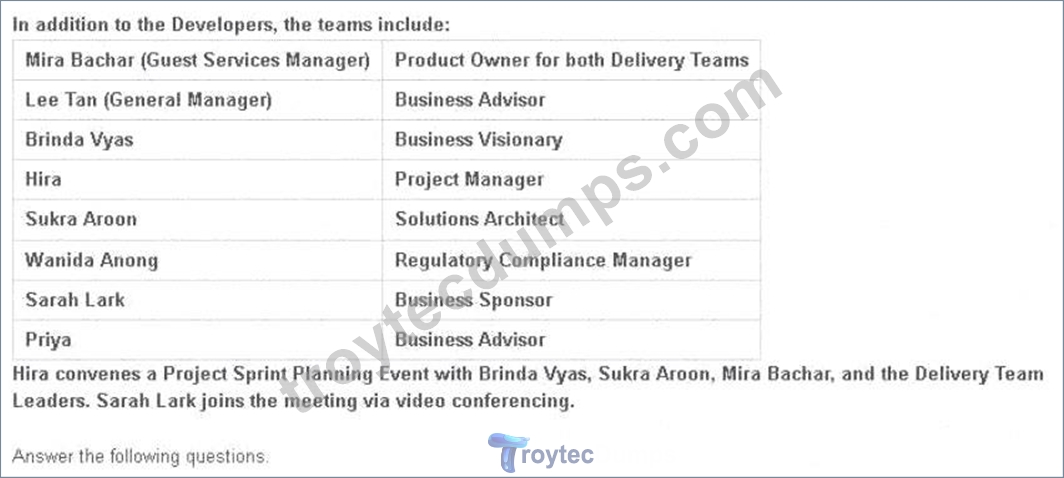
(Hira decides to update the Delivery Plan to prioritize the delivery of the hydrotherapy facilities first for early testing.
Is this action appropriate?)
- A. No, because sequencing should be a collaborative decision, not determined by Hira alone.
- B. Yes, because the Delivery Plan should adapt to real-world conditions.
- C. No, because the Delivery Plan is fixed after the Foundations phase unless a Must Have requirement is at risk.
- D. Yes, because all sequencing changes should be documented in the Delivery Plan.
Answer: A
Explanation:
D is correct.
In AgilePM, adapting the Delivery Plan can be entirely appropriate, especially to support early testing and reduce risk. The issue in this question is the wording that Hira decides this alone. Sequencing and delivery trade-offs should be made collaboratively with the relevant business and technical roles, not unilaterally by the Project Manager.
Why D is best:
* Delivery planning should reflect input from Delivery Teams, Product Owner, and Solution Architect.
* Hydrotherapy sequencing affects dependencies, feasibility, and business priorities.
* AgilePM supports collaborative control, not one-person plan ownership.
Why the others are weaker:
* A is partly true in principle, but it ignores the collaboration issue.
* B is also partly true, but documentation is not the core question.
* C is incorrect because the Delivery Plan is not rigidly fixed after Foundations.
So the most accurate AgilePM answer is D .
NEW QUESTION # 116
Which statement should be recorded under the High-level timing considerations heading?
- A. UniCo's new finance system was delivered in the last quarter and training in the new system is almost complete.
- B. The traditional market has changed over the last year and UniCo can no longer rest on its previous success.
- C. Completing the large contract with a Utilities company over the next nine months is a vital step to achieving the end vision.
- D. UniCo lost significant market share in the last six months and faces ongoing increased competition in the next year.
Answer: C
Explanation:
Comprehensive and Detailed Step-by-Step Explanation:
The High-level timing considerations heading requires statements that emphasize critical timelines, milestones, or deadlines that need to be factored into the change strategy. Here's why D is the most appropriate choice:
1. Understanding High-Level Timing Considerations:
* Timing considerations refer to key deadlines, schedules, or milestones that impact the execution of the change strategy.
* This heading includes initiatives or actions that have a defined timeframe and are crucial for achieving the strategic goals.
2. Option Analysis:
* Option A: The traditional market has changed over the last year and UniCo can no longer rest on its previous success.
* This statement highlights a market condition but does not specify any timeline, milestone, or timing-related requirement. It is more about market trends than timing considerations.
* Eliminate.
* Option B: UniCo lost significant market share in the last six months and faces ongoing increased competition in the next year.
* This statement discusses recent performance and anticipated competition, but it lacks a clear timeline or milestone for action. It is focused on market dynamics, not timing.
* Eliminate.
* Option C: UniCo's new finance system was delivered in the last quarter and training in the new system is almost complete.
* While this mentions past timing, it does not align with the heading as it focuses on completed tasks rather than future timing or milestones.
* Eliminate.
* Option D: Completing the large contract with a Utilities company over the next nine months is a vital step to achieving the end vision.
* This statement provides a clear timeline ("next nine months") and links it to a critical milestone (completing the contract) that contributes directly to UniCo's strategic goals.
* Correct Answer.
3. Relevance in UniCo's Scenario:
* UniCo's focus on repositioning itself in the market and delivering innovative solutions makes the Utilities contract a pivotal milestone. The nine-month timeline directly impacts UniCo's ability to meet its strategic objectives and prove its capability in the new market segment.
4. Agile Practitioner Documentation References:
* Milestone Planning in Agile: Agile emphasizes prioritizing and delivering on critical milestones within time-boxed iterations.
* Strategic Alignment: High-level timing considerations in change strategies align with Agile principles by ensuring key initiatives are completed within the required timeframe to achieve overarching goals.
NEW QUESTION # 117
When preparing for the workshop, which 2 items should the Workshop Facilitator be provided with?
- A. Empowerment to discuss any wider project issues that may arise during the workshop.
- B. A step-by-step guide to running an effective workshop.
- C. An understanding of the decision-making process.
- D. Background to the disagreement and the reasons for this.
- E. Hints and tips on how to influence and persuade others.
Answer: C,D
Explanation:
The two items that the Workshop Facilitator should be provided with when preparing for the workshop are:
*B. An understanding of the decision-making process. This will help the facilitator guide the discussion and help the group reach a consensus.
*C. Background to the disagreement and the reasons for this. This will help the facilitator understand the context of the disagreement and facilitate a more effective discussion.
Please note that while hints and tips on how to influence and persuade others (option A), empowerment to discuss any wider project issues that may arise during the workshop (option D), and a step-by-step guide to running an effective workshop (option E) could be helpful, they are not as crucial as understanding the decision-making process and the background to the disagreement for this specific workshop.
Topic 2, XAN Insurance Company Web Project
XAN Insurance Company Web Project
(Note:
Xan is a medium-sized insurance company with a worldwide
customer base and a strong presence on the internet. Its website
has been in operation for fifteen years. It operates from one location
- a large, open-plan office in the centre of a city. It is a friendly
company with no separate private offices for individual managers.
Staff members prefer to wander around the office space and have
one-to-one chats rather than use email or have lots of meetings.
The Marketing Director is considering a project to develop a new
area on the current web site to sell a new type of insurance directly
to the proprietors of coffee bars, insuring them against minor
accidents to staff and customers. The targeted coffee bars are
privately-owned franchises and are mostly situated in railway
stations, airports and shopping centres.
The Marketing Director has not yet decided whether the system will
just provide information about insurance policies online and give
quotations, the policies then being set up later by normal mailing
and telephone contact. Alternatively, it may be possible for the
system to provide the complete set-up and sale of an insurance
policy online. In this case the system would need to enable the
online capture and processing of credit card details and the issue of
an insurance policy.
The Finance Director has budgetary control over all projects in the
company and is reluctant to release finance for projects where the
outcome, timeframe and benefits are not clear.
Because of the uncertainty about the amount of development and
the length of time it may take, it is difficult to set a timeframe on this project. The Sales Manager, who reports to the Marketing Director, has insisted that the website extensions needed for this project must be operational within 12 weeks. The Sales Manager has a You have been brought in to give advice on how an Agile Project Management approach can be used to keep control of this project and to ensure that it delivers something useful to the business within 12 weeks.
After a brief feasibility assessment, conducted by the Sales
Manager, the Finance Director has decided to authorise a 12-week
project with the objective of producing a prototype system for
insurance for coffee bars, with a release at the end of that time. Six
selected coffee bars have agreed to complete an insurance
application form online, to trial the released website.
NEW QUESTION # 118
Who is responsible for approving that the change in priority of the requirement for a secondary exit from the upstairs of the building accurately reflects the scope of the project in the Prioritised Requirements List?
- A. Architecture Angels' Senior Management Team.
- B. Project Manager and Architect, in the role of Technical Co-ordinator.
- C. Marketing Director, in the role of Business Visionary.
- D. Project Manager and Solution Development Team.
Answer: A
Explanation:
The Senior Management Team, which includes the roles of the Sales, Marketing, and Finance Directors, and the Chief Executive, is typically responsible for steering the project and making decisions that reflect the overall scope and objectives of the project. They would be the appropriate body to approve changes in the project scope as represented in the Prioritised Requirements List, especially for a requirement that has legal and safety implications, such as a secondary fire exit. This team would ensure that such a change aligns with the strategic goals and compliance requirements of the project.
NEW QUESTION # 119
Using the Project Scenario and the additional information provided for
this question in the Scenario Booklet, answer the following question
about assigning the Agile Project Management team roles within this
project.
Lines 1 to 5 in the table below consist of an assertion statement and a reason statement. For each line identify the appropriate option, from options A to E. that applies. Each option can be used once, more than once or not at all.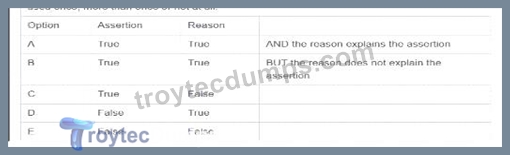
Answer:
Explanation: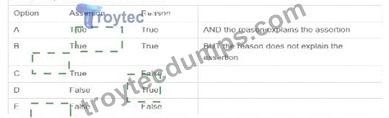
Explanation:
The activities from Column 1 should be performed in the following steps from Column 2, according to the iterative development process:
* Create the data entry screen for entering coffee bar details needed for a quotation.Selection: B.
ActionExplanation: Creating the data entry screen is part of the 'Action' step in iterative development, where the actual product or a part of it is being constructed.
* Enter numbers into a text-only field to see how the web page behaves.Selection: A. Thought Explanation: Testing how the web page behaves by entering data is part of the 'Thought' step, which includes reviewing and evaluating the work done, testing, and reflecting on the outcomes.
* Discuss the requirements of the new coffee bar insurance web page and agree which data fields are important.Selection: C. ConversationExplanation: Discussing and agreeing on the requirements is part of the 'Conversation' step, which involves interactions between team members and stakeholders to understand and define what needs to be built.
NEW QUESTION # 120
(During the Foundations phase, Lee Tan raised concerns about the lack of detailed upfront requirements for the Eco-spa, fearing confusion, constant changes, uncertainty and inefficiency.)
- A. VUCA-based, because external sustainability pressures create uncertainty that requires a flexible scope.
- B. Approach-based, because Lee should understand AgilePM uses iterative development and increment delivery, translating high-level requirements into valuable solutions.
- C. Approach-based, because there is lack of clarity of purpose preventing development from starting.
- D. VUCA-based, because market shifts and changing guest expectations require detailed definition of requirements.
Answer: B
Explanation:
The correct answer is B .
In AgilePM, risks are often viewed in two broad ways:
* VUCA-based risks arise from volatility, uncertainty, complexity, and ambiguity in the environment.
These are usually external or context-driven.
* Approach-based risks arise from how the project is being managed or understood, especially when people misapply the AgilePM method or resist its principles.
In this scenario, Lee Tan's concern is about the lack of detailed upfront requirements . That concern does not primarily come from an external uncertainty such as regulation, market instability, or environmental change. Instead, it reflects discomfort with the AgilePM delivery approach itself .
That is why this is an approach-based risk .
Why B is correct:
AgilePM does not depend on fully detailed requirements upfront before meaningful work can begin. Instead, it works from:
* a clear business vision,
* high-level requirements,
* prioritized outcomes,
* iterative development,
* and incremental delivery.
The method assumes that detail will emerge progressively as the team learns more, collaborates with stakeholders, and validates what creates value.
Lee's concern suggests a misunderstanding of AgilePM. He is expecting a more traditional predictive model where complete definition happens early and change is seen mainly as a problem. AgilePM, by contrast, is designed to handle evolving understanding and controlled change through iteration.
So the risk here is approach-based because the issue lies in expectations about the delivery model, not in the external environment.
Why the other options are incorrect:
A). Approach-based, because there is lack of clarity of purpose preventing development from starting.
This is not the best answer. The issue described is not a lack of purpose. The case already provides a clear vision for the Eco-spa. Lee's concern is about insufficient detailed upfront requirements, not absence of project purpose.
C). VUCA-based, because market shifts and changing guest expectations require detailed definition of requirements.
This is incorrect because VUCA conditions usually support the opposite conclusion: when the environment is changing, a flexible and iterative approach is more suitable than trying to define everything in detail upfront.
D). VUCA-based, because external sustainability pressures create uncertainty that requires a flexible scope.
This statement may sound plausible in a general AgilePM sense, but it does not match the scenario. Lee's concern is specifically about the project approach to requirements, not about external sustainability pressures as the source of the risk.
AgilePM perspective:
AgilePM accepts that:
* not all detail is known at the start,
* learning happens during delivery,
* change is expected and managed,
* and value is refined through collaboration and feedback.
Therefore, when a stakeholder is worried because requirements are not fully detailed upfront, the relevant risk is often not environmental uncertainty, but misalignment with the AgilePM approach .
So the best answer is B .
NEW QUESTION # 121
Xan Insurance Company operates from one location - a large, open-plan
office in the centre of a city. Those employees that will be working within the Solution Development Team are all based in this office but work at different ends of the office in separate departments.
What action should the Project Manager suggest to ensure the most effective collaboration of the Solution Development Team?
- A. Create an email group for the Solution Development Team to collaborate on ideas.
- B. Set up a telephone or video conferencing facility so that all members of the team can collaborate effectively.
- C. Relocate these employees to a new project area, with a number of desks where the Solution Development Team can sit together.
- D. No action required as these employees are located in the same office.
Answer: C
Explanation:
The most effective action the Project Manager can suggest to ensure the most effective collaboration of the Solution Development Team is:
C: Relocate these employees to a new project area, with a number of desks where the Solution Development Team can sit together.
Co-locating team members in a shared space is a well-established practice in Agile environments to enhance communication, collaboration, and team dynamics. By having the Solution Development Team sit together, the Project Manager can facilitate more efficient face-to-face interactions, quick resolution of issues, and a better sense of team unity. This approach leverages the benefits of immediate communication and collaborative problem-solving, which are key in Agile project management. Even though the team members are currently in the same office, their separation into different ends of the office could hinder spontaneous communication and collaboration. Creating a dedicated project area for the team can significantly improve their ability to work together effectively.
NEW QUESTION # 122
(Brinda Vyas has been absent for two weeks, leaving Mira Bachar and the Delivery Teams to make decisions.
Recent strategic adjustments haven ' t been communicated to the Delivery Teams causing frustration and risk of rework.
Which 2 statements describe how this risk should be handled within the AgilePM framework?)
- A. Hira should engage other business stakeholders to assume Brinda Vyas ' responsibilities to ensure the Delivery Teams receives strategic guidance.
- B. Mira Bachar and the Delivery Teams should document assumptions behind decisions and continue progress without validation.
- C. The Delivery Teams should focus on backlog items with clear business direction and pause tasks that require Brinda Vyas ' input until guidance is available.
- D. Continue increment work based on the backlog, assuming adjustments can be made when Brinda Vyas returns.
- E. Hira should escalate to Sarah Lark, the Business Sponsor, to replace Brinda Vyas with another qualified Business Visionary.
Answer: A,C
Explanation:
The correct answers are C and E .
This is a classic business availability and decision-latency risk in AgilePM. The problem is not just that Brinda is absent. The bigger issue is that the Business Visionary input is missing at a time when strategic adjustments are affecting delivery decisions . That creates a real risk of:
* misalignment with the project vision,
* unnecessary assumptions,
* frustration in the Delivery Teams,
* and costly rework.
AgilePM relies heavily on active business involvement . When a key business role becomes unavailable, the right response is to restore decision-making guidance quickly and protect the teams from working blindly on uncertain items .
Why C is correct
"Hira should engage other business stakeholders to assume Brinda Vyas ' responsibilities to ensure the Delivery Teams receives strategic guidance." This aligns strongly with AgilePM.
Hira, as Project Manager, should act to restore the missing business guidance by coordinating with suitable business stakeholders who can temporarily support or cover the gap. AgilePM does not encourage leaving teams without access to strategic direction. It also does not assume that work should continue normally when a key business authority is unavailable.
This response is good because it:
* maintains business engagement,
* reduces decision delays,
* protects alignment with the vision,
* and helps the Delivery Teams continue with informed guidance.
In AgilePM, if a critical role is unavailable, the project should adapt so the necessary business input remains accessible.
Why E is correct
"The Delivery Teams should focus on backlog items with clear business direction and pause tasks that require Brinda Vyas ' input until guidance is available." This is also very AgilePM-aligned.
It is a practical risk response that avoids reckless progress based on guesswork. Teams should keep moving where the direction is already clear, but they should avoid pushing ahead on items that depend on missing strategic clarification.
This balances:
* maintaining momentum,
* avoiding unnecessary delay across all work,
* and reducing the risk of rework on unclear items.
That is exactly the kind of sensible, adaptive delivery behavior AgilePM supports.
Why the other options are incorrect
A). Continue increment work based on the backlog, assuming adjustments can be made when Brinda Vyas returns.
This is not a good AgilePM response because it normalizes working with outdated or incomplete strategic guidance. If recent strategic changes have not been communicated, continuing as normal increases the risk of building the wrong thing.
B). Mira Bachar and the Delivery Teams should document assumptions behind decisions and continue progress without validation.
Documenting assumptions is better than ignoring them, but continuing without validation is still too risky in this scenario. AgilePM values transparency, but it does not support knowingly progressing on uncertain strategic assumptions when better escalation and stakeholder engagement are possible.
D). Hira should escalate to Sarah Lark, the Business Sponsor, to replace Brinda Vyas with another qualified Business Visionary.
This may become necessary if the absence is prolonged or the project is materially threatened, but it is too strong as the best immediate response here. AgilePM would first look to restore business guidance through practical engagement and controlled work selection before moving to formal replacement.
AgilePM perspective
AgilePM expects:
* active and timely business input,
* collaborative response to risks,
* continued delivery where direction is clear,
* and escalation or substitution when critical decision-making is missing.
So the best way to handle this risk is to:
* restore business guidance through other suitable stakeholders , and
* limit work to items that have clear direction until ambiguity is resolved .
Therefore, the correct answers are:
C, E
NEW QUESTION # 123
Using the Project Scenario and the additional information provided for this question in the Scenario Booklet, answer the following question about the responsibilities of the roles in the Agile team.
Lines 1 to 5 in the table below consist of an assertion statement and a reason statement. For each line identify the appropriate option, from options A to E, that applies.
Each option can be used once, more than once or not at all.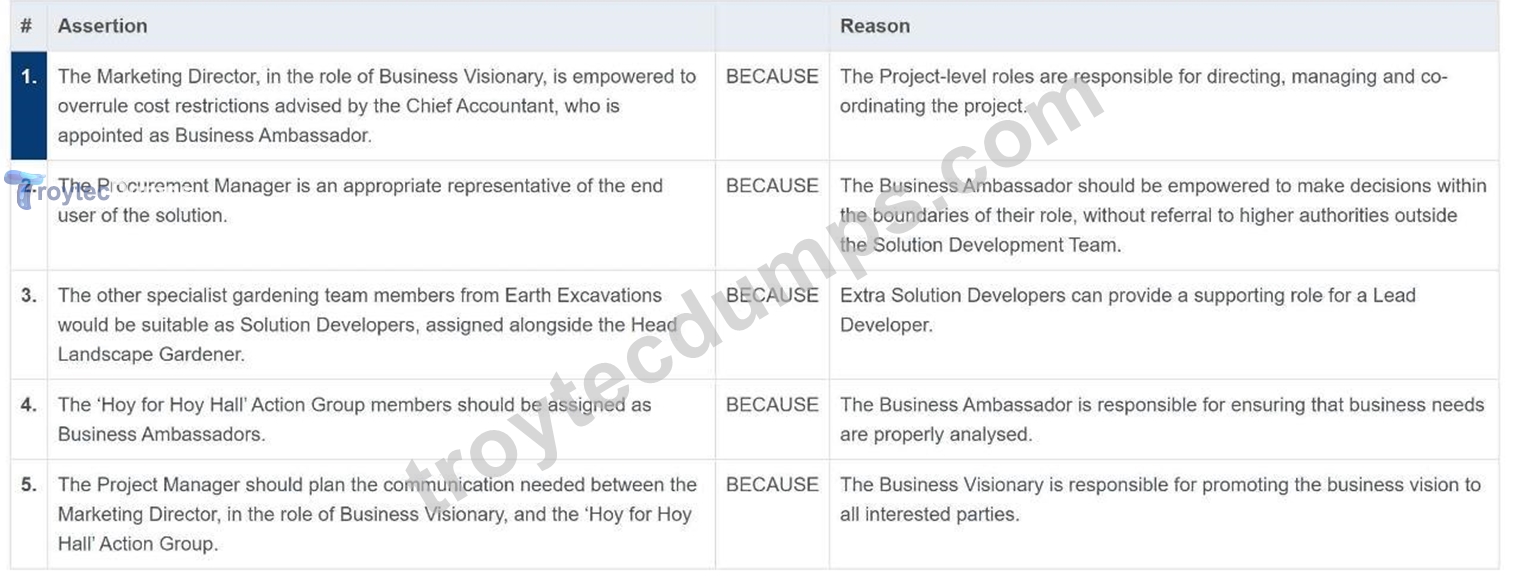
Assertion
* The Marketing Director, in the role of Business Visionary, is empowered to overrule cost restrictions advised by the Chief Accountant, who is appointed as Business Ambassador.
BECAUSE
The Project-level roles are responsible for directing, managing and co- ordinating the project.
* The Procurement Manager is an appropriate representative of the end user of the solution.
BECAUSE
The Business Ambassador should be empowered to make decisions within
the boundaries of their role, without referral to higher authorities outside the Solution Development Team.
* The other specialist gardening team members from Earth Excavations would be suitable as Solution Developers, assigned alongside the Head Landscape Gardener.
BECAUSE
Extra Solution Developers can provide a supporting role for a Lead
Developer.
* The ' Hoy for Hoy Hall ' Action Group members should be assigned as Business Ambassadors.
BECAUSE
The Business Ambassador is responsible for ensuring that business needs are properly analysed.
* The Project Manager should plan the communication needed between the Marketing Director, in the role of Business Visionary, and the ' Hoy for Hoy Hall ' Action Group.
BECAUSE
The Business Visionary is responsible for promoting the business vision to all interested parties.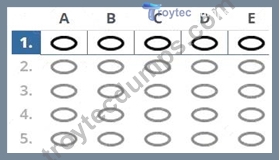
Answer:
Explanation: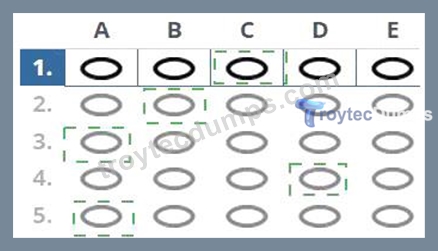
Explanation:
Here are the appropriate options for each assertion and reason combination:
* The Marketing Director, in the role of Business Visionary, is empowered to overrule cost restrictions advised by the Chief Accountant, who is appointed as Business Ambassador.
* C. True (Assertion) False (Reason)
* Rationale: While the Business Visionary may have the authority to make strategic decisions that could overrule cost restrictions, the reason given relates to project-level roles directing the project, not to the authority to overrule cost-related advice.
* The Procurement Manager is an appropriate representative of the end user of the solution.
* B. True (Assertion) True (Reason) BUT the reason does not explain the assertion
* Rationale: The Procurement Manager, as part of the operational team, could represent the end user. However, the reason given talks about the empowerment of the Business Ambassador, which does not directly explain why the Procurement Manager is a representative of the end user.
* The other specialist gardening team members from Earth Excavations would be suitable as Solution Developers, assigned alongside the Head Landscape Gardener.
* A. True (Assertion) True (Reason) AND the reason explains the assertion
* Rationale: Specialist gardening team members would be suitable as Solution Developers, providing support to the Lead Developer, which is a common practice in Agile teams.
* The ' Hoy for Hoy Hall ' Action Group members should be assigned as Business Ambassadors.
* D. False (Assertion) True (Reason)
* Rationale: While the Business Ambassador should ensure that business needs are analyzed, the ' Hoy for Hoy Hall ' Action Group members being assigned as Business Ambassadors is not necessarily true as they are external stakeholders and not necessarily equipped to represent the business internally on a project.
* The Project Manager should plan the communication needed between the Marketing Director, in the role of Business Visionary, and the ' Hoy for Hoy Hall ' Action Group.
* A. True (Assertion) True (Reason) AND the reason explains the assertion
* Rationale: The Project Manager typically has the responsibility to plan and manage communication between the project team and external stakehold ers, and the Business Visionary ' s role includes promoting the business vision to interested parties, which includes the ' Hoy for Hoy Hall ' Action Group.
NEW QUESTION # 124
For cognitive learning, which is the BEST example of providing 'learning feedback'?
- A. Discussion at the learners' next annual performance reviews.
- B. Reviewing learners' ideas in a group discussion.
- C. Testing before and after learning.
- D. Giving supervisor feedback on return to work.
Answer: B
Explanation:
Comprehensive and Detailed Explanation:
Providing learning feedback in cognitive learning focuses on offering timely, actionable information that helps learners assess their understanding and adjust their approach during or immediately after the learning process.
1. Feedback in Gagne's Nine Events of Instruction:
* Gagne's Fifth Event emphasizes the importance of providing feedback during learning activities to reinforce correct understanding and correct misconceptions.
* Effective feedback is specific, immediate, and relevant to the learning task. It allows learners to reflect on their performance and apply improvements in real time.
2. Why Option C is Correct:
* Reviewing learners' ideas in a group discussion provides an interactive opportunity for real-time feedback. It allows learners to:
* Share their understanding.
* Receive constructive input from peers and facilitators.
* Make immediate adjustments to their thinking.
* Group discussions align with cognitive learning principles by promoting active engagement, critical thinking, and collaborative feedback.
3. Analysis of Other Options:
* Option A: Giving supervisor feedback on return to work.
* Supervisor feedback is important but typically occurs after the learning activity. It is more suited for workplace performance improvement rather than immediate learning feedback.
* Option B: Testing before and after learning.
* Testing evaluates knowledge acquisition but does not provide real-time feedback during the learning process, which is crucial for cognitive learning.
* Option D: Discussion at the learners' next annual performance reviews.
* Annual reviews occur too late to be effective for learning feedback. Feedback needs to be immediate and closely tied to the learning activity for maximum impact.
4. Practical Example:
* During a training session on problem-solving, participants share their approaches in a group discussion.
The trainer provides constructive feedback, highlighting strengths and offering corrections, enabling learners to refine their skills on the spot.
5. Reference to Gagne's Model:
* Event 5: Provide Learner Feedback
* Gagne emphasizes that feedback reinforces learning, ensures understanding, and guides learners toward desired outcomes.
NEW QUESTION # 125
......
AgilePM-Practitioner Dumps Updated Practice Test and 186 unique questions: https://www.troytecdumps.com/AgilePM-Practitioner-troytec-exam-dumps.html
Latest 100% Exam Passing Ratio - AgilePM-Practitioner Dumps PDF: https://drive.google.com/open?id=1rc76digFpAVRwEp_j_g1nVsd5I1PqIrW