

Use Real DP-420 Dumps - Microsoft Correct Answers updated on 2025
Azure Cosmos DB Developer Specialty DP-420 Exam Practice Dumps
What are the objectives of the Microsoft DP-420 Certification Exam?
As per the guidance of the DP-420 Dumps, there are 02 main objectives of the Microsoft DP-420 Certification Exam. The first is to understand Azure Cosmos DB architecture & components, and the second is to understand the design and implementation of cloud-native applications using Microsoft Azure Cosmos DB. Assessment of the candidate's technical knowledge and skills in the field of Azure SQL Database Administration.
Microsoft DP-420 exam is an advanced-level certification designed to validate the skills and knowledge of professionals in designing and implementing cloud-native applications using Microsoft Azure Cosmos DB. Designing and Implementing Cloud-Native Applications Using Microsoft Azure Cosmos DB certification is highly valued in the industry and can help professionals advance their careers in cloud-native application development. If you are interested in taking DP-420 exam, make sure to prepare thoroughly and gain hands-on experience with Azure Cosmos DB and other related technologies.
NEW QUESTION # 44
You are developing an application that will connect to an Azure Cosmos DB for NoSQL account. The account has a single readme region and one agonal read region. The regions are configured for automatic failover.
The account has the following connect strings. (Line numbers are included for reference only.)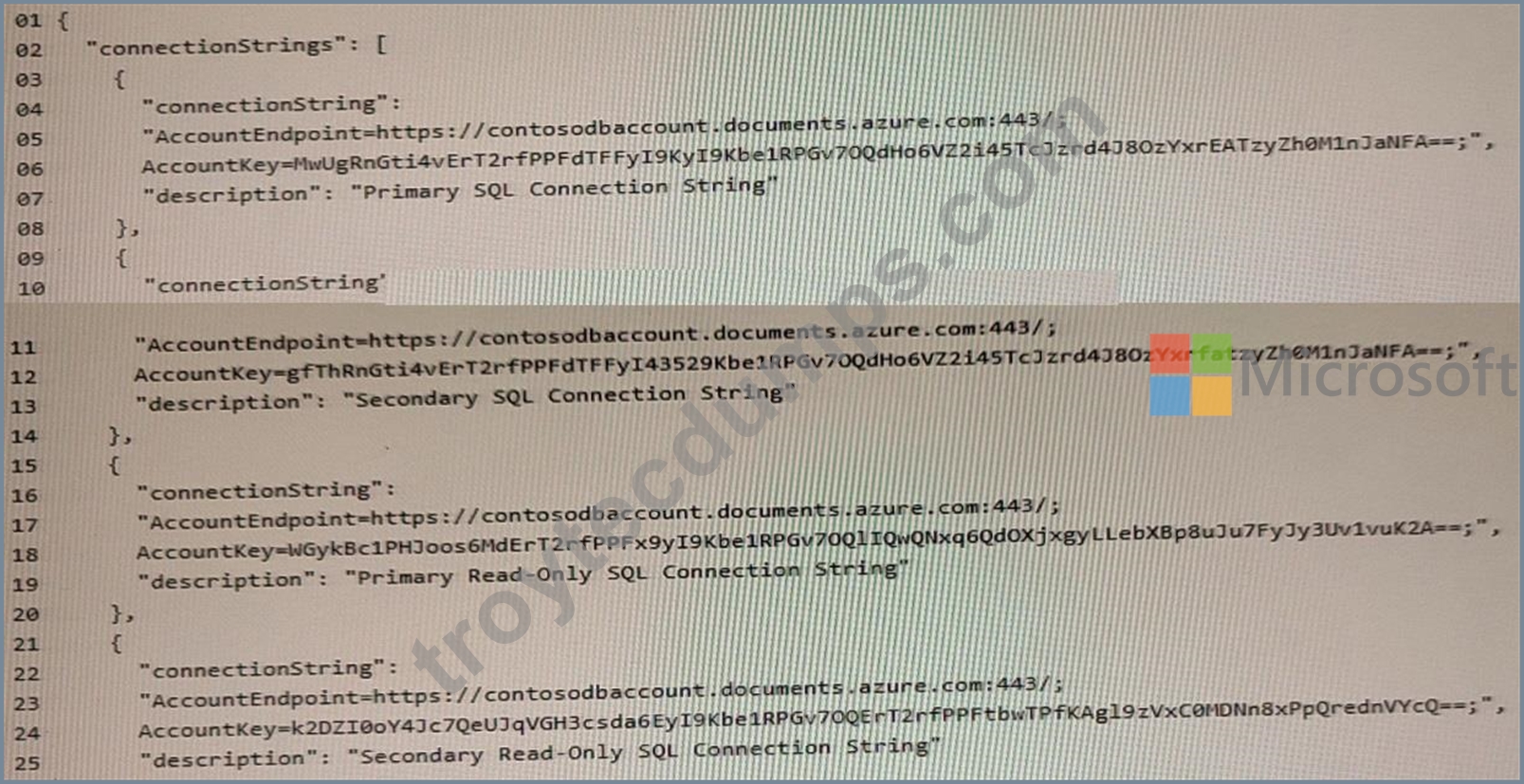
For each of the following statements, select Yes if the statement is true. otherwise, select No.
NOTE: Each correct selection is worth one point.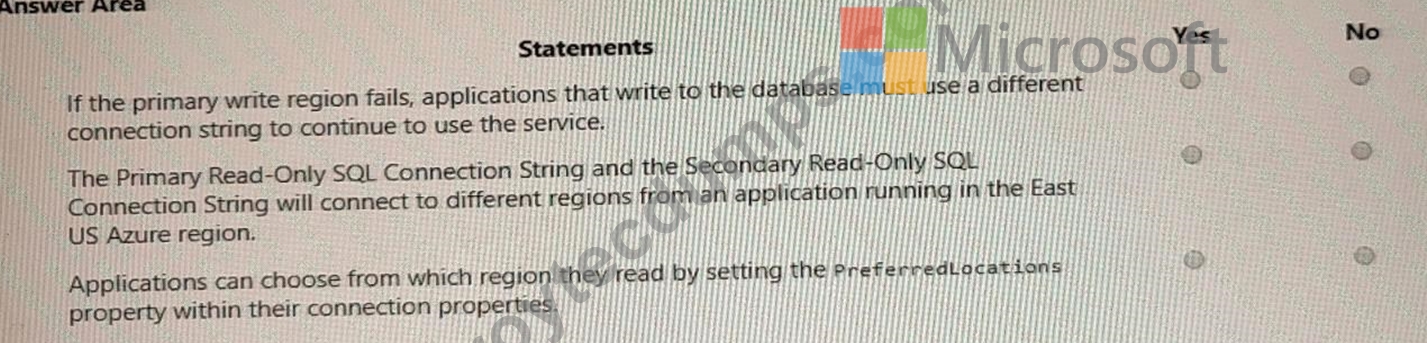
Answer:
Explanation: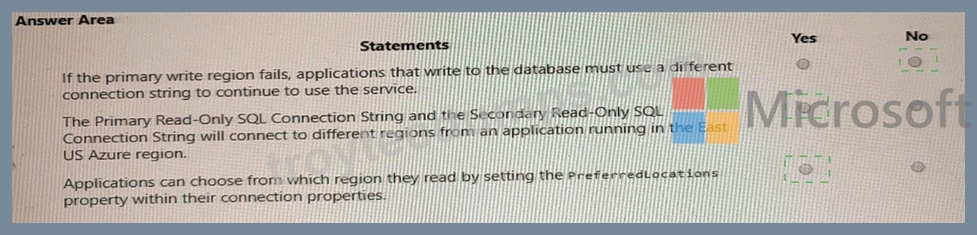
Explanation:
If the primary write region fails, applications that write to the database must use a different connection string to continue to use the service. = NO You do not need to use a different connection string to continue to use the service if the primary write region fails. This is because Azure Cosmos DB supports automatic failover, which means that it will automatically switch the primary write region to another region in case of a regional outage2. The application does not need to change the connection string or specify the failover priority3. The connection string contains a list of all the regions associated with your account, and Azure Cosmos DB will route the requests to the appropriate region based on the availability and latency1.
The primary Read-Only SQL Connection String and the Secondary Read-Only SQL Connection String will connect to different regions from an application running in the East US Azure region = Yes The primary read-only SQL connection string and the secondary read-only SQL connection string will connect to different regions from an application running in the East US Azure region. This is because the primary read-only SQL connection string contains the endpoint for the East US region, which is the same as the primary write region. The secondary read-only SQL connection string contains the endpoint for the West US region, which is the additional read region. Therefore, if an application running in the East US Azure region uses these connection strings, it will connect to different regions depending on which one it chooses.
Applications can choose from which region by setting the PreferredLocations property within their connection properties = Yes Applications can choose from which region by setting the PreferredLocations property within their connection properties. This property allows you to specify a list of regions that you prefer to read from based on their proximity to your application2. Azure Cosmos DB will route the requests to the appropriate region based on the availability and latency1. You can also set the ApplicationRegionproperty to the region where your application is deployed, and Azure Cosmos DB will automatically populate the PreferredLocations property based on the geo-proximity from that location1.
NEW QUESTION # 45
You are developing an application that will use an Azure Cosmos DB Core (SQL) API account as a data source.
You need to create a report that displays the top five most ordered fruits as shown in the following table.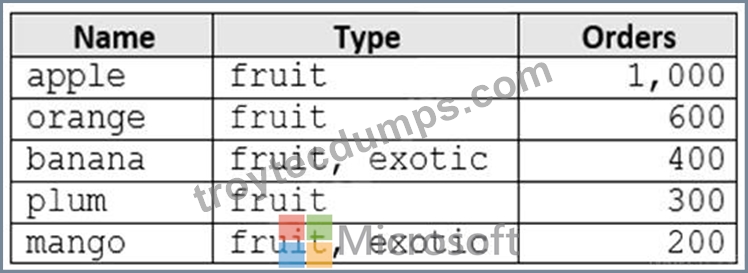
A collection that contains aggregated data already exists. The following is a sample document:
{
"name": "apple",
"type": ["fruit", "exotic"],
"orders": 10000
}
Which two queries can you use to retrieve data for the report? Each correct answer presents a complete solution.
NOTE: Each correct selection is worth one point.
A)
B)
C)
D)
- A. Option C
- B. Option B
- C. Option A
- D. Option D
Answer: B,D
Explanation:
Explanation
ARRAY_CONTAINS returns a Boolean indicating whether the array contains the specified value. You can check for a partial or full match of an object by using a boolean expression within the command.
Reference: https://docs.microsoft.com/en-us/azure/cosmos-db/sql/sql-query-array-contains
NEW QUESTION # 46
You have a container that stores data about families. The following is a sample document.
For each of the following statements, select Yes if the statement is true. otherwise, select No.
NOTE: Each correct selection is worth one point.
Answer:
Explanation:
Explanation:
Children who do no have parents defined will appear on the list = NO
Children who do not have parents defined will not appear on the list. This is because the document schema defines the children property as an array of objects that contain the firstName and gender properties of each child, as well as a parents property that references the id values of the parents. If a child does not have parents defined, it means that the parents property is either missing or empty for that child. Therefore, such a child will not be included in the list of children who have parents defined.
Children who have more than one pet will appear on the list multiple times. = Yes Children who have more than one pet will appear on the list multiple times. This is because the document schema defines the pets property as an array of objects that contain the givenName and type properties of each pet, as well as a children property that references the id values of the children who own the pet. If a child has more than one pet, it means that the child's id value will appear in the children property of multiple pet objects. Therefore, such a child will be included in the list of children who have pets multiple times.
Children who do no have pets defined will appear on the list = No
Children who do not have pets defined will not appear on the list. This is because the document schema defines the pets property as an array of objects that contain the givenName and type properties of each pet, as well as a children property that references the id values of the children who own the pet. If a child does not have pets defined, it means that the child's id value does not appear in the children property of any pet object.
Therefore, such a child will not be included in the list of children who have pets defined.
NEW QUESTION # 47
You plan to deploy two Azure Cosmos DB Core (SQL) API accounts that will each contain a single database.
The accounts will be configured as shown in the following table.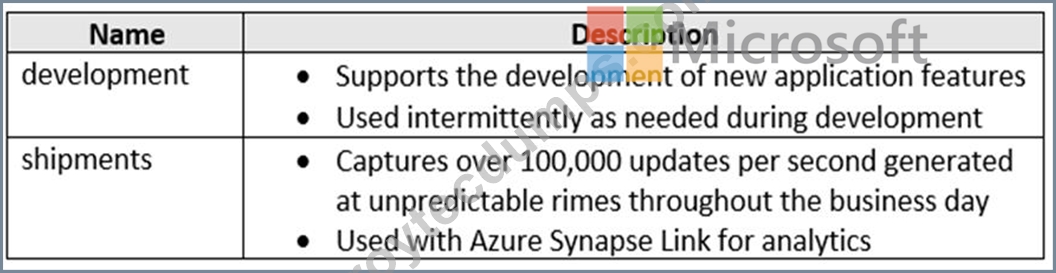
How should you provision the containers within each account to minimize costs? To answer, select the appropriate options in the answer area.
NOTE: Each correct selection is worth one point.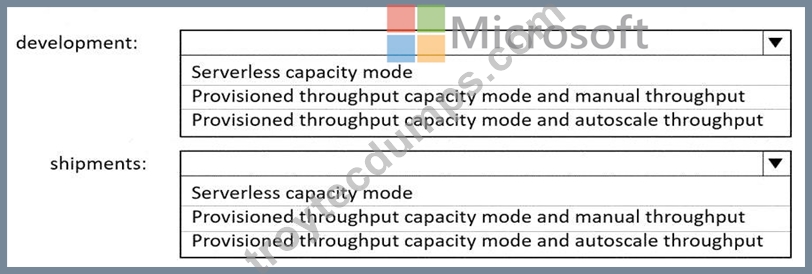
Answer:
Explanation: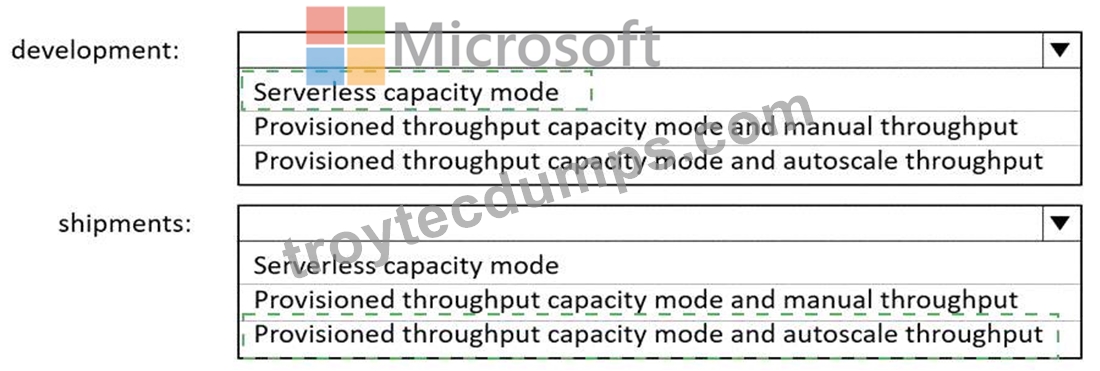
Explanation: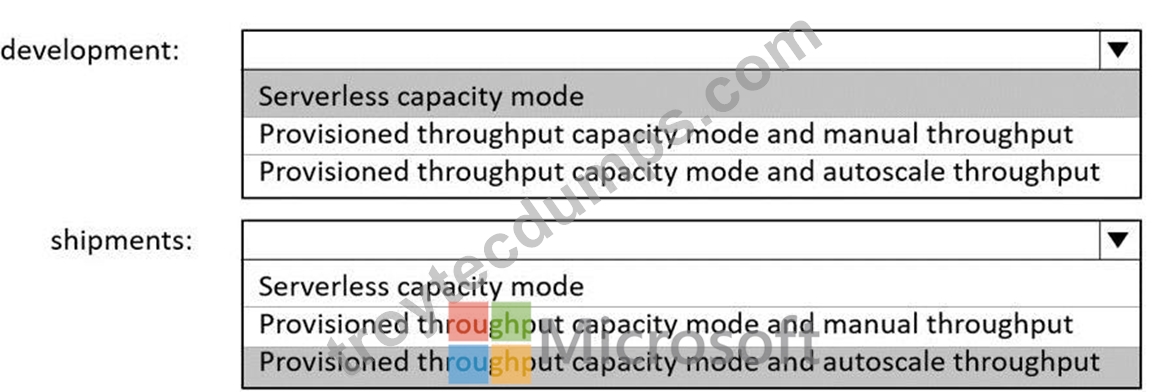
Box 1: Serverless capacity mode
Azure Cosmos DB serverless best fits scenarios where you expect intermittent and unpredictable traffic with long idle times. Because provisioning capacity in such situations isn't required and may be cost-prohibitive, Azure Cosmos DB serverless should be considered in the following use-cases:
Getting started with Azure Cosmos DB
Running applications with bursty, intermittent traffic that is hard to forecast, or low (<10%) average-to-peak traffic ratio Developing, testing, prototyping and running in production new applications where the traffic pattern is unknown Integrating with serverless compute services like Azure Functions Box 2: Provisioned throughput capacity mode and autoscale throughput The use cases of autoscale include:
Variable or unpredictable workloads: When your workloads have variable or unpredictable spikes in usage, autoscale helps by automatically scaling up and down based on usage. Examples include retail websites that have different traffic patterns depending on seasonality; IOT workloads that have spikes at various times during the day; line of business applications that see peak usage a few times a month or year, and more. With autoscale, you no longer need to manually provision for peak or average capacity.
Reference:
https://docs.microsoft.com/en-us/azure/cosmos-db/serverless
https://docs.microsoft.com/en-us/azure/cosmos-db/provision-throughput-autoscale#use-cases-of-autoscale
NEW QUESTION # 48
You have an Azure Cosmos DB Core (SQL) API account named account1 that has the disableKeyBasedMetadataWriteAccess property enabled.
You are developing an app named App1 that will be used by a user named DevUser1 to create containers in account1. DevUser1 has a non-privileged user account in the Azure Active Directory (Azure AD) tenant.
You need to ensure that DevUser1 can use App1 to create containers in account1.
What should you do? To answer, select the appropriate options in the answer area.
NOTE: Each correct selection is worth one point.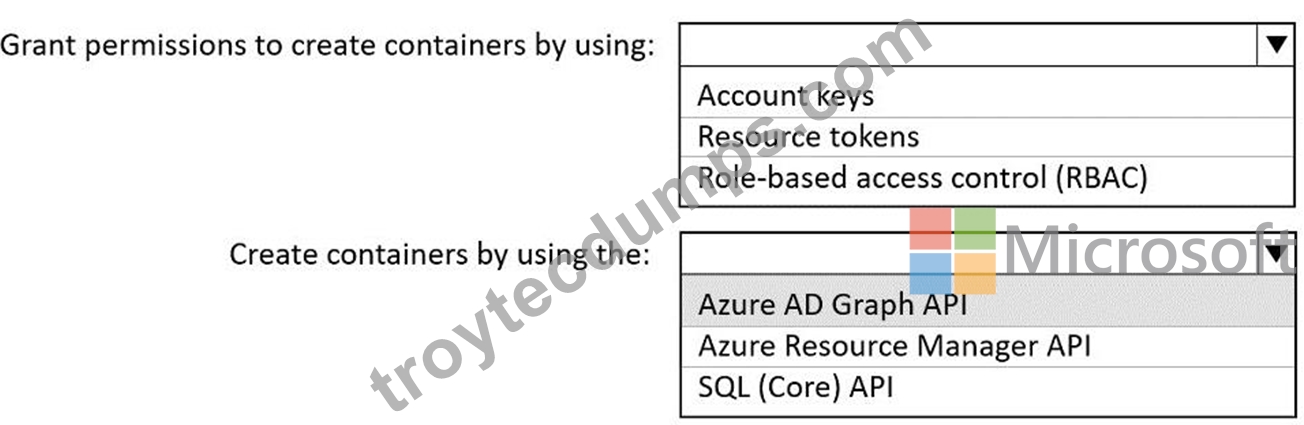
Answer:
Explanation: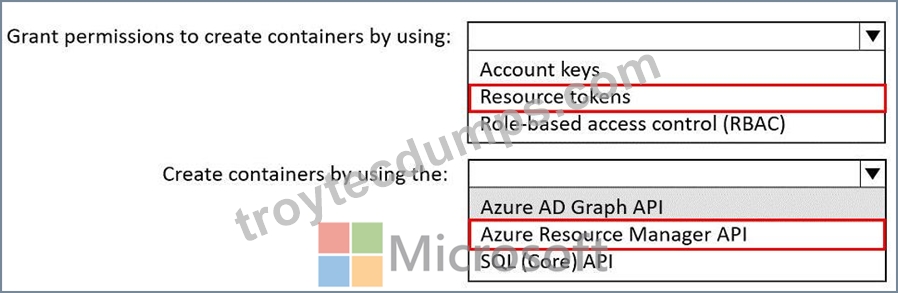
Reference:
https://docs.microsoft.com/en-us/azure/cosmos-db/secure-access-to-data
https://docs.microsoft.com/en-us/rest/api/resources/
NEW QUESTION # 49
You need to select the capacity mode and scale configuration for account2 to support the planned changes and meet the business requirements. What should you select? To answer, select the appropriate options in the answer are a. NOTE: Each correct selection is worth one point.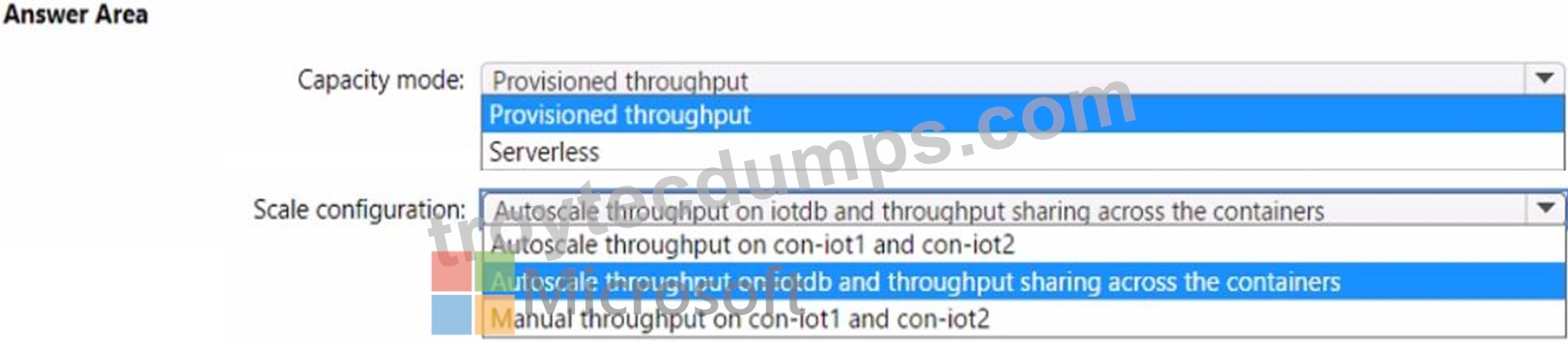
Answer:
Explanation: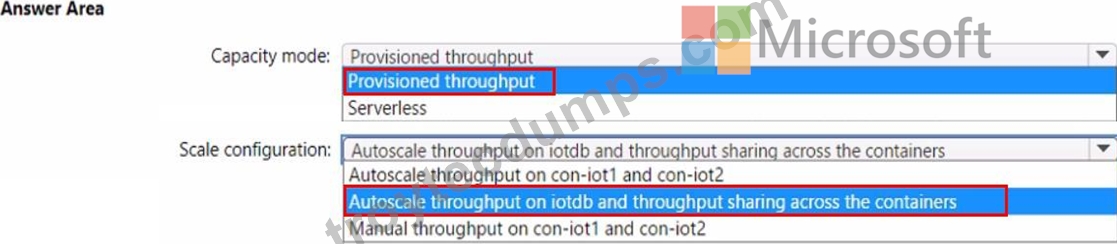
NEW QUESTION # 50
You have an Azure subscription that contains an Azure Cosmos DB for NoSQL account named account1 and a Log Analytics workspace named Workspace1. Workspace 1 stores the logs of account1.
You need to identify which operations used the most request units per second (RU/s) during the last 24 hours.
How should you complete the query? To answer, select the appropriate options in the answer area.
NOTE: Each correct selection is worth one point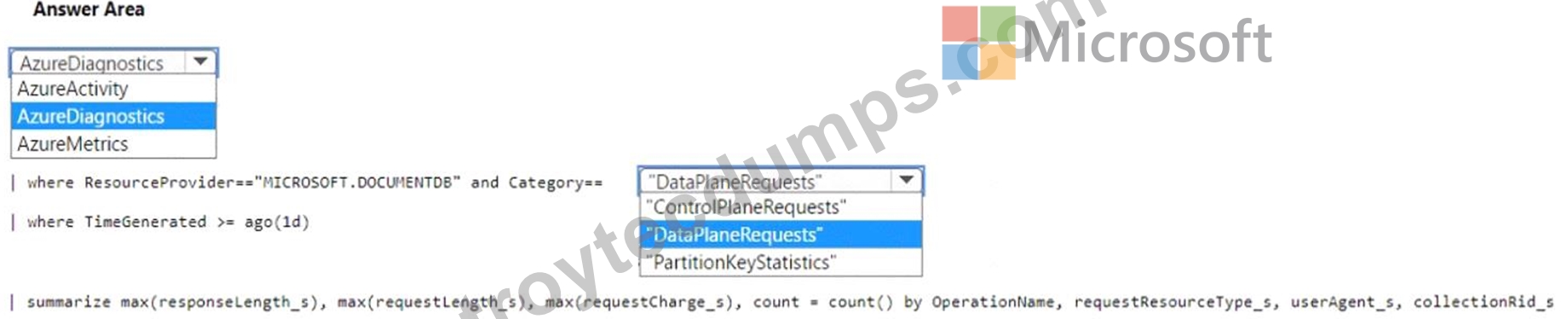
Answer:
Explanation: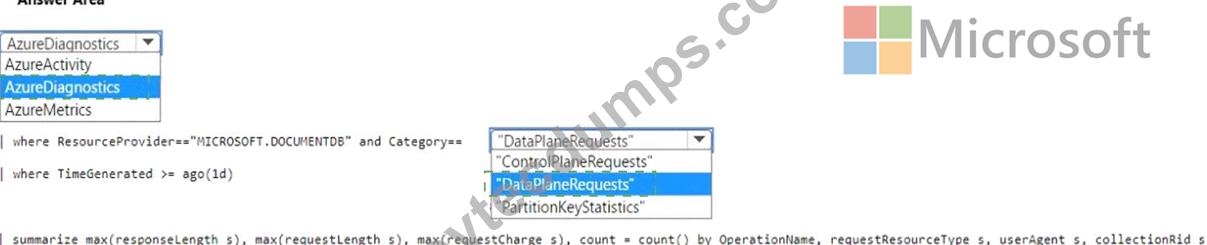
Explanation:
NEW QUESTION # 51
You plan to implement con-iot1 and con-iot2.
You need to configure the default Time to Live setting for each container. The solution must meet the loT telemetry requirements.
What should you configure? To answer, select the appropriate options in the answer NOTE: Each correct selection is worth one point.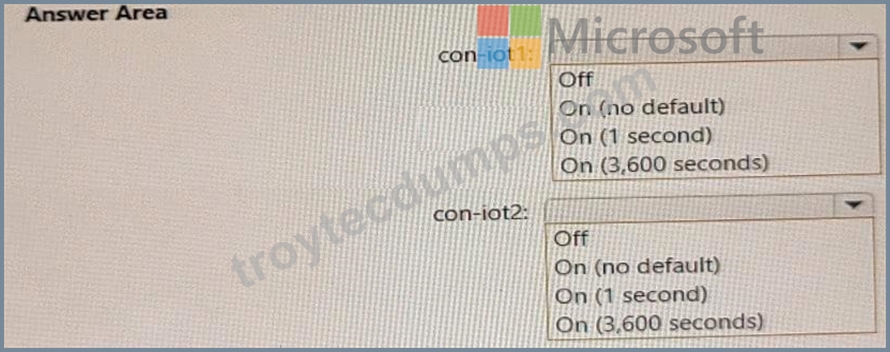
Answer:
Explanation: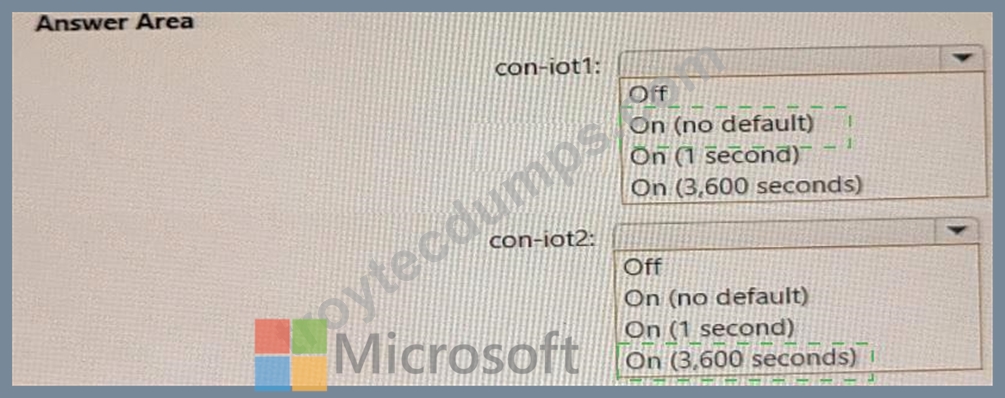
Explanation
Box 1 = On (no default)For con-iot1, you need to configure the default TTL setting to On (no default), which means that items in this container do not expire by default, but you can override the TTL value on a per-item basis. This meets the requirement of retaining all telemetry data unless overridden1.
Box 2 = On (3600 seconds)For con-iot2, you need to configure the default TTL setting to On (3600 seconds), which means that items in this container will expire 3600 seconds (one hour) after their last modified time. This meets the requirement of deleting all telemetry data older than one hour1.
NEW QUESTION # 52
You have a database named db1 in an Azure Cosmos DB for NoSQL account named account1. The db1 database has a manual throughput of 4,000 request units per second (RU/s).
You need to move db1 from manual throughput to autoscale throughput by using the Azure CLI. The solution must provide a minimum of 4,000 RU/s and a maximum of 40,000 RU/s.
How should you complete the CLI statements? To answer, select the appropriate options in the answer area.
NOTE: Each correct selection is worth one point.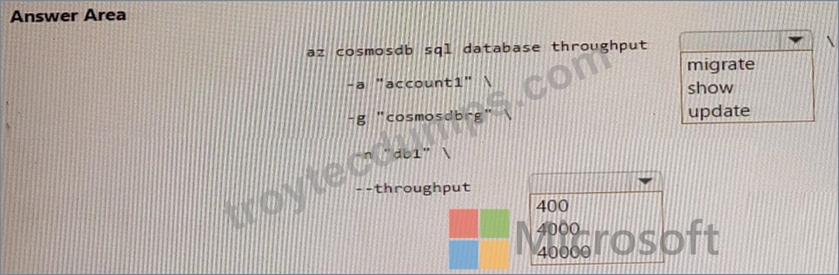
Answer:
Explanation: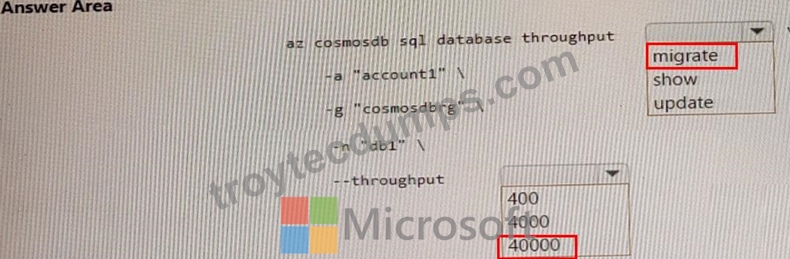
NEW QUESTION # 53
Note: This question is part of a series of questions that present the same scenario. Each question in the series contains a unique solution that might meet the stated goals. Some question sets might have more than one correct solution, while others might not have a correct solution.
After you answer a question in this section, you will NOT be able to return to it. As a result, these questions will not appear in the review screen.
You have an Azure Cosmos DB Core (SQL) API account named account 1 that uses autoscale throughput.
You need to run an Azure function when the normalized request units per second for a container in account1 exceeds a specific value.
Solution: You configure an Azure Monitor alert to trigger the function.
Does this meet the goal?
- A. No
- B. Yes
Answer: B
Explanation:
You can set up alerts from the Azure Cosmos DB pane or the Azure Monitor service in the Azure portal.
Note: Alerts are used to set up recurring tests to monitor the availability and responsiveness of your Azure Cosmos DB resources. Alerts can send you a notification in the form of an email, or execute an Azure Function when one of your metrics reaches the threshold or if a specific event is logged in the activity log.
NEW QUESTION # 54
You have an Azure Cosmos DB Core (SQL) API account named account1.
You have the Azure virtual networks and subnets shown in the following table.
The vnet1 and vnet2 networks are connected by using a virtual network peer.
The Firewall and virtual network settings for account1 are configured as shown in the exhibit.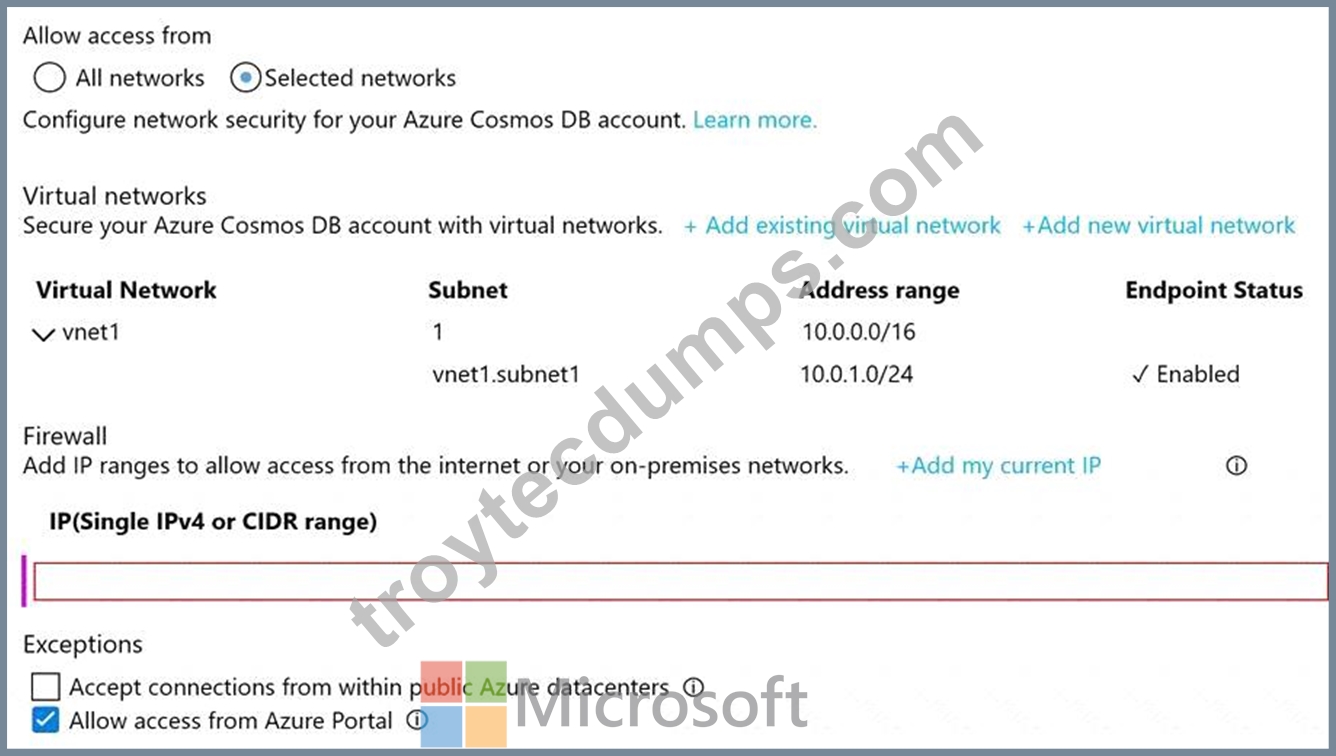
For each of the following statements, select Yes if the statement is true. Otherwise, select No.
NOTE: Each correct selection is worth one point.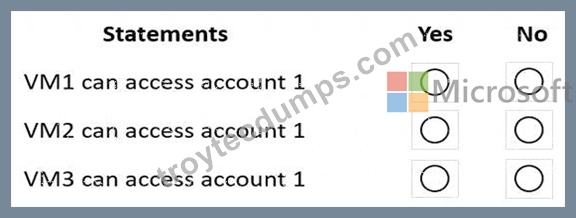
Answer:
Explanation: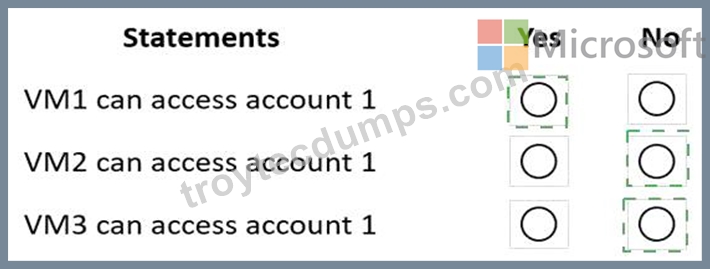
Explanation: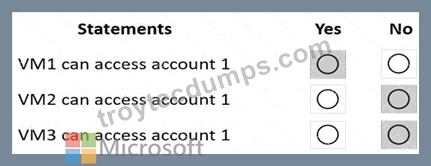
Box 1: Yes
VM1 is on vnet1.subnet1 which has the Endpoint Status enabled.
Box 2: No
Only virtual network and their subnets added to Azure Cosmos account have access. Their peered VNets cannot access the account until the subnets within peered virtual networks are added to the account.
Box 3: No
Only virtual network and their subnets added to Azure Cosmos account have access.
Reference: https://docs.microsoft.com/en-us/azure/cosmos-db/how-to-configure-vnet-service-endpoint
NEW QUESTION # 55
The settings for a container in an Azure Cosmos DB Core (SQL) API account are configured as shown in the following exhibit.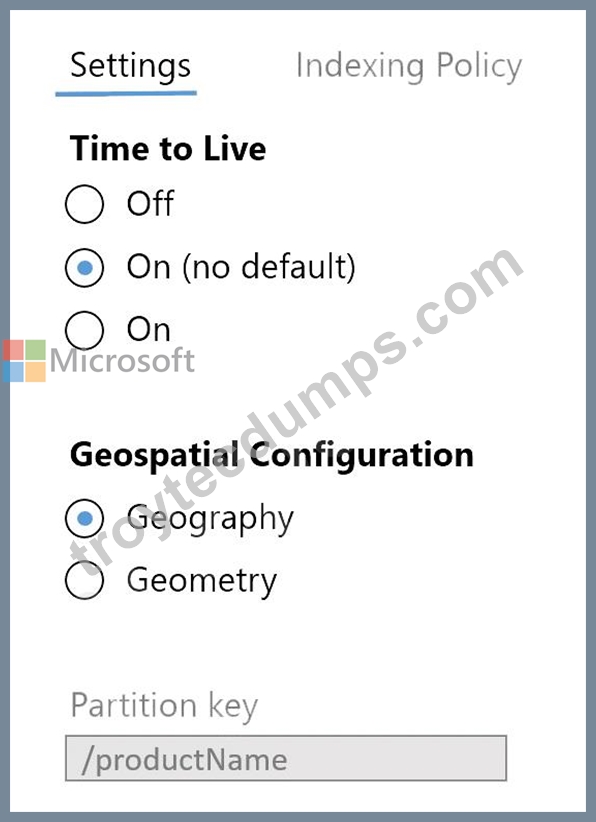
Which statement describes the configuration of the container?
- A. Items stored in the collection will expire only if the item has a time to live value.
- B. All items will be deleted after one hour.
- C. All items will be deleted after one year.
- D. Items stored in the collection will be retained always, regardless of the items time to live value.
Answer: A
Explanation:
When DefaultTimeToLive is -1 then your Time to Live setting is On (No default) Time to Live on a container, if present and the value is set to "-1", it is equal to infinity, and items don't expire by default.
Time to Live on an item:
This Property is applicable only if DefaultTimeToLive is present and it is not set to null for the parent container.
If present, it overrides the DefaultTimeToLive value of the parent container.
Reference: https://docs.microsoft.com/en-us/azure/cosmos-db/sql/time-to-live
NEW QUESTION # 56
You have an Azure Cosmos DB for NoSQL account.
You plan 10 create a container named container1. The container1 container will store items that include two properties named nm and age The most commonly executed queries will query container1 for a specific name. The following is a sample of the query.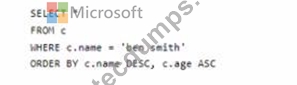
You need to define an opt-in Indexing policy for container1. The solution must meet the following requirements:
* Minimize the number of request units consumed by the queries.
* Ensure that the _etag property is excluded from indexing.
How should you define the indexing poky? To answer, select the appropriate options in the answer area.
NOTE: Each correct selection Is worth one point.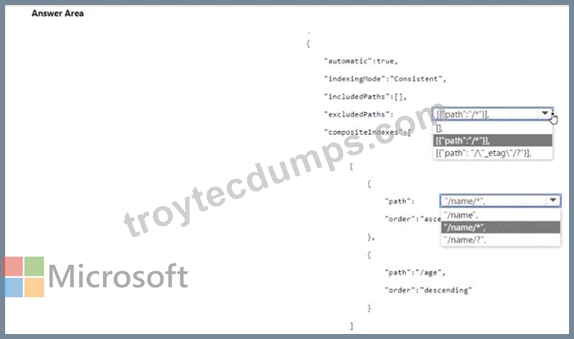
Answer:
Explanation: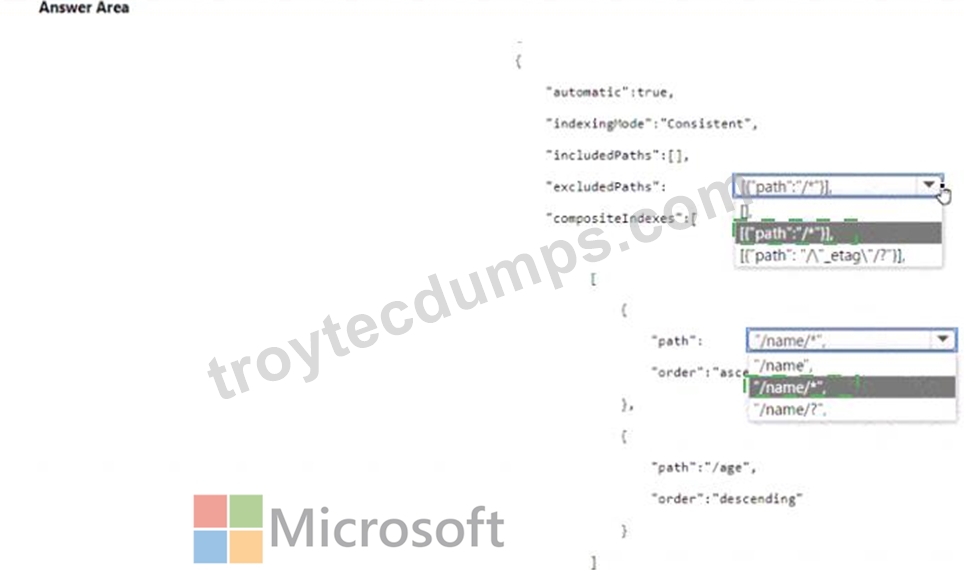
Explanation:
NEW QUESTION # 57
You have an Azure Cosmos DB for NoSQL account that contains a container named container1.
You plan to use container1 as a key-value store that will perform point reads on the item ID and partition key.
You need to define an indexing policy for container! The solution must meet the following requirements:
* Provide the ability to set DefauitTimeToLive for container1.
* Minimize implementation time.
* Minimize costs.
How should you complete the JSON definition of the indexing policy? To answer, select the appropriate options in the answer area.
NOTE: Each correct selection is worth one point.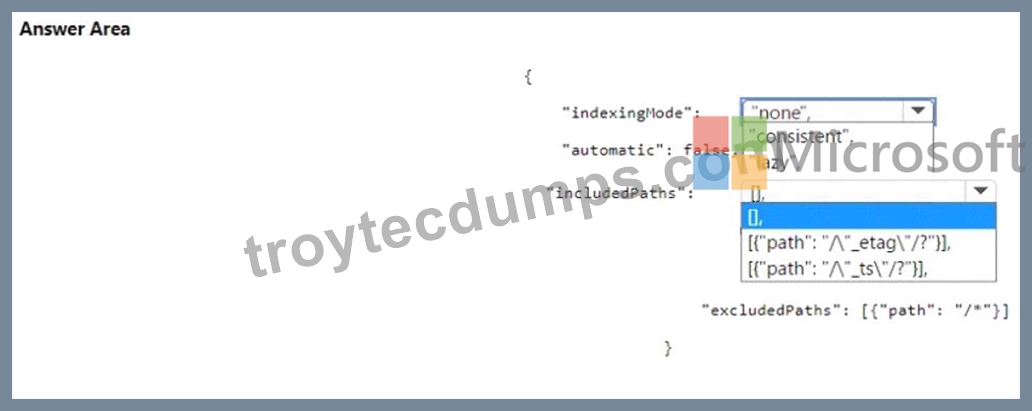
Answer:
Explanation: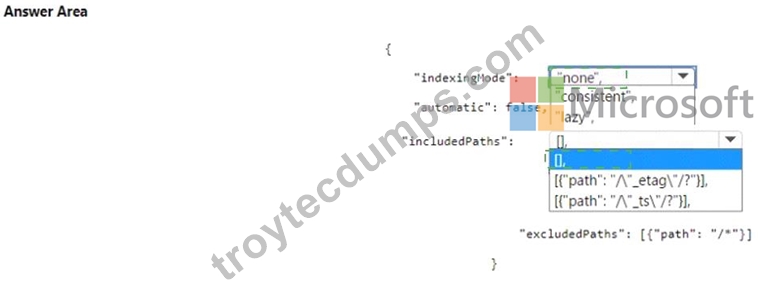
Explanation
NEW QUESTION # 58
You have an Azure Cosmos DB Core (SQL) API account named account1.
You have the Azure virtual networks and subnets shown in the following table.
The vnet1 and vnet2 networks are connected by using a virtual network peer.
The Firewall and virtual network settings for account1 are configured as shown in the exhibit.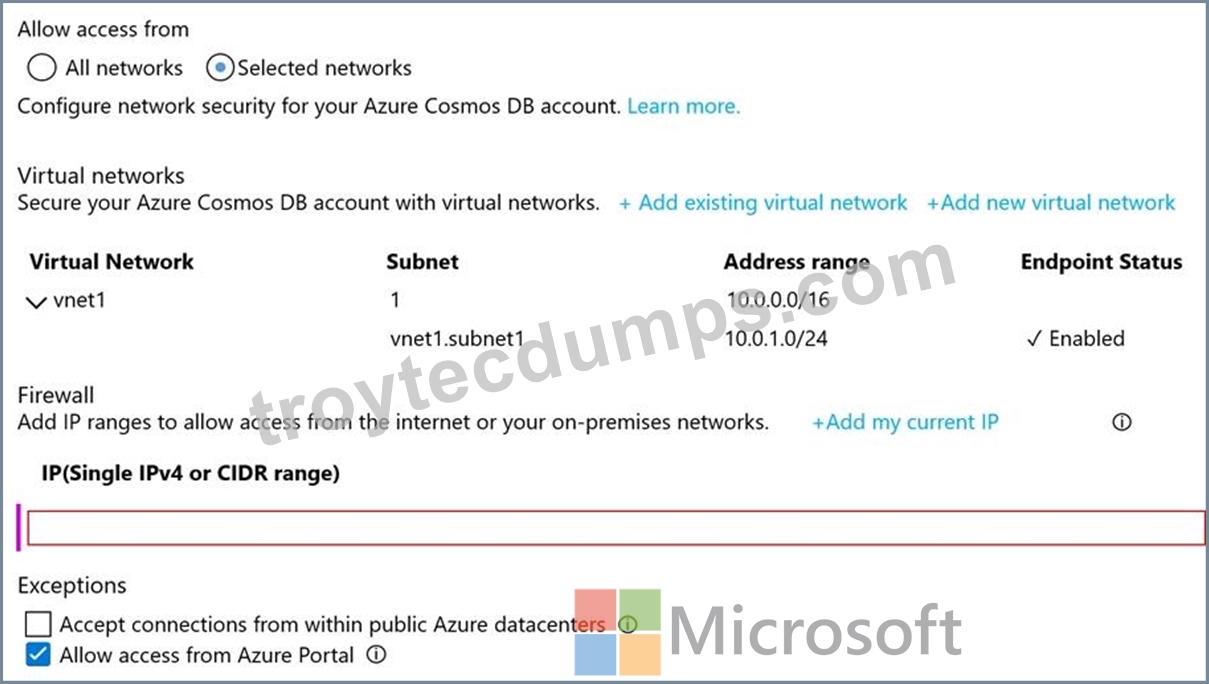
For each of the following statements, select Yes if the statement is true. Otherwise, select No.
NOTE: Each correct selection is worth one point.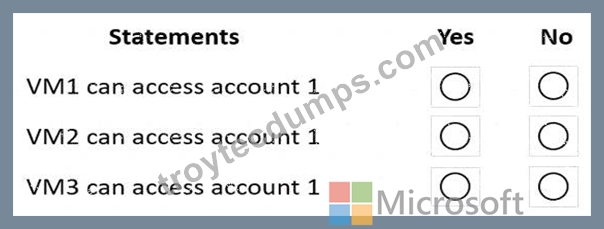
Answer:
Explanation: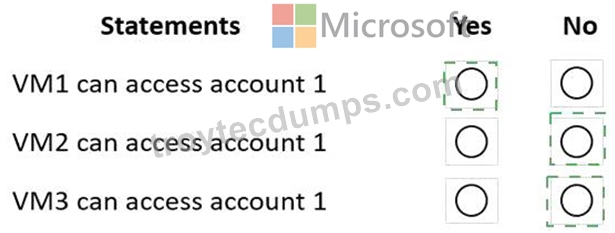
Explanation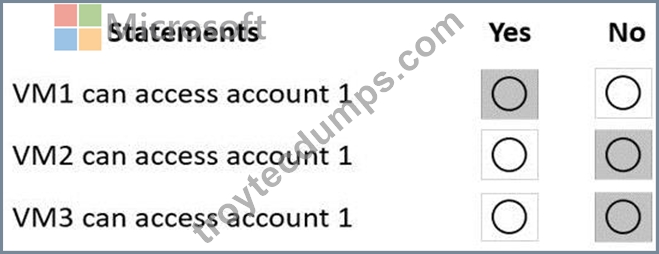
Box 1: Yes
VM1 is on vnet1.subnet1 which has the Endpoint Status enabled.
Box 2: No
Only virtual network and their subnets added to Azure Cosmos account have access. Their peered VNets cannot access the account until the subnets within peered virtual networks are added to the account.
Box 3: No
Only virtual network and their subnets added to Azure Cosmos account have access.
Reference: https://docs.microsoft.com/en-us/azure/cosmos-db/how-to-configure-vnet-service-endpoint
NEW QUESTION # 59
You are developing an application that will connect to an Azure Cosmos DB for NoSQL account. The account has a single readme region and one agonal read region. The regions are configured for automatic failover.
The account has the following connect strings. (Line numbers are included for reference only.)
For each of the following statements, select Yes if the statement is true. otherwise, select No.
NOTE: Each correct selection is worth one point.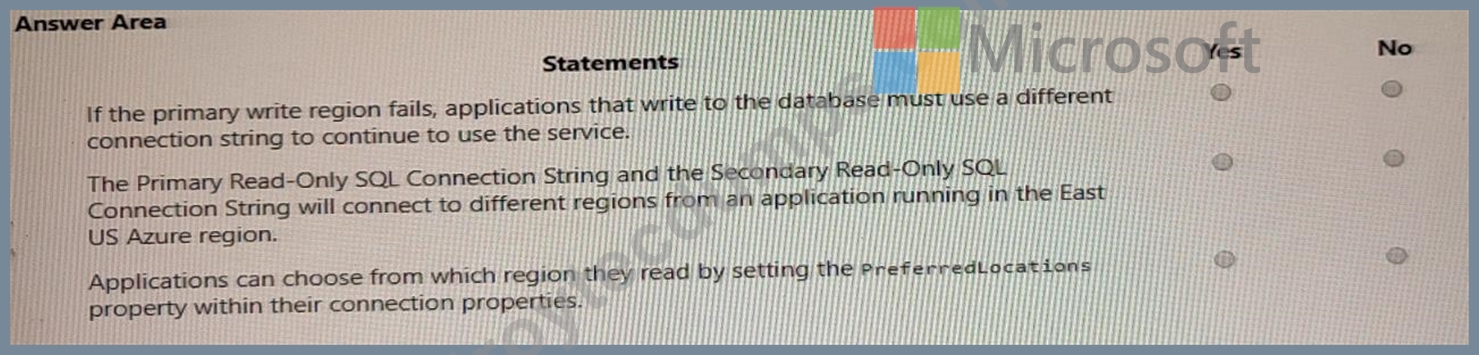
Answer:
Explanation: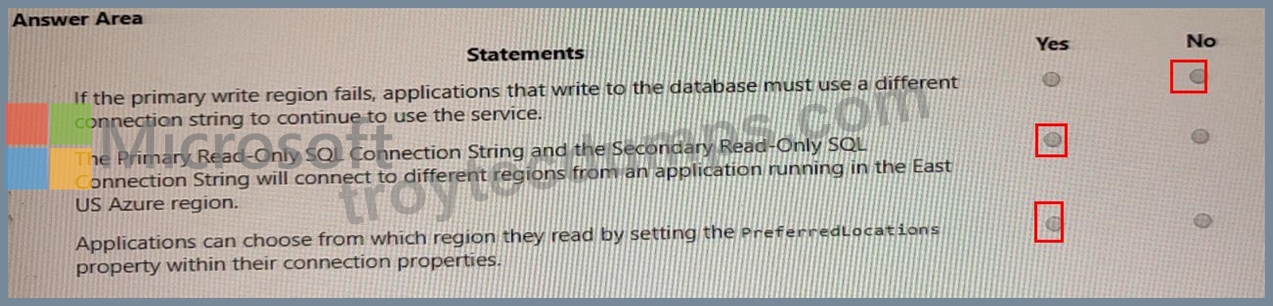
Topic 1, Litware, inc
Overview
This is a case study. Case studies are not timed separately. You can use as much exam time as you would like to complete each case. However, there may be additional case studies and sections on this exam. You must manage your time to ensure that you are able to complete all questions included on this exam in the time provided.
To answer the questions included in a case study, you will need to reference information that is provided in the case study. Case studies might contain exhibits and other resources that provide more information about the scenario that is described in the case study. Each question is independent of the other questions in this case study.
At the end of this case study, a review screen will appear. This screen allows you to review your answers and to make changes before you move to the next section of the exam. After you begin a new section, you cannot return to this section.
To start the case study
To display the first question in this case study, click the Next button. Use the buttons in the left pane to explore the content of the case study before you answer the questions. Clicking these buttons displays information such as business requirements, existing environment, and problem statements. If the case study has an All Information tab, note that the information displayed is identical to the information displayed on the subsequent tabs. When you are ready to answer a question, click the Question button to return to the question.
Overview
Litware, Inc. is a United States-based grocery retailer. Litware has a main office and a primary datacenter in Seattle. The company has 50 retail stores across the United States and an emerging online presence. Each store connects directly to the internet.
Existing environment. Cloud and Data Service Environments.
Litware has an Azure subscription that contains the resources shown in the following table.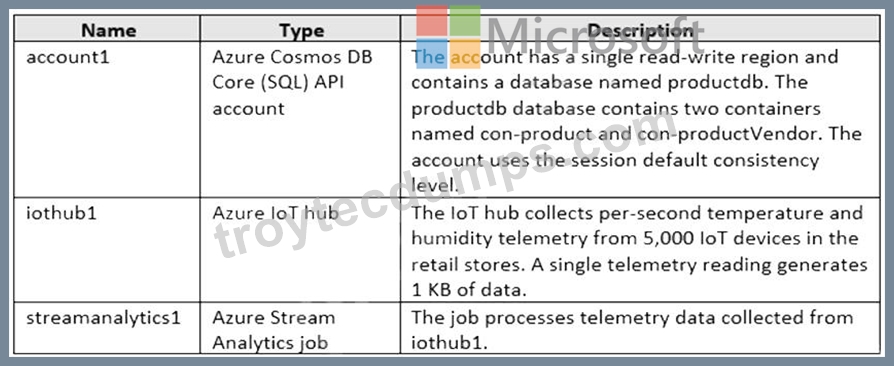
Each container in productdb is configured for manual throughput.
The con-product container stores the company's product catalog data. Each document in con-product includes a con-productvendor value. Most queries targeting the data in con-product are in the following format.
SELECT * FROM con-product p WHERE p.con-productVendor - 'name'
Most queries targeting the data in the con-productVendor container are in the following format SELECT * FROM con-productVendor pv ORDER BY pv.creditRating, pv.yearFounded Existing environment. Current Problems.
Litware identifies the following issues:
Updates to product categories in the con-productVendor container do not propagate automatically to documents in the con-product container.
Application updates in con-product frequently cause HTTP status code 429 "Too many requests". You discover that the 429 status code relates to excessive request unit (RU) consumption during the updates.
Requirements. Planned Changes
Litware plans to implement a new Azure Cosmos DB Core (SQL) API account named account2 that will contain a database named iotdb. The iotdb database will contain two containers named con-iot1 and con-iot2.
Litware plans to make the following changes:
Store the telemetry data in account2.
Configure account1 to support multiple read-write regions.
Implement referential integrity for the con-product container.
Use Azure Functions to send notifications about product updates to different recipients.
Develop an app named App1 that will run from all locations and query the data in account1.
Develop an app named App2 that will run from the retail stores and query the data in account2. App2 must be limited to a single DNS endpoint when accessing account2.
Requirements. Business Requirements
Litware identifies the following business requirements:
Whenever there are multiple solutions for a requirement, select the solution that provides the best performance, as long as there are no additional costs associated.
Ensure that Azure Cosmos DB costs for IoT-related processing are predictable.
Minimize the number of firewall changes in the retail stores.
Requirements. Product Catalog Requirements
Litware identifies the following requirements for the product catalog:
Implement a custom conflict resolution policy for the product catalog data.
Minimize the frequency of errors during updates of the con-product container.
Once multi-region writes are configured, maximize the performance of App1 queries against the data in account1.
Trigger the execution of two Azure functions following every update to any document in the con-product container.
NEW QUESTION # 60
Note: This question is part of a series of questions that present the same scenario. Each question in the series contains a unique solution that might meet the stated goals. Some question sets might have more than one correct solution, while others might not have a correct solution.
After you answer a question in this section, you will NOT be able to return to it. As a result, these questions will not appear in the review screen.
You have an Azure Cosmos DB Core (SQL) API account named account 1 that uses autoscale throughput.
You need to run an Azure function when the normalized request units per second for a container in account1 exceeds a specific value.
Solution: You configure an application to use the change feed processor to read the change feed and you configure the application to trigger the function.
Does this meet the goal?
- A. Yes
- B. No
Answer: B
Explanation:
Explanation
Instead configure an Azure Monitor alert to trigger the function.
You can set up alerts from the Azure Cosmos DB pane or the Azure Monitor service in the Azure portal.
Reference: https://docs.microsoft.com/en-us/azure/cosmos-db/create-alerts
NEW QUESTION # 61
......
The DP-420 certification exam covers a wide range of topics related to Azure Cosmos DB, including data modeling, partitioning, indexing, querying, and tuning. Candidates are expected to have a deep understanding of how to use Azure Cosmos DB to build scalable, resilient, and highly available cloud-native applications. They should also be familiar with Azure services such as Azure Functions, Azure App Service, and Azure Event Grid.
Get ready to pass the DP-420 Exam right now using our Azure Cosmos DB Developer Specialty Exam Package: https://www.troytecdumps.com/DP-420-troytec-exam-dumps.html
DP-420 Premium Files Test pdf - Free Dumps Collection: https://drive.google.com/open?id=1IVsG-F5OcBxSVhRsHpj2Yetdvo6hKulO