

Updated May 06, 2026 Verified Pass 300-740 Exam in First Attempt Guaranteed
Free 300-740 Sample Questions and 100% Cover Real Exam Questions (Updated 201 Questions)
NEW QUESTION # 20
Restoring affected systems after a security incident is known as _________.
- A. quarantining
- B. reinstituting
- C. abandoning
- D. complicating
Answer: B
NEW QUESTION # 21
A Web Application Firewall (WAF) is primarily used for:
- A. Filtering email spam
- B. Accelerating website performance
- C. Protecting web applications from attacks such as SQL injection and XSS
- D. Managing website content
Answer: C
NEW QUESTION # 22
What does the term "workload" refer to in the context of cloud security?
- A. The amount of data processed by the cloud
- B. Applications and processes running in cloud environments
- C. The physical servers in a data center
- D. The user's responsibility in managing cloud security
Answer: B
NEW QUESTION # 23
What is associated with implementing Cisco zero-trust architecture?
- A. It assumes that all network traffic is trustworthy.
- B. It verifies trust before granting access to resources.
- C. It provides the same security as the VPN technology.
- D. It focuses on perimeter-based security.
Answer: B
Explanation:
Zero Trust is based on the concept of "never trust, always verify." It ensures that no user or device is inherently trusted, even if they are inside the corporate network. Cisco's Zero Trust Architecture implements continuous trust verification for every access request, using identity, device posture, and behavior analysis.
SCAZT Section 1 (Cloud Security Architecture, Pages 13-17) describes how Cisco's Zero Trust model authenticates and authorizes access before permitting resource interaction.
Reference: Designing and Implementing Secure Cloud Access for Users and Endpoints (SCAZT), Section 1, Pages 13-17
=========
NEW QUESTION # 24
The term Security Services Edge (SSE) refers to:
- A. A decrease in security measures for edge devices
- B. Physical security measures at the perimeter of a network
- C. An outdated security model no longer used in modern networks
- D. A comprehensive security solution that combines multiple functions like SWG, CASB, and ZTNA
Answer: D
NEW QUESTION # 25 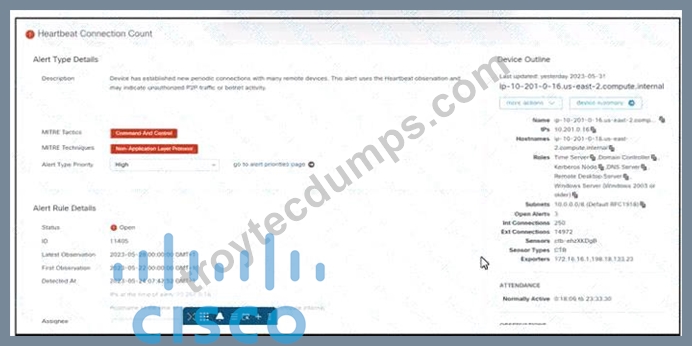
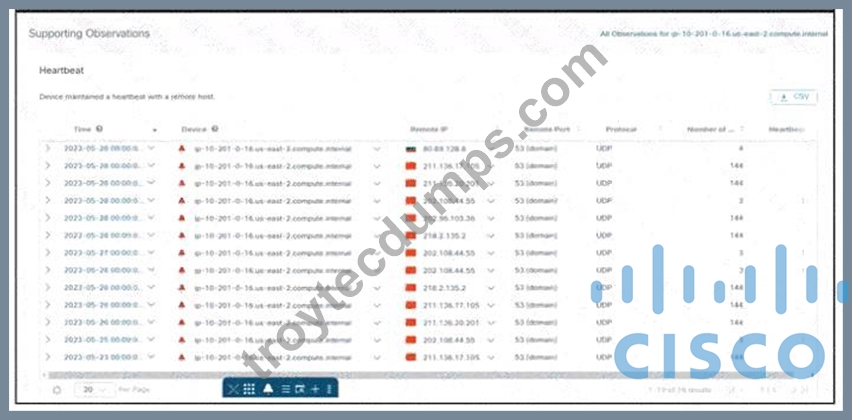
Refer to the exhibit. An engineer is investigating an unauthorized connection issue using Cisco Secure Cloud Analytics. Which two actions must be taken? (Choose two.)
- A. Reinstall the host from a recent backup.
- B. Inform the incident management team.
- C. Validate the IDS logs
- D. Reinstall the host from scratch.
- E. Block the unwanted IP addresses on the firewall
Answer: B,E
Explanation:
The Secure Cloud Analytics alert indicates suspicious heartbeat-based connections from an internal server (ip-
10-201-0-16) to multiple suspicious IPs over UDP/port 53 (DNS). This behavior suggests command-and- control (C2) activity or botnet communications.
B: Alerting the incident response (IR) team is a critical next step in escalating a verified threat as per SCAZT Section 6 (Threat Response, Pages 114-117).
D: Blocking the identified malicious IPs on perimeter firewalls or network access control devices is an appropriate containment step to disrupt communication.
Reinstallation (A/E) is premature without a full forensic investigation. Validating IDS logs (C) is useful but not immediate response-focused compared to actions B and D.
Reference: Designing and Implementing Secure Cloud Access for Users and Endpoints (SCAZT), Section 6, Pages 114-117
NEW QUESTION # 26
Cisco Secure Cloud Analytics specializes in:
- A. Reducing the amount of actionable security intelligence
- B. Detecting threats in cloud and hybrid environments by analyzing traffic patterns
- C. Only managing physical network devices
- D. Encouraging a siloed approach to cloud security
Answer: B
NEW QUESTION # 27
The main goal of implementing secure domains within the SAFE framework is to:
- A. Simplify the user authentication process
- B. Enhance the flexibility of network configurations
- C. Improve security by creating defined areas of trust
- D. Increase operational efficiency
Answer: C
NEW QUESTION # 28
A common identity across systems is essential for:
- A. Isolating network segments
- B. Increasing operational costs
- C. Simplifying user access and security management
- D. Reducing network speed
Answer: C
NEW QUESTION # 29
The "Places in the Network" within the SAFE Key structure refers to:
- A. Locations where physical security controls are implemented
- B. Only the user's physical location
- C. The geographical distribution of data centers
- D. Different network segments and their specific security needs
Answer: D
NEW QUESTION # 30
Which industry security frameworks are mentioned as part of cloud security architecture?
- A. NIST
- B. DISA
- C. IEEE
- D. CISA
Answer: A,B,D
NEW QUESTION # 31
An organization is distributed across several sites. Each site is connected to the main HQ using site-to-site VPNs implemented using Secure Firewall Threat Defense. Which functionality must be implemented if the security manager wants to send SaaS traffic directly to the internet?
- A. IPsec tunnels
- B. Multi-instances
- C. Policy-based routing
- D. ECMP routing
Answer: C
Explanation:
Policy-Based Routing (PBR) enables routing decisions based on criteria such as source IP, destination IP, or application. To send SaaS traffic (e.g., Office 365, Salesforce) directly to the internet rather than over a site-to- site VPN, PBR must be configured at each site firewall. According to SCAZT Section 1 (Cloud Security Architecture, Pages 18-20), this approach enables secure local internet breakout-commonly used in direct internet access (DIA) architectures.
Reference: Designing and Implementing Secure Cloud Access for Users and Endpoints (SCAZT), Section 1, Pages 18-20
NEW QUESTION # 32
What is the primary purpose of implementing identity certificates for user and device authentication?
- A. To track device locations
- B. To increase network speed
- C. To ensure secure access to resources
- D. To monitor user activity
Answer: C
NEW QUESTION # 33
What does SAML/SSO stand for and what is its purpose?
- A. Security Assertion Markup Language / Single Sign-On, to simplify logins across different systems
- B. Single Access Markup Language / Single Sign-On, to simplify logins across different systems
- C. Secure Access Markup Language / Secure Sign-On, to increase login complexity
- D. Security Assertion Markup Language / Secure Sign-Out, to secure logouts across systems
Answer: A
NEW QUESTION # 34
An administrator must deploy an endpoint posture policy for all users. The organization wants to have all endpoints checked against antimalware definitions and operating system updates and ensure that the correct Secure Client modules are installed properly. How must the administrator meet the requirements?
- A. Identify the antimalware being used, create an endpoint script to ensure that it is updated, and send the update log to Cisco ISE for processing.
- B. Create the required posture policy within Cisco ISE, configure redirection on the NAD, and ensure that the client provisioning policy is correct.
- C. Configure the WLC to provide local posture services, and configure Cisco ISE to receive the compliance verification from the WLC to be used in an authorization policy.
- D. Create an ASA Firewall posture policy, upload the Secure Client images to the NAD, and create a local client provisioning portal.
Answer: B
Explanation:
Cisco Identity Services Engine (ISE) is the central policy engine for posture assessments. As outlined in the SCAZT guide (Section 2: User and Device Security, Pages 39-44), to implement posture assessment and client provisioning correctly, an administrator must create posture policies within Cisco ISE and configure the Network Access Device (NAD)-such as a switch, WLC, or firewall-for redirection. This redirection sends the user to the posture portal, where ISE verifies the Secure Client modules (such as AnyConnect) and enforces compliance with antivirus signatures and OS updates.
ISE evaluates endpoint health based on pre-defined compliance rules and supports automatic remediation via the client provisioning portal. This ensures consistency and policy enforcement across distributed environments.
Reference: Designing and Implementing Secure Cloud Access for Users and Endpoints (SCAZT), User and Device Security, Pages 39-44
NEW QUESTION # 35
Firewall logs are crucial for:
- A. Avoiding detection of unauthorized access attempts
- B. Decreasing network performance intentionally
- C. Tracking and analyzing attempts to access network resources
- D. Simplifying network attacks by external actors
Answer: C
NEW QUESTION # 36
How does Cisco XDR perform threat prioritization by using its visibility across multiple platforms?
- A. By prioritizing threats based on their frequency across platforms
- B. By using a fixed priority system for all platforms
- C. By correlating detection risk and asset value at risk
- D. By assigning priority based on the detection platform
Answer: C
Explanation:
Cisco Extended Detection and Response (XDR) leverages telemetry from Cisco Secure Endpoint, Secure Email, Secure Network Analytics, and other sources to correlate threat detections with contextual data, such as asset value and business impact. This allows Cisco XDR to prioritize threats not only by the risk of the detection but also by the importance of the affected asset-essentially assessing the risk to business. This dynamic and context-aware prioritization method enables security teams to address the most impactful threats first.
Reference: Designing and Implementing Secure Cloud Access for Users and Endpoints (SCAZT), Section 6:
Threat Response, Pages 108-111.
NEW QUESTION # 37
Telemetry reports are essential for:
- A. Decreasing network performance
- B. Manual analysis of all network data
- C. Ignoring minor security incidents
- D. Identifying suspicious activities and potential threats within a network
Answer: D
NEW QUESTION # 38
......
Download Real Cisco 300-740 Exam Dumps Test Engine Exam Questions: https://www.troytecdumps.com/300-740-troytec-exam-dumps.html
Verified 300-740 Dumps Q&As - 300-740 Test Engine with Correct Answers: https://drive.google.com/open?id=1QaH2mawlJmfjnP-P06OHA094Fqv2Ir73