

DP-100 Dumps By Pros - 1st Attempt Guaranteed Success
100% Guarantee Download DP-100 Exam Dumps PDF Q&A
Microsoft DP-100 exam is an important certification for data scientists working with Azure. It covers a range of topics related to data science and requires candidates to demonstrate their ability to design and implement end-to-end machine learning solutions on Azure. With the right preparation and training, candidates can pass the DP-100 exam and earn a valuable certification that can help them advance their careers.
NEW QUESTION # 178
Note: This question is part of a series of questions that present the same scenario. Each question in the series contains a unique solution that might meet the stated goals. Some question sets might have more than one correct solution, while others might not have a correct solution.
After you answer a question in this section, you will NOT be able to return to it. As a result, these questions will not appear in the review screen.
You are creating a new experiment in Azure Machine Learning Studio.
One class has a much smaller number of observations than the other classes in the training set.
You need to select an appropriate data sampling strategy to compensate for the class imbalance.
Solution: You use the Stratified split for the sampling mode.
Does the solution meet the goal?
- A. No
- B. Yes
Answer: A
Explanation:
Instead use the Synthetic Minority Oversampling Technique (SMOTE) sampling mode.
Note: SMOTE is used to increase the number of underepresented cases in a dataset used for machine learning. SMOTE is a better way of increasing the number of rare cases than simply duplicating existing cases.
References:
https://docs.microsoft.com/en-us/azure/machine-learning/studio-module-reference/smote
NEW QUESTION # 179
You are evaluating a Python NumPy array that contains six data points defined as follows:
data = [10, 20, 30, 40, 50, 60]
You must generate the following output by using the k-fold algorithm implantation in the Python Scikit-learn machine learning library:
train: [10 40 50 60], test: [20 30]
train: [20 30 40 60], test: [10 50]
train: [10 20 30 50], test: [40 60]
You need to implement a cross-validation to generate the output.
How should you complete the code segment? To answer, select the appropriate code segment in the dialog box in the answer area.
NOTE: Each correct selection is worth one point.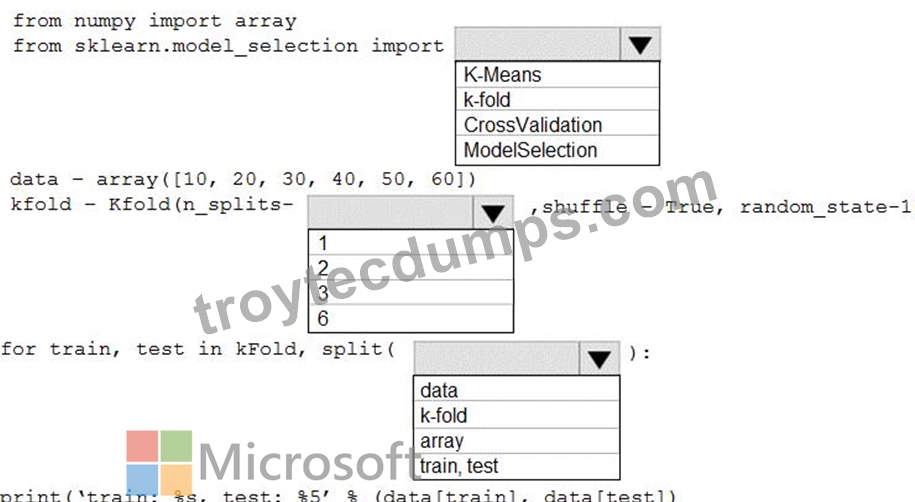
Answer:
Explanation: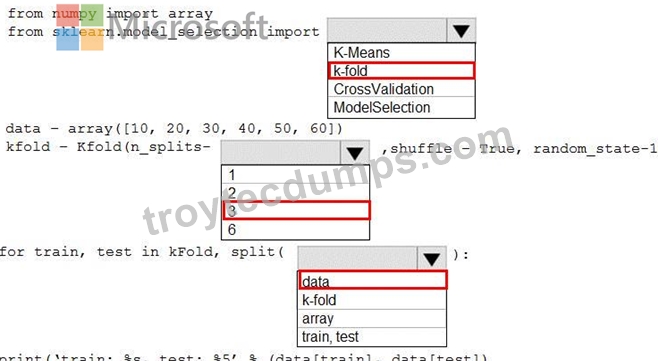
Reference:
https://scikit-learn.org/stable/modules/generated/sklearn.model_selection.KFold.html
NEW QUESTION # 180
Note: This question is part of a series of questions that present the same scenario. Each question in the series contains a unique solution that might meet the stated goals. Some question sets might have more than one correct solution, while others might not have a correct solution.
After you answer a question in this section, you will NOT be able to return to it. As a result, these questions will not appear in the review screen.
You are using Azure Machine Learning to run an experiment that trains a classification model.
You want to use Hyperdrive to find parameters that optimize the AUC metric for the model. You configure a HyperDriveConfig for the experiment by running the following code: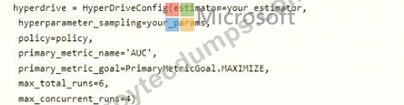
You plan to use this configuration to run a script that trains a random forest model and then tests it with validation data. The label values for the validation data are stored in a variable named y_test variable, and the predicted probabilities from the model are stored in a variable named y_predicted.
You need to add logging to the script to allow Hyperdrive to optimize hyperparameters for the AUC metric.
Solution: Run the following code: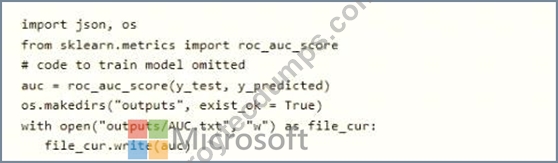
Does the solution meet the goal?
- A. No
- B. Yes
Answer: A
Explanation:
Explanation
Use a solution with logging.info(message) instead.
Note: Python printing/logging example:
logging.info(message)
Destination: Driver logs, Azure Machine Learning designer
Reference:
https://docs.microsoft.com/en-us/azure/machine-learning/how-to-debug-pipelines
NEW QUESTION # 181
You need to set up the Permutation Feature Importance module according to the model training requirements.
Which properties should you select? To answer, select the appropriate options in the answer area.
NOTE: Each correct selection is worth one point.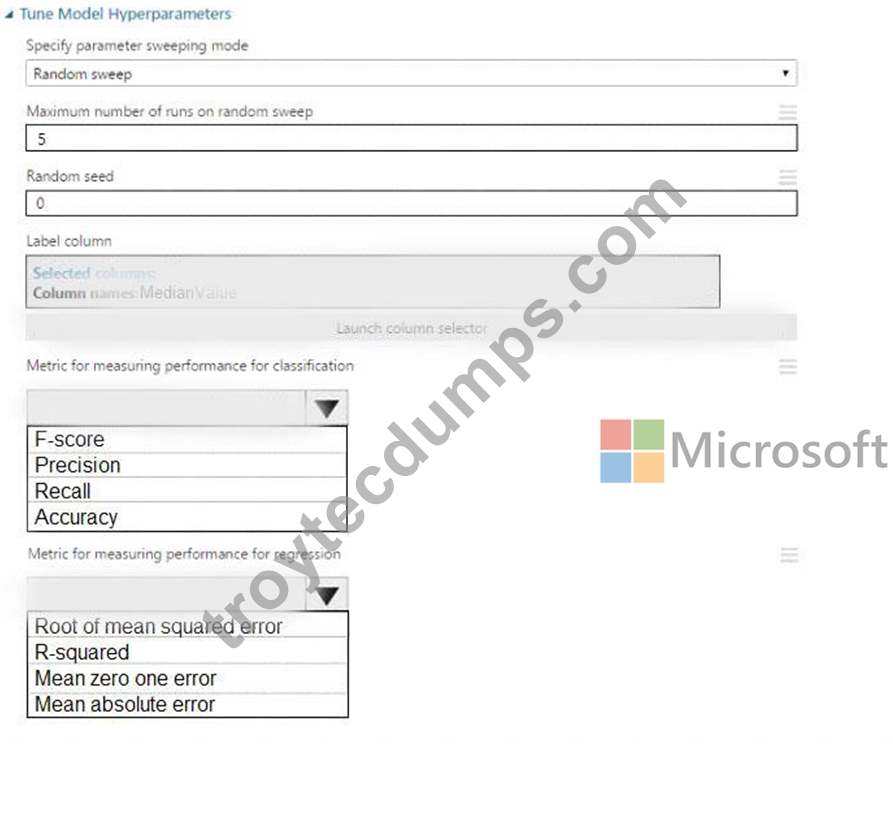
Answer:
Explanation: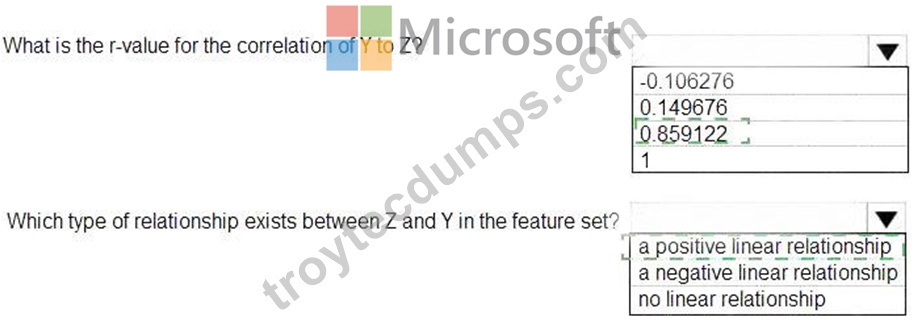
Explanation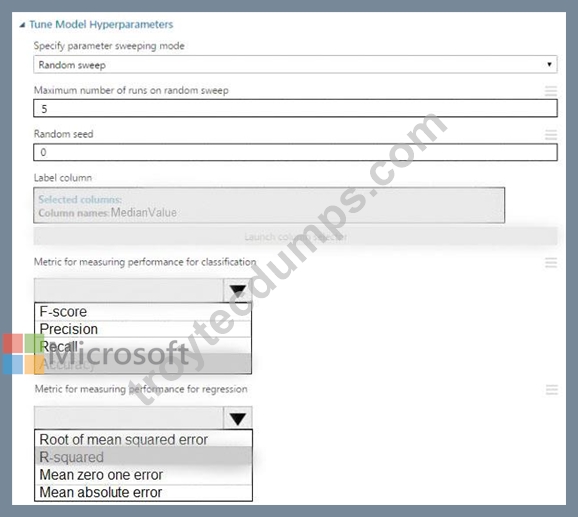
Box 1: Accuracy
Scenario: You want to configure hyperparameters in the model learning process to speed the learning phase by using hyperparameters. In addition, this configuration should cancel the lowest performing runs at each evaluation interval, thereby directing effort and resources towards models that are more likely to be successful.
Box 2: R-Squared
NEW QUESTION # 182
You create a multi-class image classification deep learning model.
You train the model by using PyTorch version 1.2.
You need to ensure that the correct version of PyTorch can be identified for the inferencing environment when the model is deployed.
What should you do?
- A. Save the model locally as a.pt file, and deploy the model as a local web service.
- B. Register the model with a .pt property.
- C. Deploy the model on computer that is configured to use the default Azure Machine Learning conda environment.
- D. Register the model, specifying the model_framework_version properties.
Answer: D
Explanation:
Explanation
framework_version: The PyTorch version to be used for executing training code.
Reference:
https://docs.microsoft.com/en-us/python/api/azureml-train-core/azureml.train.dnn.pytorch?view=azure-ml-py
NEW QUESTION # 183
You create an experiment in Azure Machine Learning Studio- You add a training dataset that contains 10.000 rows. The first 9.000 rows represent class 0 (90 percent). The first 1.000 rows represent class 1 (10 percent).
The training set is unbalanced between two Classes. You must increase the number of training examples for class 1 to 4,000 by using data rows. You add the Synthetic Minority Oversampling Technique (SMOTE) module to the experiment.
You need to configure the module.
Which values should you use? To answer, select the appropriate options in the dialog box in the answer area.
NOTE: Each correct selection is worth one point.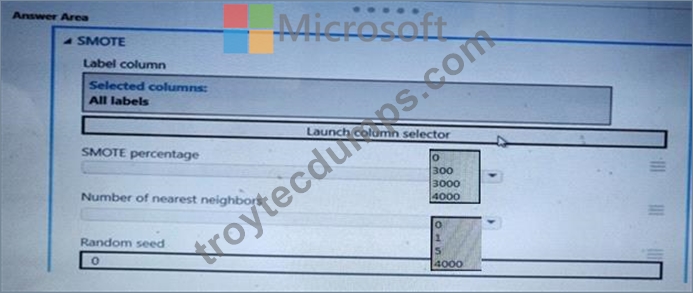
Answer:
Explanation: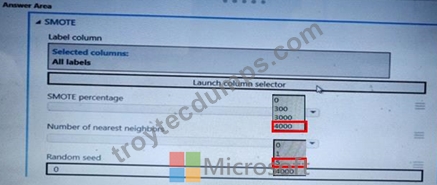
NEW QUESTION # 184
You have a dataset that includes home sales data for a city. The dataset includes the following columns.
Each row in the dataset corresponds to an individual home sales transaction.
You need to use automated machine learning to generate the best model for predicting the sales price based on the features of the house.
Which values should you use? To answer, select the appropriate options in the answer area.
NOTE: Each correct selection is worth one point.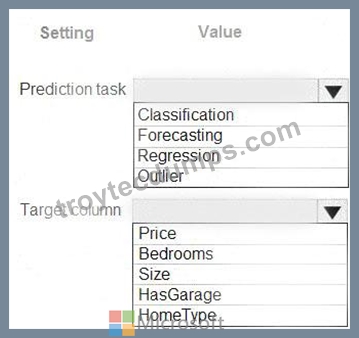
Answer:
Explanation: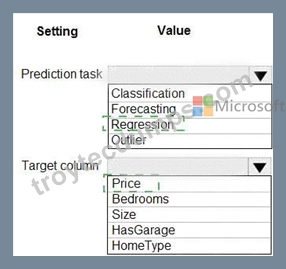
Explanation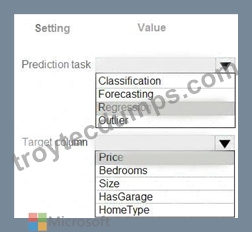
Box 1: Regression
Regression is a supervised machine learning technique used to predict numeric values.
Box 2: Price
Reference:
https://docs.microsoft.com/en-us/learn/modules/create-regression-model-azure-machine-learning-designer
NEW QUESTION # 185
You plan to use automated machine learning to train a regression model. You have data that has features which have missing values, and categorical features with few distinct values.
You need to configure automated machine learning to automatically impute missing values and encode categorical features as part of the training task.
Which parameter and value pair should you use in the AutoMLConfig class?
- A. task = 'classification'
- B. featurization = 'auto'
- C. enable_voting_ensemble = True
- D. exclude_nan_labels = True
- E. enable_tf = True
Answer: B
Explanation:
Featurization str or FeaturizationConfig
Values: 'auto' / 'off' / FeaturizationConfig
Indicator for whether featurization step should be done automatically or not, or whether customized featurization should be used.
Column type is automatically detected. Based on the detected column type preprocessing/featurization is done as follows:
Categorical: Target encoding, one hot encoding, drop high cardinality categories, impute missing values.
Numeric: Impute missing values, cluster distance, weight of evidence.
DateTime: Several features such as day, seconds, minutes, hours etc.
Text: Bag of words, pre-trained Word embedding, text target encoding.
Reference:
https://docs.microsoft.com/en-us/python/api/azureml-train-automl-client/ azureml.train.automl.automlconfig.automlconfig Develop models Testlet 1 Case study Overview You are a data scientist in a company that provides data science for professional sporting events. Models will use global and local market data to meet the following business goals:
* Understand sentiment of mobile device users at sporting events based on audio from crowd reactions.
* Assess a user's tendency to respond to an advertisement.
* Customize styles of ads served on mobile devices.
* Use video to detect penalty events
Current environment
* Media used for penalty event detection will be provided by consumer devices. Media may include images and videos captured during the sporting event and shared using social media. The images and videos will have varying sizes and formats.
* The data available for model building comprises of seven years of sporting event media. The sporting event media includes; recorded video transcripts or radio commentary, and logs from related social media feeds captured during the sporting events.
* Crowd sentiment will include audio recordings submitted by event attendees in both mono and stereo formats.
Penalty detection and sentiment
* Data scientists must build an intelligent solution by using multiple machine learning models for penalty event detection.
* Data scientists must build notebooks in a local environment using automatic feature engineering and model building in machine learning pipelines.
* Notebooks must be deployed to retrain by using Spark instances with dynamic worker allocation.
* Notebooks must execute with the same code on new Spark instances to recode only the source of the data.
* Global penalty detection models must be trained by using dynamic runtime graph computation during training.
* Local penalty detection models must be written by using BrainScript.
* Experiments for local crowd sentiment models must combine local penalty detection data.
* Crowd sentiment models must identify known sounds such as cheers and known catch phrases. Individual crowd sentiment models will detect similar sounds.
* All shared features for local models are continuous variables.
* Shared features must use double precision. Subsequent layers must have aggregate running mean and standard deviation metrics available.
Advertisements
During the initial weeks in production, the following was observed:
* Ad response rated declined.
* Drops were not consistent across ad styles.
* The distribution of features across training and production data are not consistent Analysis shows that, of the 100 numeric features on user location and behavior, the 47 features that come from location sources are being used as raw features. A suggested experiment to remedy the bias and variance issue is to engineer 10 linearly uncorrelated features.
* Initial data discovery shows a wide range of densities of target states in training data used for crowd sentiment models.
* All penalty detection models show inference phases using a Stochastic Gradient Descent (SGD) are running too slow.
* Audio samples show that the length of a catch phrase varies between 25%-47% depending on region
* The performance of the global penalty detection models shows lower variance but higher bias when comparing training and validation sets. Before implementing any feature changes, you must confirm the bias and variance using all training and validation cases.
* Ad response models must be trained at the beginning of each event and applied during the sporting event.
* Market segmentation models must optimize for similar ad response history.
* Sampling must guarantee mutual and collective exclusively between local and global segmentation models that share the same features.
* Local market segmentation models will be applied before determining a user's propensity to respond to an advertisement.
* Ad response models must support non-linear boundaries of features.
* The ad propensity model uses a cut threshold is 0.45 and retrains occur if weighted Kappa deviated from
0.1 +/- 5%.
* The ad propensity model uses cost factors shown in the following diagram: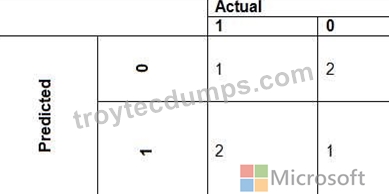
* The ad propensity model uses proposed cost factors shown in the following diagram: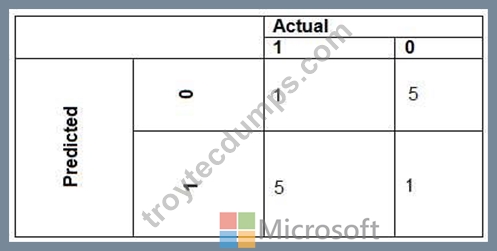
* Performance curves of current and proposed cost factor scenarios are shown in the following diagram: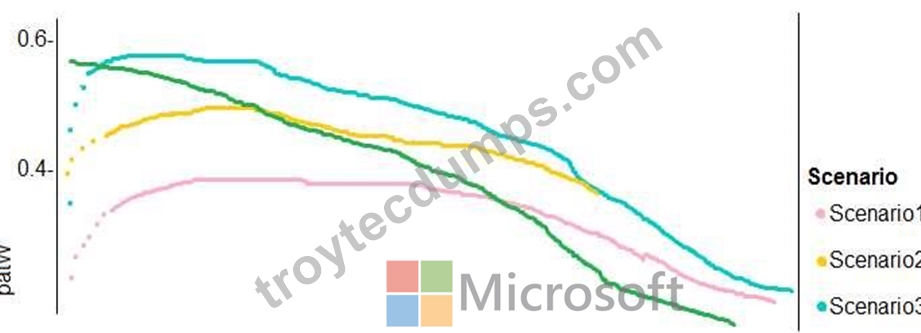
NEW QUESTION # 186
You create an Azure Machine Learning workspace and set up a development environment. You plan to train a deep neural network (DNN) by using the Tensorflow framework and by using estimators to submit training scripts.
You must optimize computation speed for training runs.
You need to choose the appropriate estimator to use as well as the appropriate training compute target configuration.
Which values should you use? To answer, select the appropriate options in the answer area.
NOTE: Each correct selection is worth one point.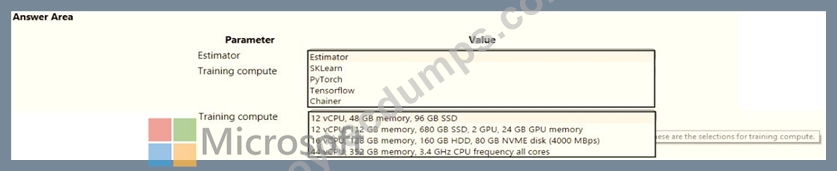
Answer:
Explanation: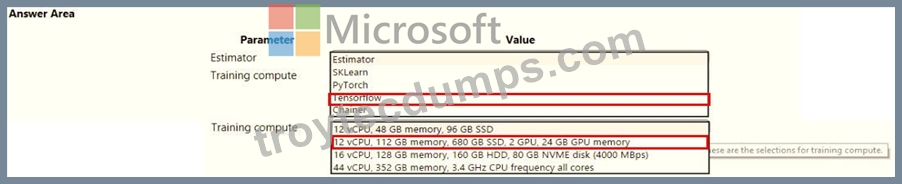
Reference:
https://docs.microsoft.com/en-us/python/api/azureml-train-core/azureml.train.dnn
NEW QUESTION # 187
You are performing feature scaling by using the scikit-learn Python library for x.1 x2, and x3 features.
Original and scaled data is shown in the following image.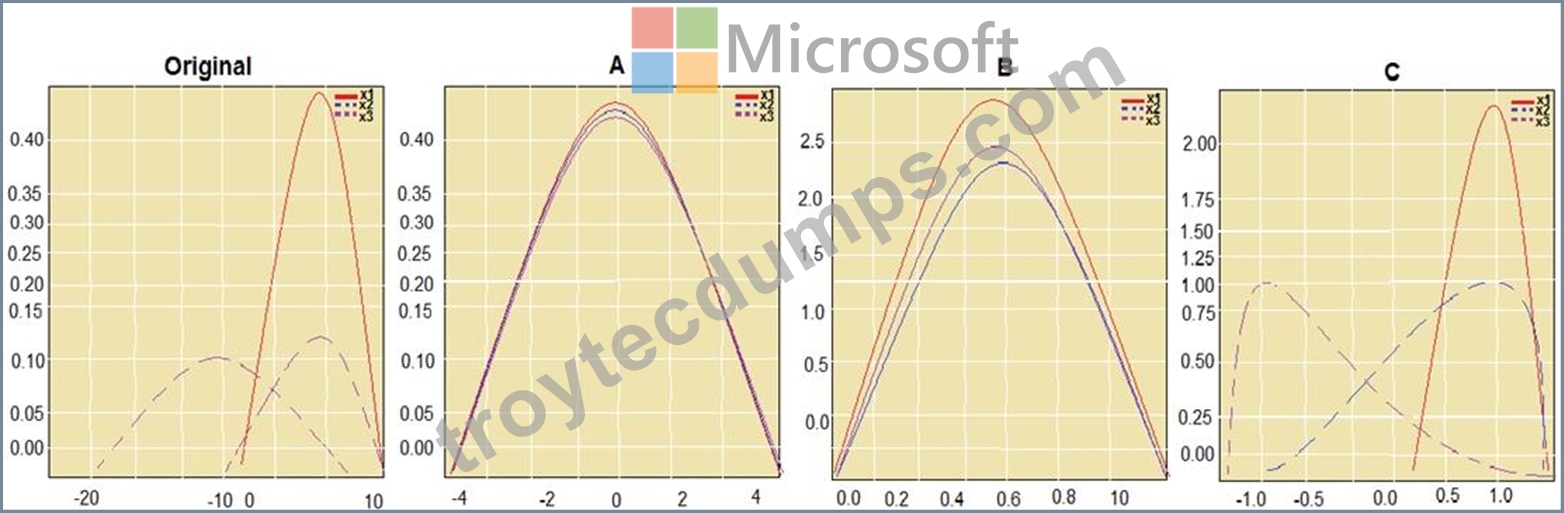
Use the drop-down menus to select the answer choice that answers each question based on the information presented in the graphic.
NOTE: Each correct selection is worth one point.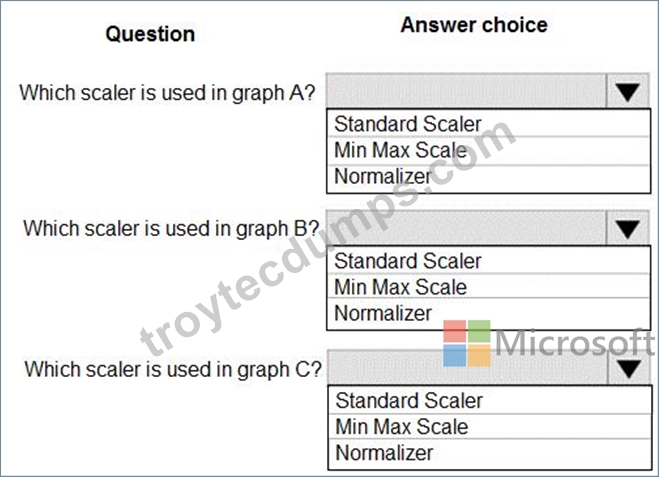
Answer:
Explanation: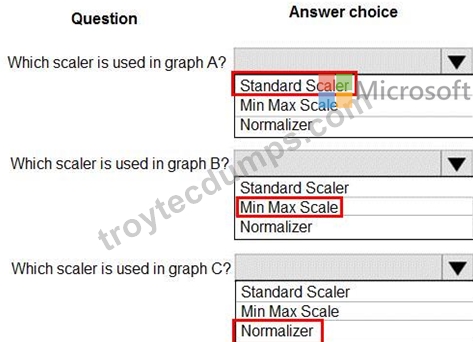
Reference:
http://benalexkeen.com/feature-scaling-with-scikit-learn/
NEW QUESTION # 188
Note: This question is part of a series of questions that present the same scenario. Each question in the series contains a unique solution that might meet the stated goals. Some question sets might have more than one correct solution, while others might not have a correct solution.
After you answer a question in this section, you will NOT be able to return to it. As a result, these questions will not appear in the review screen.
You are using Azure Machine Learning to run an experiment that trains a classification model.
You want to use Hyperdrive to find parameters that optimize the AUC metric for the model. You configure a HyperDriveConfig for the experiment by running the following code: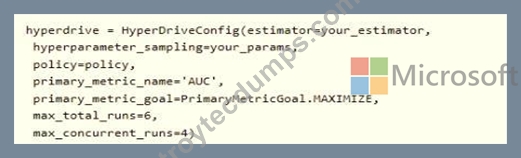
You plan to use this configuration to run a script that trains a random forest model and then tests it with validation data. The label values for the validation data are stored in a variable named y_test variable, and the predicted probabilities from the model are stored in a variable named y_predicted.
Solution: Run the following code: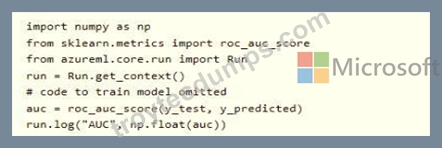
Does the solution meet the goal?
- A. No
- B. Yes
Answer: B
NEW QUESTION # 189
You need to produce a visualization for the diagnostic test evaluation according to the data visualization requirements.
Which three modules should you recommend be used in sequence? To answer, move the appropriate modules from the list of modules to the answer area and arrange them in the correct order.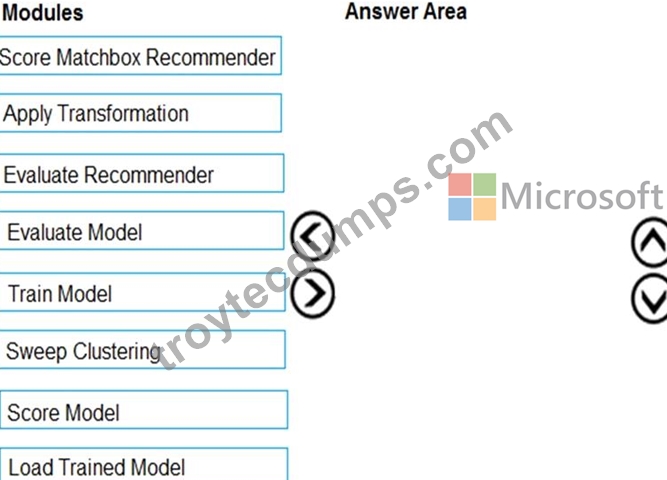
Answer:
Explanation: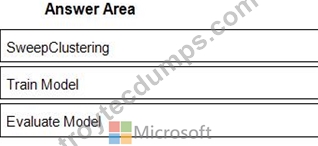
1 - SweepClustering
2 - Train Model
3 - Evaluate Model
NEW QUESTION # 190
Note: This question is part of a series of questions that present the same scenario. Each question in the series contains a unique solution that might meet the stated goals. Some question sets might have more than one correct solution, while others might not have a correct solution.
After you answer a question in this section, you will NOT be able to return to it. As a result, these questions will not appear in the review screen.
You are analyzing a numerical dataset which contains missing values in several columns.
You must clean the missing values using an appropriate operation without affecting the dimensionality of the feature set.
You need to analyze a full dataset to include all values.
Solution: Remove the entire column that contains the missing data point.
Does the solution meet the goal?
- A. No
- B. Yes
Answer: B
NEW QUESTION # 191
You need to use the Python language to build a sampling strategy for the global penalty detection models.
How should you complete the code segment? To answer, select the appropriate options in the answer area.
NOTE: Each correct selection is worth one point.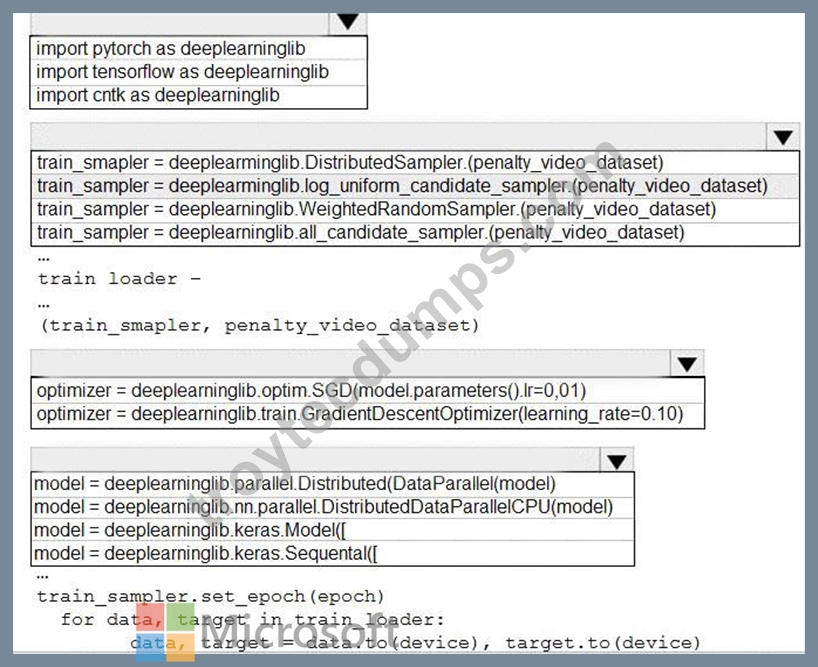
Answer:
Explanation: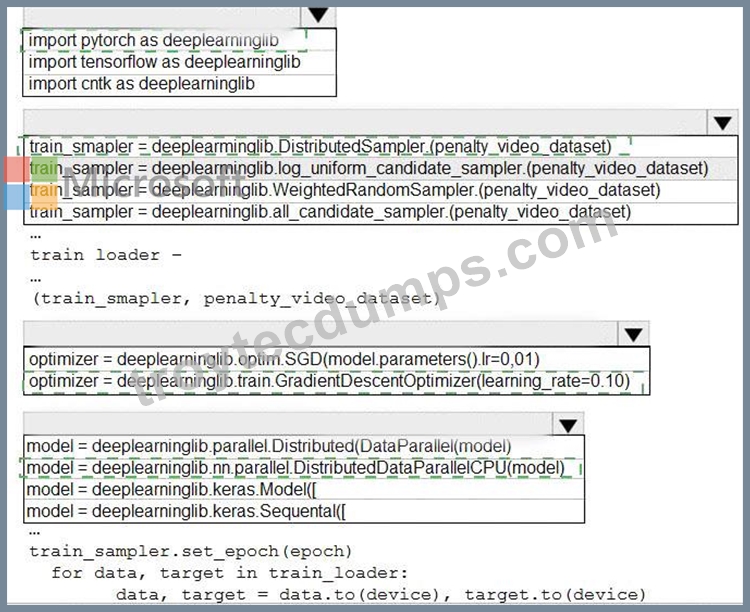
Explanation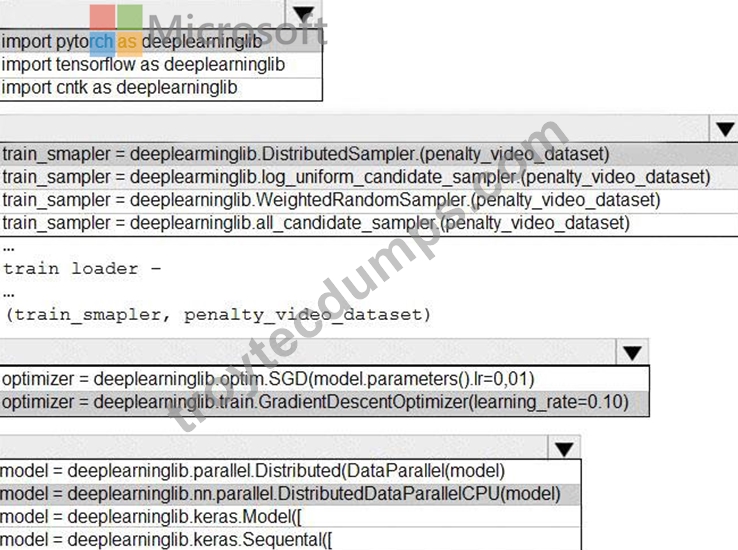
Box 1: import pytorch as deeplearninglib
Box 2: ..DistributedSampler(Sampler)..
DistributedSampler(Sampler):
Sampler that restricts data loading to a subset of the dataset.
It is especially useful in conjunction with class:`torch.nn.parallel.DistributedDataParallel`. In such case, each process can pass a DistributedSampler instance as a DataLoader sampler, and load a subset of the original dataset that is exclusive to it.
Scenario: Sampling must guarantee mutual and collective exclusively between local and global segmentation models that share the same features.
Box 3: optimizer = deeplearninglib.train. GradientDescentOptimizer(learning_rate=0.10)
NEW QUESTION # 192
You create a binary classification model by using Azure Machine Learning Studio.
You must tune hyperparameters by performing a parameter sweep of the model. The parameter sweep must meet the following requirements:
* iterate all possible combinations of hyperparameters
* minimize computing resources required to perform the sweep
You need to perform a parameter sweep of the model.
Which parameter sweep mode should you use?
- A. Sweep clustering
- B. Random grid
- C. Entire grid
- D. Random sweep
Answer: B
Explanation:
Maximum number of runs on random grid: This option also controls the number of iterations over a random sampling of parameter values, but the values are not generated randomly from the specified range; instead, a matrix is created of all possible combinations of parameter values and a random sampling is taken over the matrix. This method is more efficient and less prone to regional oversampling or undersampling.
If you are training a model that supports an integrated parameter sweep, you can also set a range of seed values to use and iterate over the random seeds as well. This is optional, but can be useful for avoiding bias introduced by seed selection.
Incorrect Answers:
B: If you are building a clustering model, use Sweep Clustering to automatically determine the optimum number of clusters and other parameters.
C: Entire grid: When you select this option, the module loops over a grid predefined by the system, to try different combinations and identify the best learner. This option is useful for cases where you don't know what the best parameter settings might be and want to try all possible combination of values.
Reference:
https://docs.microsoft.com/en-us/azure/machine-learning/studio-module-reference/tune-model- hyperparameters
NEW QUESTION # 193
You create a binary classification model to predict whether a person has a disease.
You need to detect possible classification errors.
Which error type should you choose for each description? To answer, select the appropriate options in the answer area.
NOTE: Each correct selection is worth one point.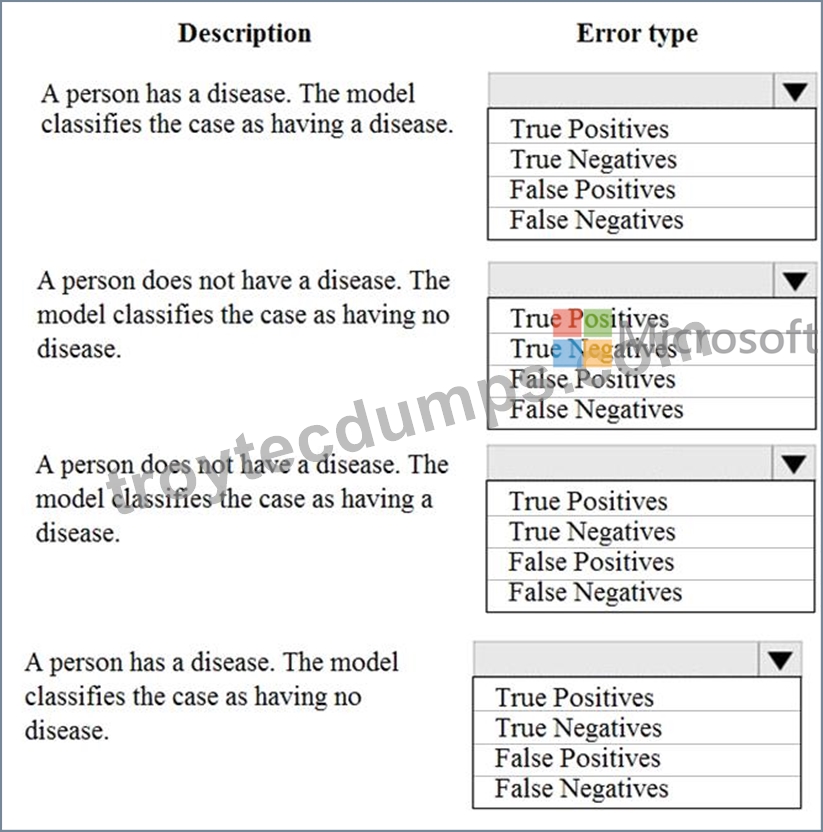
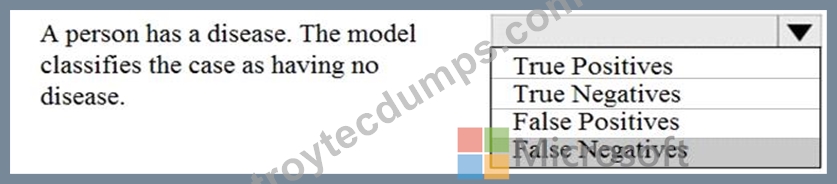
Answer:
Explanation: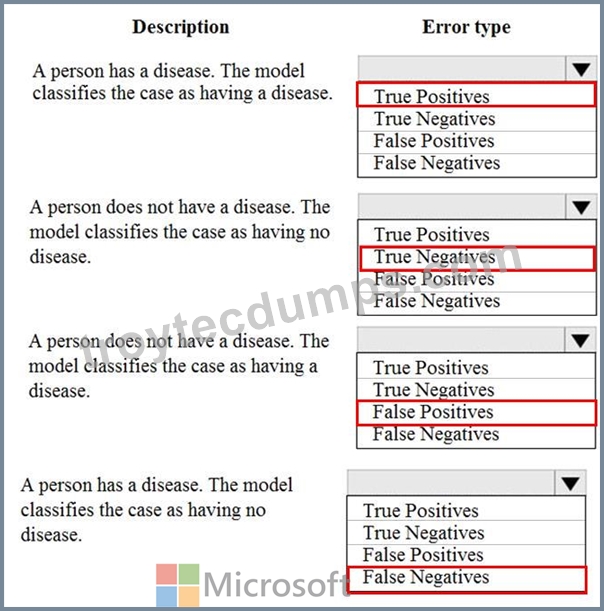
Explanation:
Box 1: True Positive
A true positive is an outcome where the model correctly predicts the positive class Box 2: True Negative A true negative is an outcome where the model correctly predicts the negative class.
Box 3: False Positive
A false positive is an outcome where the model incorrectly predicts the positive class.
Box 4: False Negative
A false negative is an outcome where the model incorrectly predicts the negative class.
Note: Let's make the following definitions:
"Wolf" is a positive class.
"No wolf" is a negative class.
We can summarize our "wolf-prediction" model using a 2x2 confusion matrix that depicts all four possible outcomes:
Reference:
https://developers.google.com/machine-learning/crash-course/classification/true-false-positive-negative
NEW QUESTION # 194
You use Azure Machine Learning Studio to build a machine learning experiment.
You need to divide data into two distinct datasets.
Which module should you use?
- A. Group Data into Bins
- B. Load Trained Model
- C. Assign Data to Clusters
- D. Split Data
Answer: A
Explanation:
Explanation
The Group Data into Bins module supports multiple options for binning data. You can customize how the bin edges are set and how values are apportioned into the bins.
References:
https://docs.microsoft.com/en-us/azure/machine-learning/studio-module-reference/group-data-into-bins
NEW QUESTION # 195
You create an Azure Machine Learning workspace.
You must configure an event handler to send an email notification wten data drift is detected in the workspace datasets. You must minimize development efforts.
You need to configure an Azure service to send the notification.
Which Azure service should you use?
- A. Azure DevOps pipeline
- B. Azure Automation runbook
- C. Azure Function apps
- D. Azure Logic Apps
Answer: D
NEW QUESTION # 196
You need to implement a new cost factor scenario for the ad response models as illustrated in the performance curve exhibit.
Which technique should you use?
- A. Set the threshold to 0.05 and retrain if weighted Kappa deviates +/- 5% from 0.5.
- B. Set the threshold to 0.75 and retrain if weighted Kappa deviates +/- 5% from 0.15.
- C. Set the threshold to 0.2 and retrain if weighted Kappa deviates +/- 5% from 0.6.
- D. Set the threshold to 0.5 and retrain if weighted Kappa deviates +/- 5% from 0.45.
Answer: D
Explanation:
Explanation/Reference:
Explanation:
Scenario:
Performance curves of current and proposed cost factor scenarios are shown in the following diagram: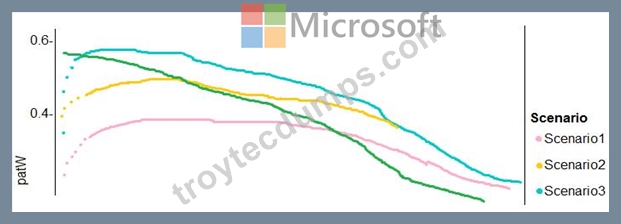
The ad propensity model uses a cut threshold is 0.45 and retrains occur if weighted Kappa deviated from
0.1 +/- 5%.
NEW QUESTION # 197
You define a datastore named ml-data for an Azure Storage blob container. In the container, you have a folder named train that contains a file named data.csv. You plan to use the file to train a model by using the Azure Machine Learning SDK.
You plan to train the model by using the Azure Machine Learning SDK to run an experiment on local compute.
You define a DataReference object by running the following code: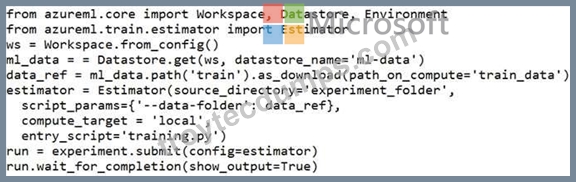
You need to load the training data.
Which code segment should you use?
- A.

- B.

- C.

- D.

- E.

Answer: A
Explanation:
Example:
data_folder = args.data_folder
# Load Train and Test data
train_data = pd.read_csv(os.path.join(data_folder, 'data.csv'))
Reference:
https://www.element61.be/en/resource/azure-machine-learning-services-complete-toolbox-ai Perform Feature Engineering Testlet 1 Case study Overview You are a data scientist in a company that provides data science for professional sporting events. Models will use global and local market data to meet the following business goals:
* Understand sentiment of mobile device users at sporting events based on audio from crowd reactions.
* Assess a user's tendency to respond to an advertisement.
* Customize styles of ads served on mobile devices.
* Use video to detect penalty events
Current environment
* Media used for penalty event detection will be provided by consumer devices. Media may include images and videos captured during the sporting event and shared using social media. The images and videos will have varying sizes and formats.
* The data available for model building comprises of seven years of sporting event media. The sporting event media includes; recorded video transcripts or radio commentary, and logs from related social media feeds captured during the sporting events.
* Crowd sentiment will include audio recordings submitted by event attendees in both mono and stereo formats.
Penalty detection and sentiment
* Data scientists must build an intelligent solution by using multiple machine learning models for penalty event detection.
* Data scientists must build notebooks in a local environment using automatic feature engineering and model building in machine learning pipelines.
* Notebooks must be deployed to retrain by using Spark instances with dynamic worker allocation.
* Notebooks must execute with the same code on new Spark instances to recode only the source of the data.
* Global penalty detection models must be trained by using dynamic runtime graph computation during training.
* Local penalty detection models must be written by using BrainScript.
* Experiments for local crowd sentiment models must combine local penalty detection data.
* Crowd sentiment models must identify known sounds such as cheers and known catch phrases. Individual crowd sentiment models will detect similar sounds.
* All shared features for local models are continuous variables.
* Shared features must use double precision. Subsequent layers must have aggregate running mean and standard deviation metrics available.
Advertisements
During the initial weeks in production, the following was observed:
* Ad response rated declined.
* Drops were not consistent across ad styles.
* The distribution of features across training and production data are not consistent Analysis shows that, of the 100 numeric features on user location and behavior, the 47 features that come from location sources are being used as raw features. A suggested experiment to remedy the bias and variance issue is to engineer 10 linearly uncorrelated features.
* Initial data discovery shows a wide range of densities of target states in training data used for crowd sentiment models.
* All penalty detection models show inference phases using a Stochastic Gradient Descent (SGD) are running too slow.
* Audio samples show that the length of a catch phrase varies between 25%-47% depending on region
* The performance of the global penalty detection models shows lower variance but higher bias when comparing training and validation sets. Before implementing any feature changes, you must confirm the bias and variance using all training and validation cases.
* Ad response models must be trained at the beginning of each event and applied during the sporting event.
* Market segmentation models must optimize for similar ad response history.
* Sampling must guarantee mutual and collective exclusively between local and global segmentation models that share the same features.
* Local market segmentation models will be applied before determining a user's propensity to respond to an advertisement.
* Ad response models must support non-linear boundaries of features.
* The ad propensity model uses a cut threshold is 0.45 and retrains occur if weighted Kappa deviated from
0.1 +/- 5%.
* The ad propensity model uses cost factors shown in the following diagram:
* The ad propensity model uses proposed cost factors shown in the following diagram:
* Performance curves of current and proposed cost factor scenarios are shown in the following diagram:
NEW QUESTION # 198
You write five Python scripts that must be processed in the order specified in Exhibit A - which allows the same modules to run in parallel, but will wait for modules with dependencies.
You must create an Azure Machine Learning pipeline using the Python SDK, because you want to script to create the pipeline to be tracked in your version control system. You have created five PythonScriptSteps and have named the variables to match the module names.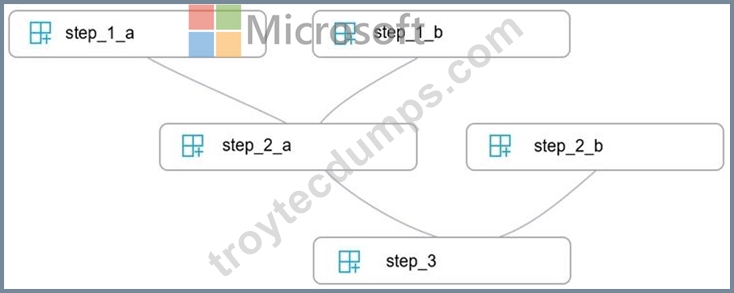
You need to create the pipeline shown. Assume all relevant imports have been done.
Which Python code segment should you use?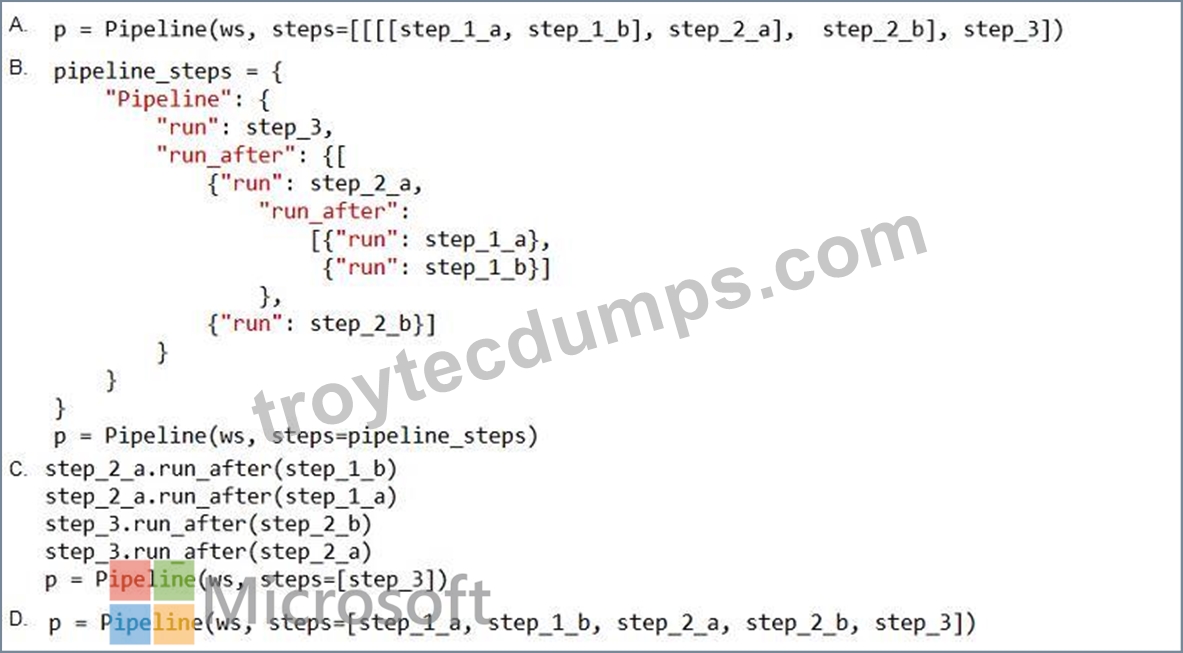
- A. Option C
- B. Option A
- C. Option D
- D. Option B
Answer: B
Explanation:
Explanation
The steps parameter is an array of steps. To build pipelines that have multiple steps, place the steps in order in this array.
Reference:
https://docs.microsoft.com/en-us/azure/machine-learning/how-to-use-parallel-run-step
NEW QUESTION # 199
You are creating an experiment by using Azure Machine Learning Studio.
You must divide the data into four subsets for evaluation. There is a high degree of missing values in the data.
You must prepare the data for analysis.
You need to select appropriate methods for producing the experiment.
Which three modules should you run in sequence? To answer, move the appropriate actions from the list of actions to the answer area and arrange them in the correct order.
NOTE: More than one order of answer choices is correct. You will receive credit for any of the correct orders you select.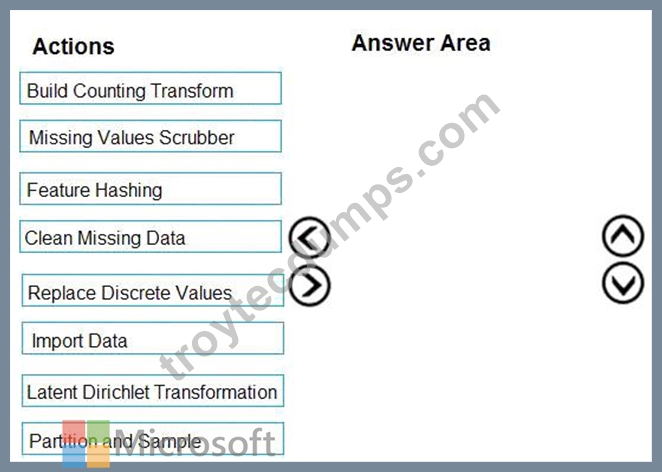
Answer:
Explanation: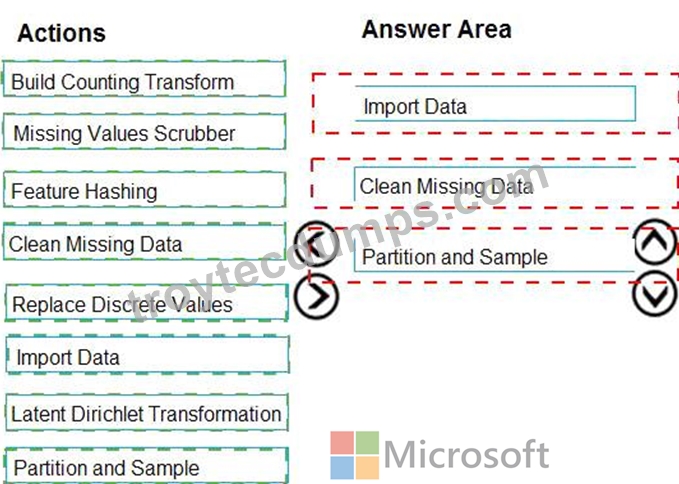
Explanation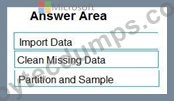
The Clean Missing Data module in Azure Machine Learning Studio, to remove, replace, or infer missing values.
NEW QUESTION # 200
You have a binary classifier that predicts positive cases of diabetes within two separate age groups.
The classifier exhibits a high degree of disparity between the age groups.
You need to modify the output of the classifier to maximize its degree of fairness across the age groups and meet the following requirements:
* Eliminate the need to retrain the model on which the classifier is based.
* Minimize the disparity between true positive rates and false positive rates across age groups.
Which algorithm and panty constraint should you use? To answer, select the appropriate options in the answer are a. NOTE: Each correct selection is worth one point.
Answer:
Explanation: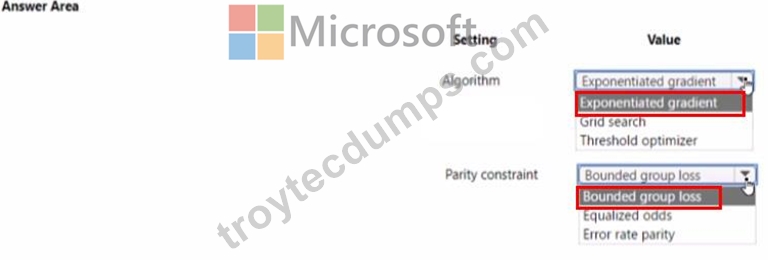
NEW QUESTION # 201
You need to define a process for penalty event detection.
Which three actions should you perform in sequence? To answer, move the appropriate actions from the list of actions to the answer area and arrange them in the correct order.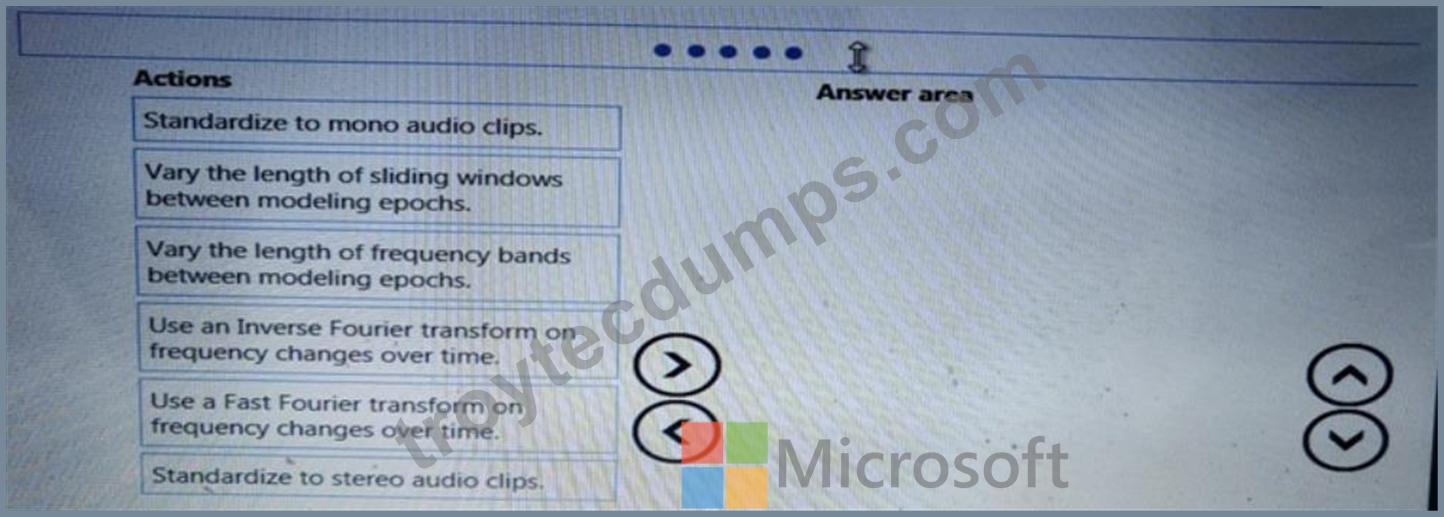
Answer:
Explanation: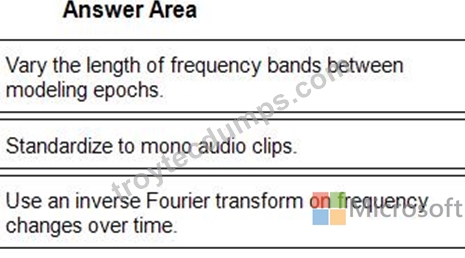
1 - Vary the length of frequency bands between modeling epochs.
2 - Standardize to mono audio clips.
3 - Use an inverse Fourier transform on frequency changes over time.
NEW QUESTION # 202
You are performing feature scaling by using the scikit-learn Python library for x.1 x2, and x3 features.
Original and scaled data is shown in the following image.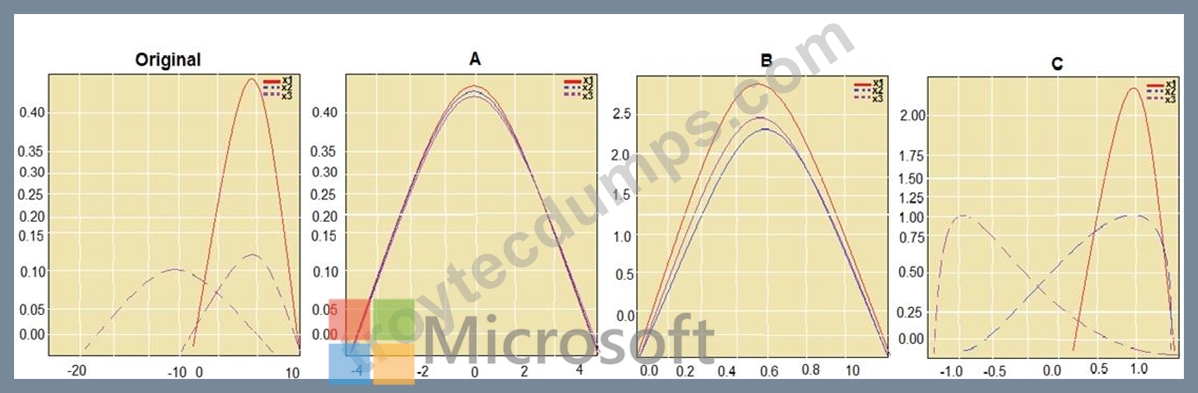
Use the drop-down menus to select the answer choice that answers each question based on the information presented in the graphic.
NOTE: Each correct selection is worth one point.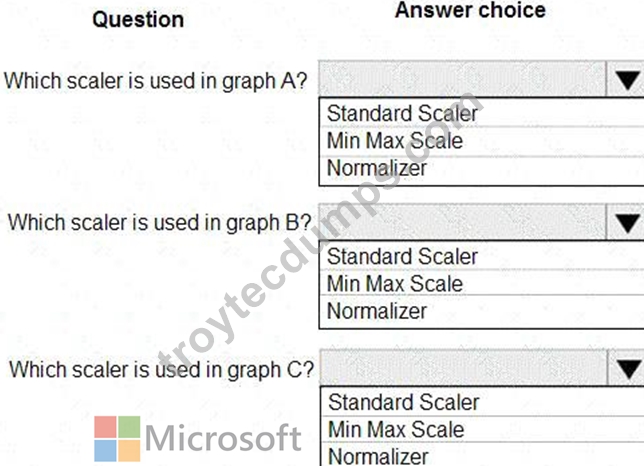
Answer:
Explanation: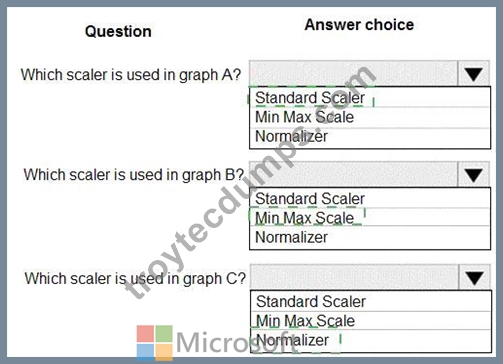
Explanation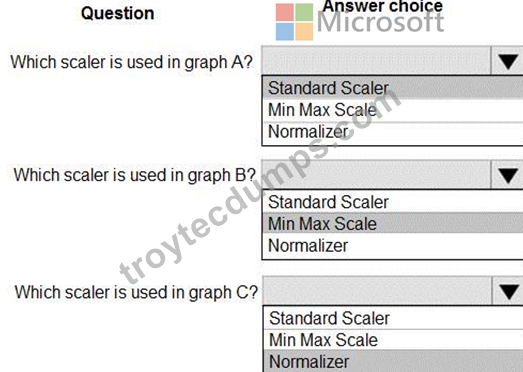
Box 1: StandardScaler
The StandardScaler assumes your data is normally distributed within each feature and will scale them such that the distribution is now centred around 0, with a standard deviation of 1.
Example:
All features are now on the same scale relative to one another.
Box 2: Min Max Scaler
Notice that the skewness of the distribution is maintained but the 3 distributions are brought into the same scale so that they overlap.
Box 3: Normalizer
References:
http://benalexkeen.com/feature-scaling-with-scikit-learn/
NEW QUESTION # 203
......
The DP-100 exam is a valuable certification for data scientists who work with Azure, as it demonstrates their proficiency in designing and implementing data science solutions on this platform. Designing and Implementing a Data Science Solution on Azure certification can help data scientists advance their careers and increase their earning potential.
Microsoft DP-100 (Designing and Implementing a Data Science Solution on Azure) Exam is a certification exam that tests the candidate's knowledge and skills in designing and implementing data science solutions on the Azure platform. DP-100 exam is designed for data scientists, data engineers, and machine learning engineers who work with large amounts of data and want to leverage the power of Azure to build scalable and efficient data solutions.
Earn Quick And Easy Success With DP-100 Dumps: https://www.troytecdumps.com/DP-100-troytec-exam-dumps.html
Kickstart your Career with Real Updated Questions: https://drive.google.com/open?id=1WEluuVmNmCXD3QL0vYwzSGrK_Rvq1SZ0