

[Mar-2025] Latest UiPath UiPath-ADPv1 exam dumps and online Test Engine
UiPath UiPath-ADPv1: Selling UiPath Certified Professional - Developer Track Products and Solutions
NEW QUESTION # 56
Suppose you have the following workflow that verifies if the text value of an element is equal to "Work Items":
The configuration for the Verify Control Attribute and Get Text activities is shown below:
The element and its selector are highlighted in the image below:
Taking into consideration that the page shown above will be present on screen at execution time, what will be the result of the Verify Control Attribute activity?
- A. Verification will be passed.
- B. An exception will be thrown because there is no variable set in the Save to property of the Get text activity.
- C. Verification will not be executed.
- D. Verification will be failed because the actual value is different than expected value.
Answer: A
Explanation:
The workflow in question uses a 'Verify Control Attribute' activity to check if the text value of a UI element is equal to "Work Items". The Get Text activity is used to retrieve the text from the specified UI element, and the result of this activity is compared against the expected value "Work Items".
From the provided information, the 'Verify Control Attribute' activity has been set up with the Expression
"Work Items" and the Operator set to Equality. The 'Get Text' activity is configured to extract the text from the UI element with the visible text "Work Items", as indicated by the selector shown in the image.
Since the actual value of the UI element's text is "Work Items" (which matches the expected value in the
'Verify Control Attribute' activity), and provided that the 'Get Text' activity successfully retrieves this value, the verification will pass. The configuration indicates that the activity should take a screenshot only if the verification fails (TakeScreenshotIfFailed is set to True), which will not be the case here.
Therefore, assuming that there are no other issues such as incorrect selectors or unexpected changes to the UI element at execution time, the result of the 'Verify Control Attribute' activity will be a pass.
References:
UiPath Documentation: Verify Control Attribute Activity
NEW QUESTION # 57
Under what conditions will a trigger be automatically disabled upon failure in Integration Service?
- A. When the job is not able to start after 3 attempts for a single event or the job does not start for the last 25 events.
- B. When the job is not able to start after 5 attempts for a single event or the job does not start for the last 50 events.
- C. When the job is not able to start after 20 attempts for a single event or the job does not start for the last
200 events. - D. When the job is not able to start after 11 attempts for a single event or the job does not start for the last
100 events.
Answer: A
Explanation:
In UiPath Integration Service, a trigger will be automatically disabled upon failure under specific conditions to prevent continuous failure and unnecessary resource consumption. This typically happens when the job associated with the trigger fails to start after a predefined number of attempts for a single event, or when it consistently fails to start across a series of events. The condition of failing to start after 3 attempts for a single event or not starting for the last 25 events is designed to safeguard against persistent issues that could disrupt the automation flow or lead to resource wastage.References:
UiPath Integration Service Documentation: Triggers and Events
NEW QUESTION # 58
What advantages do pre-built connectors in UiPath Integration Service offer?
- A. Providing a fully customizable catalog of connectors for developing proprietary applications.
- B. Replacing all types of authorization and authentication protocols with a single, standardized method.
- C. Simplified integration with popular applications, faster deployment, and integration across all UiPath Platform product solutions.
- D. Reducing the need for Ul and API automation, allowing developers to work exclusively with connectors.
Answer: C
Explanation:
UiPath Integration Service is the component of the UiPath Platform that makes the automation of third-party applications much easier by standardizing authorization and authentication, helping you manage API connections and also allowing faster integration into SaaS platforms1. By using pre-built connectors, the development of automation projects in UiPath Studio is more simple and more consistent, regardless of the third-party applications you are automating1. Some of the advantages of pre-built connectors are:
They enable automation with an out-of-the-box library of connectors for popular applications such as Salesforce, Slack, Microsoft Office 365, SAP, ServiceNow, and Google G Suite23.
They help setting up and managing connections easily with standardized authentication methods such as OAuth 2.0, Basic, API Key, and Custom1.
They enable kicking off automations with server-side triggers or events, such as receiving an email, creating a record, or updating a field1.
They provide curated activities and events (with additional data filters) for ease of use in UiPath Studio1.
They simplify automation design by providing a uniform experience across all Studio designers1.
They integrate across all UiPath Platform product solutions, such as UiPath Orchestrator, UiPath Assistant, UiPath Action Center, and UiPath Apps3.
References:
Introducing UiPath Integration Service | UiPath
Integration Service - Introduction - UiPath Documentation Portal
Integration Service - Connectors - UiPath Documentation Portal
New UiPath Integration Service | UiPath
NEW QUESTION # 59
When developing a process, you were provided with two data tables, "DT1" and "DT2", as shown below:
The process documentation specifies that the two data tables need to be manipulated in order to reflect the following "DT2":
How should the properties of the Merge Data Table activity be configured?
- A.
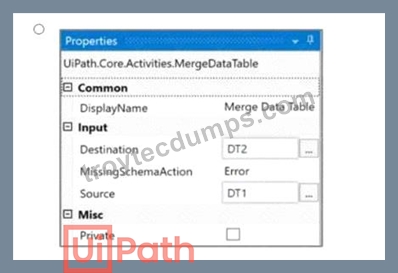
- B.

- C.

- D.

Answer: B
Explanation:
Given the two data tables DT1 and DT2, to achieve the desired result where DT2 contains both the department and the names, the Merge Data Table activity should be configured to merge DT1 into DT2. This configuration requires specifying DT1 as the source table and DT2 as the destination table. The MissingSchemaAction should be set to AddWithKey which ensures that if the source table (DT1) contains columns that are not found in the destination table (DT2), they will be added to the destination table with the primary key information preserved.
Option A shows the correct configuration for the Merge Data Table activity to achieve this result:
Destination: DT1
Source: DT2
MissingSchemaAction: AddWithKey
This setup correctly adds the "Name" column from DT1 to DT2 based on the shared "ID" column, which acts as the key. Since both tables have an "ID" column with matching values, the names will be added to the corresponding IDs in DT2, resulting in a merged table with ID, Department, and Name columns.
NEW QUESTION # 60
What do the percentages from the Test Explorer panel represent?
- A. Percent of test data run.
- B. Coverage percent.
- C. Correctness of the code percent.
- D. Passing percent.
Answer: D
Explanation:
The percentages from the Test Explorer panel represent the passing percent of the test cases that are executed.
The Test Explorer panel shows the status of each test case, the total number of test cases, the number of passed test cases, the number of failed test cases, and the passing percent. The passing percent is calculated by dividing the number of passed test cases by the total number of test cases and multiplying by 100. For example, if there are 10 test cases and 8 of them pass, the passing percent is 80%. References: Test Explorer
NEW QUESTION # 61
What is the purpose of the Interval filter in the Orchestrator's Monitoring page?
- A. It allows you to allocate licenses per machine for the displayed data.
- B. It allows you to choose between background and foreground processes for the displayed data.
- C. It enables you to sort the displayed data based on job priorities.
- D. It allows you to control the granularity of the displayed data and check the health of your system in either the last day or the last hour.
Answer: D
Explanation:
The purpose of the Interval filter in the Orchestrator's Monitoring page is to allow you to control the granularity of the displayed data and check the health of your system in either the last day or the last hour. The Monitoring page provides various metrics and charts that show the status and performance of your robots, processes, queues, and transactions. The Interval filter lets you choose the time frame for the data that you want to see. You can select either the last day or the last hour as the interval. The data will be updated accordingly and show you the trends and changes in your system over the selected period. This can help you identify any issues or anomalies and take corrective actions if needed.
NEW QUESTION # 62
Given the following list of arguments:
and the following code:
What is the value that will be displayed in the Output Panel at the end of the sequence below:
- A. 0
- B. 1
- C. 2
- D. 3
Answer: A
Explanation:
The value that will be displayed in the Output Panel at the end of the sequence is 9. This is because the code in the Invoke Code activity is looping through the array in_numArray and setting the variable out_numVar to the highest value in the array. The array in_numArray has the values {1, 2, 7, 9, 4} as shown in the list of arguments. The variable out_numVar is initialized to 0. The For loop iterates from 0 to the upper bound of the array, which is 4. In each iteration, the If condition checks if the current element of the array is greater than the current value of out_numVar. If it is, then out_numVar is assigned to the current element of the array.
Otherwise, out_numVar remains unchanged. Therefore, after the first iteration, out_numVar becomes 1. After the second iteration, out_numVar becomes 2. After the third iteration, out_numVar becomes 7. After the fourth iteration, out_numVar becomes 9. After the fifth iteration, out_numVar remains 9, since 4 is not greater than 9. The Write Line activity outputs the value of out_numVar to the console, which is
9. References: Invoke Code
NEW QUESTION # 63
Under what conditions will a trigger be automatically disabled upon failure in Integration Service?
- A. When the job is not able to start after 5 attempts for a single event or the job does not start for the last
50 events. - B. When the job is not able to start after 3 attempts for a single event or the job does not start for the last
25 events. - C. When the job is not able to start after 20 attempts for a single event or the job does not start for the last
200 events. - D. When the job is not able to start after 11 attempts for a single event or the job does not start for the last
100 events.
Answer: B
Explanation:
In UiPath Integration Service, a trigger will be automatically disabled upon failure under specific conditions to prevent continuous failure and unnecessary resource consumption. This typically happens when the job associated with the trigger fails to start after a predefined number of attempts for a single event, or when it consistently fails to start across a series of events. The condition of failing to start after 3 attempts for a single event or not starting for the last 25 events is designed to safeguard against persistent issues that could disrupt the automation flow or lead to resource wastage.References:
* UiPath Integration Service Documentation: Triggers and Events
NEW QUESTION # 64
While troubleshooting a process developed using the Robotic Enterprise (RE) Framework, you have placed a breakpoint at the "Invoke InitAllSettings" workflow activity.
Given the current state of the Executor, what will occur when you click on the Step Over button?
- A. Executor directs to the first InitAllSettings workflow activity
- B. Executor directs to the first activity outside "If first run, read local configuration"
- C. Executor directs to the "First Run" sequence
- D. Executor directs to the "If in_OrchestratorQ ... " activity
Answer: D
Explanation:
When a breakpoint is placed at a particular activity within the workflow and the Step Over function is used, the Executor will move to the next activity in the sequence.
Given the context of the REFramework, after stepping over the "Invoke InitAllSettings" workflow, the next activity that would execute is the "If in_OrchestratorQueueName ..." activity, assuming there are no activities in between within the "InitAllSettings" workflow itself.
Step Over will not go into the invoked workflow but will move to the next activity at the same level of the workflow where the breakpoint was placed.
References:
UiPath Studio Guide: Debugging
NEW QUESTION # 65
What status needs to be selected in the Set Transaction Status activity in UiPath Studio so that the respective Queue Item will be retried?
- A. Retried
- B. Failed
- C. Postponed
- D. Abandoned
Answer: B
Explanation:
The Set Transaction Status activity in UiPath Studio is used to set the status of an Orchestrator queue item to Failed or Successful. This activity is usually placed at the end of the Process Transaction state in the REFramework template, after the Try Catch block. The status of the queue item determines whether it will be retried or not.
To retry a queue item, the status needs to be set to Failed. This means that the transaction was not completed successfully, and it needs to be processed again. The number of retries for a queue item depends on the MaxRetryNumber parameter in the Config file of the REFramework. By default, it is set to 2, which means that each queue item can be retried twice before it is marked as permanently failed.
The other options are not valid statuses for the Set Transaction Status activity. Option A is incorrect, because Retried is not a status, but a property of a queue item that indicates whether it has been retried or not. Option C is incorrect, because Abandoned is a status that is automatically assigned by Orchestrator to a queue item that has been in progress for more than 24 hours, and it cannot be retried. Option D is incorrect, because Postponed is a status that is automatically assigned by Orchestrator to a queue item that has a specific start date in the future, and it cannot be retried until that date is reached.
References: Activities - Set Transaction Status - UiPath Documentation Portal, REFramework documentation - UiPath Documentation Portal, Set Transaction Status - Help - UiPath Community Forum, [Set Transaction Status - Orchestrator - UiPath Community Forum]
NEW QUESTION # 66
Which of the following options is correct about a State Machine layout?
- A. Can have multiple initial states and multiple final states.
- B. Can have only one initial state and multiple final states.
- C. Can have multiple initial states and only one final state.
- D. Can have only one initial state and only one final state.
Answer: B
NEW QUESTION # 67
In the context of a linear process, implemented with REFramework, how many times will the process enter the Get Transaction Data state?
- A. 1 lime
- B. Until there are no more queue items left unprocessed in Orchestrator
- C. 2 times.
- D. The process will not enter the Get Transaction Data state because a linear process is not transactional.
Answer: A
Explanation:
In the context of a linear process, implemented with REFramework, the process will enter the Get Transaction Data state only 1 time. This is because the Get Transaction Data state is responsible for fetching the next transaction item from the data source and assigning it to the TransactionItem variable. In a linear process, there is only one transaction item that represents the entire process, and it is fetched at the beginning of the execution. Therefore, the process will enter the Get Transaction Data state only once, and then move to the Process Transaction state, where the main logic of the process is executed. The process will not return to the Get Transaction Data state, unless there is an exception or a retry in the Process Transaction state. References:
[Robotic Enterprise Framework], [REFramework for Linear Processes]
NEW QUESTION # 68
Which activity Is specific tor Ul synchronization in UlPath Studio?
- A. Process Start Trigger
- B. Use Applicationy/Browser
- C. Check App State
- D. Get Processes
Answer: C
Explanation:
The Check App State activity is specifically designed for UI synchronization. It checks the state of a UI element, ensuring that subsequent actions are performed when the UI element is in the desired state.
NEW QUESTION # 69
What are the primary functions of the UiPath Integration Service?
- A. Automates Ul design, manages API connections, provides limited activities and events, simplifies automation design.
- B. Enables automation with API integration, manages connections with user-provided authentication, kicks off automations based on application-specific triggers, simplifies automation design with the help of third-party libraries.
- C. Enables automation with a library of connectors, manages connections easily with standardized authentication, kicks off automations with server-side triggers or events, provides curated activities and events, simplifies automation design.
- D. Enables automation with Ul components, manages API keys, kicks off automations with client-side triggers, provides curated events.
Answer: C
Explanation:
UiPath Integration Service is a component of the UiPath Platform that allows users to automate third-party applications using both UI and API integration. It has the following primary functions1:
* Enables automation with a library of connectors: Connectors are pre-built API integrations that provide a consistent developer experience and simplify the integration process. Users can browse and import connectors from the Connector Catalog or the UiPath Marketplace, or create their own connectors using the Connector Builder (Preview).
* Manages connections easily with standardized authentication: Users can create and manage secure connections to various applications using standardized authentication methods, such as OAuth 2.0, Basic, API Key, etc. Users can also share connections with other users, groups, or automations within the UiPath Platform.
* Kicks off automations with server-side triggers or events: Users can trigger automations based on events from external applications, such as webhooks, email, or schedules. Users can also configure parameters and filters for the events to customize the automation logic.
* Provides curated activities and events: Users can access a set of curated activities and events that are specific to each connector and application. These activities and events can be used in UiPath Studio or UiPath StudioX to design and execute automations.
* Simplifies automation design: Users can leverage the UiPath Integration Service Designer to create and test integrations in a graphical interface. Users can also import common API formats, such as Swagger, YAML, or Postman collections, to generate connectors automatically.
References:
1: Integration Service - Introduction - UiPath Documentation Portal
NEW QUESTION # 70
A developer configured the properties for a Click activity as shown below:
What happens if the activity cannot find its target at runtime?
- A. The next activity is executed after 10 milliseconds.
- B. An exception is thrown after 10 milliseconds.
- C. An exception is thrown after 10 seconds.
- D. The next activity is executed after 10 seconds.
Answer: C
Explanation:
The Click activity has a property called TimeoutMS. This property specifies the amount of time (in milliseconds) to wait for the activity to be executed before an error is thrown. In this case, the TimeoutMS property is set to 10000 milliseconds (10 seconds). Therefore, if the activity cannot find its target at runtime, an exception will be thrown after 10 seconds.
NEW QUESTION # 71
A developer examines a workflow in which filenames are stored within a collection. The collection is initialized with a single filename. When adding a new filename to the collection, which collection variable type will cause an error?
- A. System.Array
- B. System.Collections.Generic.List
- C. System.Data.DataTable
- D. System.Collections.Generic.Dictionary
Answer: A
Explanation:
The collection variable type that will cause an error when adding a new filename to the collection is System.Array. This is because System.Array is a fixed-size collection that cannot be resized or modified once it is initialized. Therefore, if the collection is initialized with a single filename, it cannot accommodate any more filenames. To add a new filename to the collection, the developer should use a dynamic collection type, such as System.Collections.Generic.List or System.Data.DataTable, that can grow or shrink as needed.
Alternatively, the developer can use System.Collections.Generic.Dictionary if the filenames need to be associated with some keys or values. References: [Array Class], [Collection Classes]
NEW QUESTION # 72
Where is the TransactionNumber incremented in the REFramework?
- A. In the New Transaction transition.
- B. Only in the RetryCurrentTransaction.xaml workflow.
- C. In the RetryCurrentTransaction.xaml workflow and in the SetTransactionStatus.xaml workflow.
- D. Only in the SetTransactionStatus.xaml workflow.
Answer: D
NEW QUESTION # 73
......
New 2025 UiPath-ADPv1 Test Tutorial (Updated 188 Questions): https://www.troytecdumps.com/UiPath-ADPv1-troytec-exam-dumps.html
Reliable UiPath-ADPv1 Exam Tips Test Pdf Exam Material: https://drive.google.com/open?id=1R9yXIwyOgMLLoo_TSoYJSrQlrJmQmYDu