

Practice Test for CY0-001 Certification Real 2026 Mock Exam
Prepare For Realistic CY0-001 Dumps PDF - 100% Passing Guarantee
NEW QUESTION # 51
An organization develops a chatbot with the following requirements:
- Does not provide harmful or explicit responses
- Must use clean and professional language
- Ensures that responses are accurate
Which of the following should the organization conduct after the chatbot is fully developed but before a customer-facing deployment?
- A. Model auditing and evaluation
- B. Data labeling and classification
- C. Regression modeling and minimization
- D. Guardrail testing and validation
Answer: D
Explanation:
Guardrail testing and validation ensure the chatbot adheres to safety, language, and accuracy requirements before deployment. This step verifies the model will not generate harmful, explicit, or unprofessional responses in a customer-facing environment.
NEW QUESTION # 52
A security architect performs threat modeling of an AI system. The architect needs to determine which attacks can be performed against the system.
Which of the following actions should the architect take next?
- A. Identify trust boundaries and perform threat modeling with Open Worldwide Application Security Project (OWASP) Top 10.
- B. Quantify the risk of known vulnerabilities identified in the AI system.
- C. Analyze MITRE Adversarial Threat Landscape for AI Systems (ATLAS) for tactics, techniques, and procedures (TTPs).
- D. Leverage a large language model (LLM) to map likely attack paths based on the code base.
Answer: A
Explanation:
MITRE ATLAS is specifically designed to catalog adversarial TTPs targeting AI systems. By analyzing ATLAS, the architect can determine which types of attacks are possible against the AI system, making it the most appropriate resource for threat modeling in this context.
NEW QUESTION # 53
What control reduces the impact radius when a single host is compromised?
- A. Obfuscation
- B. Network segmentation
- C. Redaction
- D. Tokenization
Answer: B
Explanation:
Segmentation isolates systems and limits lateral movement.
NEW QUESTION # 54
A security operations center (SOC) analyst needs to automate multiple security tasks by breaking them down into smaller parts. Which of the following AI tools is the best for this task?
- A. Retrieval-augmented generation (RAG) AI
- B. Generative AI
- C. Agentic AI
- D. Chatbot
Answer: C
Explanation:
Agentic AI is designed to autonomously break down complex tasks into smaller steps and execute them in sequence. This makes it the best tool for automating multiple security tasks in a SOC environment.
NEW QUESTION # 55
An organization is developing and implementing AI features into a customer service application.
Which of the following practices should the organization put the place before releasing the application for customer trials?
- A. External compliance audits
- B. Data masking and sanitization
- C. Third-party risk management
- D. Approved AI vendor lists
Answer: B
Explanation:
Before releasing AI features for customer trials, it is critical to protect sensitive information that may be used during testing. Data masking and sanitization ensure customer or corporate data is anonymized or obfuscated, reducing the risk of data exposure while still allowing realistic evaluation of the AI system.
NEW QUESTION # 56
SIMULATION
Instructions
Part1
Use drop-down menu to select the most appropriate protocol or cipher for each system component.
Part2
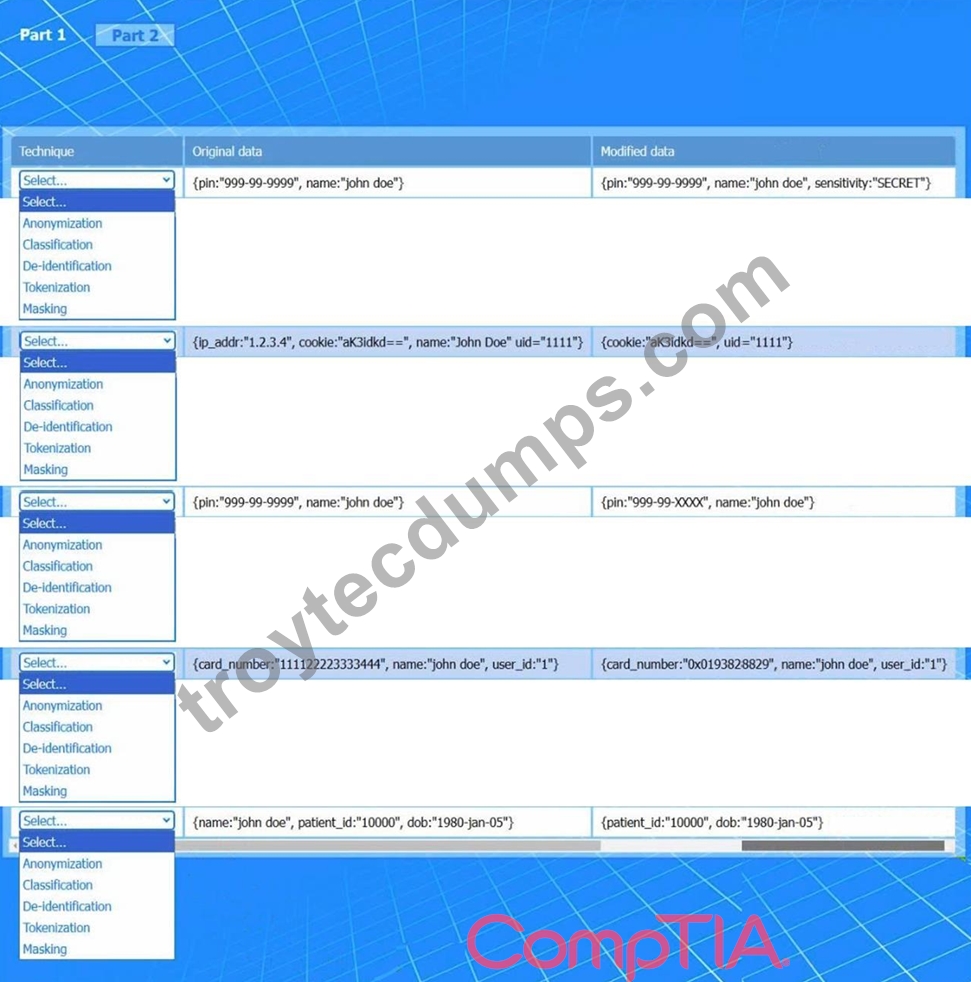
Use the drop-down menu to select the most appropriate technique to apply to the modified data.
It at any time you would like to bring back the initial state of the simulation, please click the Reset All button.
An engineer is analyzing findings from a penetration test that indicate insufficient data encryption.
The engineer must implement data security.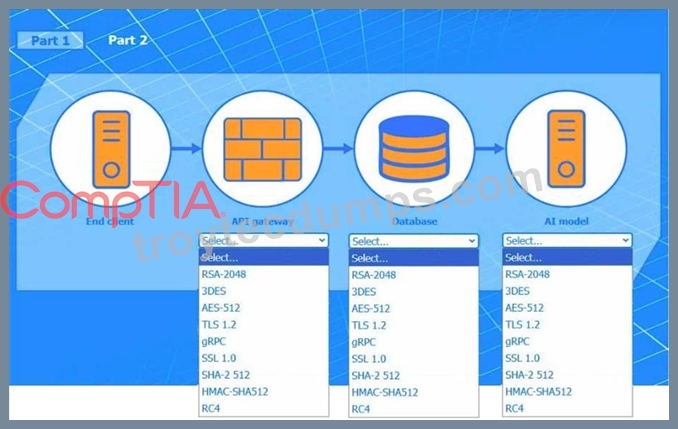
Answer:
Explanation: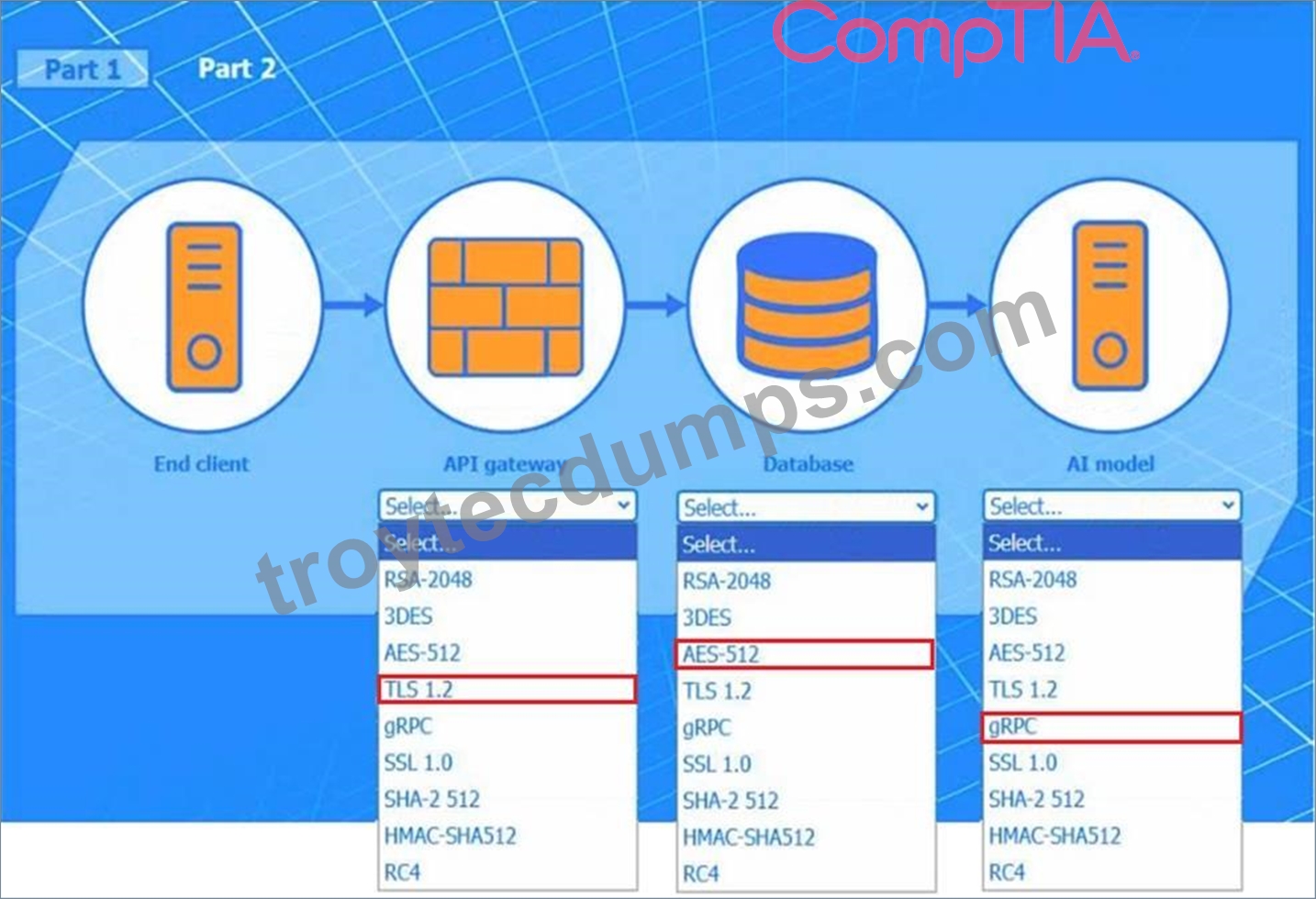
Explanation:
Part 1 (Protocols/Ciphers):
API Gateway: TLS 1.2
* Database: AES-512
* AI Model: gRPC
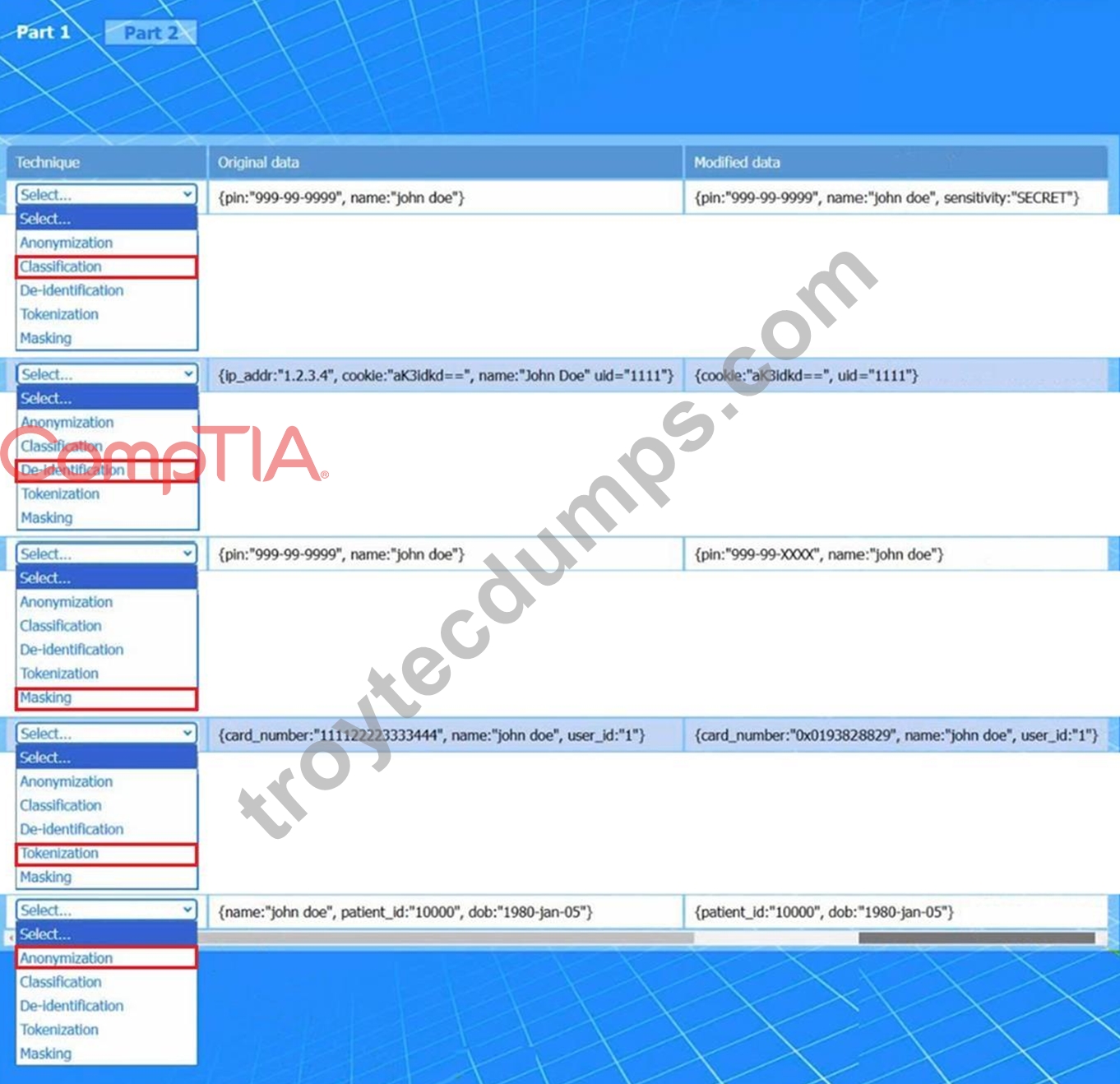
Part 2 (Techniques):
1. {pin:"999-99-9999", name:"john doe"} → {pin:"999-99-9999", name:"john doe", sensitivity:"SECRET"} → Classification
2. {ip_addr:"1.2.3.4", cookie:"aK3idkd==", name:"John Doe" uid="1111"} → {cookie:"aK3idkd==", uid="1111"} → De-identification
3. {pin:"999-99-9999", name:"john doe"} → {pin:"999-99-XXXX", name:"john doe"} → Masking
4. {card_number:"1111222233334444", name:"john doe", user_id:"1"} →
{card_number:"0x019238829", name:"john doe", user_id:"1"} → Tokenization
5. {name:"john doe", patient_id:"10000", dob:"1980-Jan-05"} → {patient_id:"10000", dob:"1980- Jan-05"} → Anonymization Part 1:
* TLS 1.2 secures client-to-gateway communications.
* AES-512 provides strong encryption for data at rest in the database.
* gRPC ensures efficient, secure communication between services (AI model).
Part 2:
* Classification tags sensitive data for handling.
* De-identification strips direct identifiers.
* Masking obscures part of sensitive values while keeping format.
* Tokenization replaces sensitive data with a reversible placeholder.
* Anonymization removes identifying attributes, making re-identification impossible.
NEW QUESTION # 57
Which of the following strengthens the performance of a large language model (LLM) for malicious reconnaissance?
- A. Enhancing a foundational model with the inclusion of retrieval-augmented generation (RAG)
- B. Instructing an AI assistant to query as an administrator
- C. Creating a web scraper script using AI to capture the company website
- D. Prompting a chatbot to describe server naming patterns and Internet Protocol (IP) ranges
Answer: A
Explanation:
RAG augments an LLM with external, up-to-date information retrieval, improving its factual accuracy and contextual scope-capabilities that directly strengthen the model's effectiveness for reconnaissance.
NEW QUESTION # 58
An organization is concerned with the exposure of sensitive data. Which of the following is the most relevant security concern?
- A. Model inversion
- B. Overfitting
- C. Hyperparameter tuning
- D. Data normalization
Answer: A
Explanation:
Model inversion is a security concern where attackers can reconstruct or infer sensitive training data from the AI model's outputs. This directly threatens data confidentiality, making it the most relevant concern for sensitive data exposure.
NEW QUESTION # 59
Which of the following is used to train an AI model with unstructured data?
- A. Fine-tuning
- B. Reinforcement training
- C. Statistical learning
- D. Supervised learning
Answer: A
Explanation:
Fine-tuning allows an AI model to adapt to unstructured data (such as text, audio, or images) by retraining it on domain-specific datasets. This process improves the model's ability to handle and generate outputs aligned with the unstructured data context.
NEW QUESTION # 60
A security alert triggers an agentic system. An analyst notices the following payload in the logs"
The alert includes multiple shell commands that are not typically run as part of any hardening.
Which of the following is the most effective control to implement?
- A. Deprecating model usage and retaining the model with safer parameters
- B. Modifying the application to ignore the SECURITY_UPDATE tag
- C. Adding logic that includes approved strings before running the shell commands
- D. Using only approved libraries when interacting with agentic systems
Answer: C
Explanation:
The payload in the alert attempts to trick the system into executing unauthorized shell commands.
The most effective control is to implement allow-list validation (approved strings) before execution. This ensures that only predefined, safe commands are executed, blocking prompt injection attempts that introduce malicious code such as the fake patch script.
NEW QUESTION # 61
A security operations center (SOC) has a very high volume of logs and alerts. The manager proposes the implementation of machine learning (ML) system to help with triage. Which of the following tasks is most suitable?
- A. Applying filters on specific alerts
- B. Identifying and classifying alerts
- C. Summarizing the content of alerts
- D. Automatically patching vulnerable systems
Answer: B
Explanation:
Machine learning is best suited for analyzing large volumes of security data and distinguishing between true threats and false positives. By identifying and classifying alerts, the ML system helps the SOC prioritize incidents and reduce analyst workload.
NEW QUESTION # 62
Which tool prevents unauthorized system file modifications?
- A. NIDS
- B. WAF
- C. Containerization
- D. File Integrity Monitoring (FIM)
Answer: D
Explanation:
FIM detects changes to critical system files.
NEW QUESTION # 63
A machine learning (ML) engineer is working with a security engineer to identify the best practices for securing a system with various AI models.
Which of the following actions should the engineers suggest?
- A. Following a secure model development life cycle (MDLC)
- B. Implementing comprehensive security architecture
- C. Conducting guardrail testing and security validation
- D. Using a secure software development life cycle (SDLC)
Answer: A
Explanation:
A secure MDLC is tailored to AI and ML systems, ensuring security is integrated throughout the model's design, training, validation, deployment, and monitoring phases. This directly addresses best practices for securing systems with AI models.
NEW QUESTION # 64
A team of data scientists is ready to release a model for enterprise use. The team wants to protect the model from unintentional changes or tampering. Which of the following is the most appropriate action?
- A. Restrict access to only IT professionals in the organization.
- B. Integrate an application programming interface (API) with identity and access management (IAM) roles to interact with the model.
- C. Provide secure copies of the model for local runtime usage.
- D. Change the model to a large language model (LLM) for interactive features with guardrails.
Answer: B
Explanation:
Protecting the model from tampering requires controlled and auditable access. By integrating the model with an API secured by IAM roles, only authenticated and authorized users or systems can interact with it, ensuring integrity and preventing unauthorized changes.
NEW QUESTION # 65
A healthcare organization plans to deploy a chatbot for appointment scheduling and patient records. Which of the following is the first step a security administrator should take?
- A. Enable role-based access management
- B. Use a secure data communication channel for chat.
- C. Conduct a risk assessment.
- D. Implement prompt firewalls.
Answer: C
Explanation:
Before deploying an AI chatbot that will handle sensitive healthcare data, the first step is to conduct a risk assessment. This identifies potential threats, compliance requirements (such as HIPAA), and security gaps, ensuring proper controls are planned before implementation.
NEW QUESTION # 66
When should containment occur during the incident response lifecycle?
- A. Immediately after recovery
- B. After lessons learned
- C. Before identification
- D. Before eradication
Answer: D
Explanation:
Containment follows identification and precedes eradication.
NEW QUESTION # 67
A security consultant needs to detect attacks across a large language model (LLM) firewall.
Which of the following techniques should the consultant use?
- A. Vulnerability enumeration
- B. Translation analysis
- C. Signature matching
- D. Distributed denial-of-service
Answer: C
Explanation:
Signature matching allows the detection of known malicious patterns, inputs, or behaviors targeting an LLM firewall. It is an effective technique for identifying and blocking prompt injection or other recognized attack methods.
NEW QUESTION # 68
A security analyst is aware of an active penetration test in the environment. The analyst examines security information and event management (SIEM) log data and notices the following output from the AI system: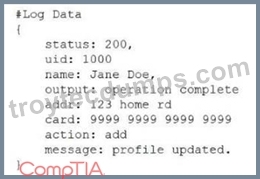
Which of the following is the vulnerability that has occurred and the control the analyst should implement?
- A. The vulnerability is sensitive information disclosure, and the analyst should employ masking.
- B. The vulnerability is prompt injection, and the analyst should use endpoint detection response (EDR).
- C. The vulnerability is jailbreaking, and the analyst should utilize role-based access control.
- D. The vulnerability is model hallucinations, and the analyst should develop output validations.
- E. The vulnerability is role impersonation, and the analyst should use validation.
Answer: A
Explanation:
The log data reveals personally identifiable information (PII) such as name, address, and a full credit card number. This represents a sensitive information disclosure vulnerability. The appropriate control is data masking, which protects sensitive data in logs and outputs while still allowing necessary system monitoring.
NEW QUESTION # 69
Which of the following attacks would be the best to automate with AI during dynamic application software testing (DAST)?
- A. Data poisoning
- B. Payload creation
- C. Threat modeling
- D. Distributed denial-of-service (DDoS)
Answer: B
Explanation:
During DAST, automating the generation of diverse, targeted attack payloads lets testers probe runtime inputs (e.g., XSS, SQLi, command injection) more thoroughly and discover vulnerabilities that manual or static tests might miss.
NEW QUESTION # 70
A manufacturing company wants to use AI within its operations to improve the efficiency and accuracy of its processes. Which of the following should the organization do first to enable adoption and achieve the business objectives?
- A. Introduce a generative adversarial network (GAN).
- B. Select a large language model (LLM).
- C. Achieve International Organization for Standardization (ISO) 42001 certification.
- D. Hire a data and AI architect.
Answer: D
Explanation:
The first step in adopting AI to meet business objectives is to establish the right expertise. A data and AI architect can design the overall strategy, infrastructure, and data pipelines needed for effective AI integration, ensuring alignment with operational goals before selecting specific models or certifications.
NEW QUESTION # 71
Hotspot Question
Instructions
Use the drop-down menus to define two appropriate security controls for each component of the AI system. Each control may be used only once.
If at any time you would like to bring back the initial state of the simulation please click the Reset All button.
An engineer is deploying a new AI system and wants to integrate it into the core system through an API.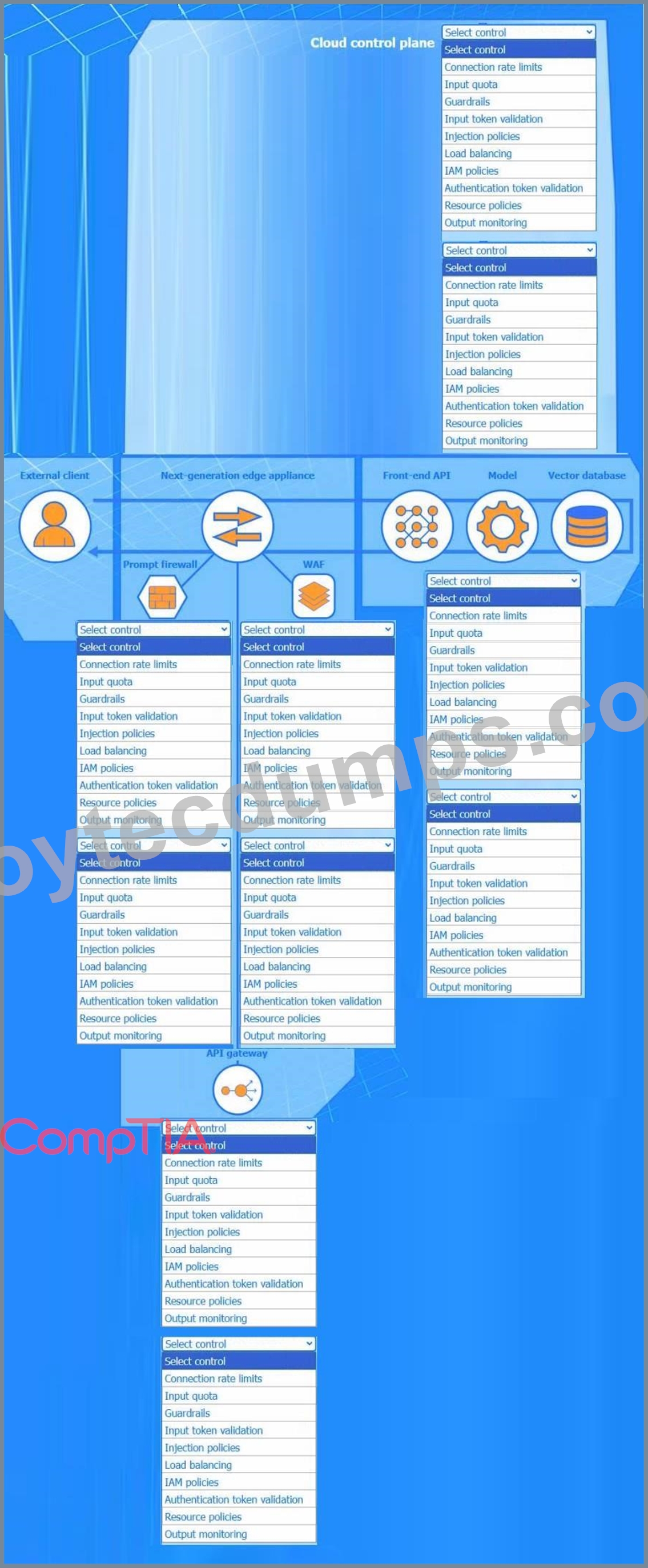
Answer:
Explanation: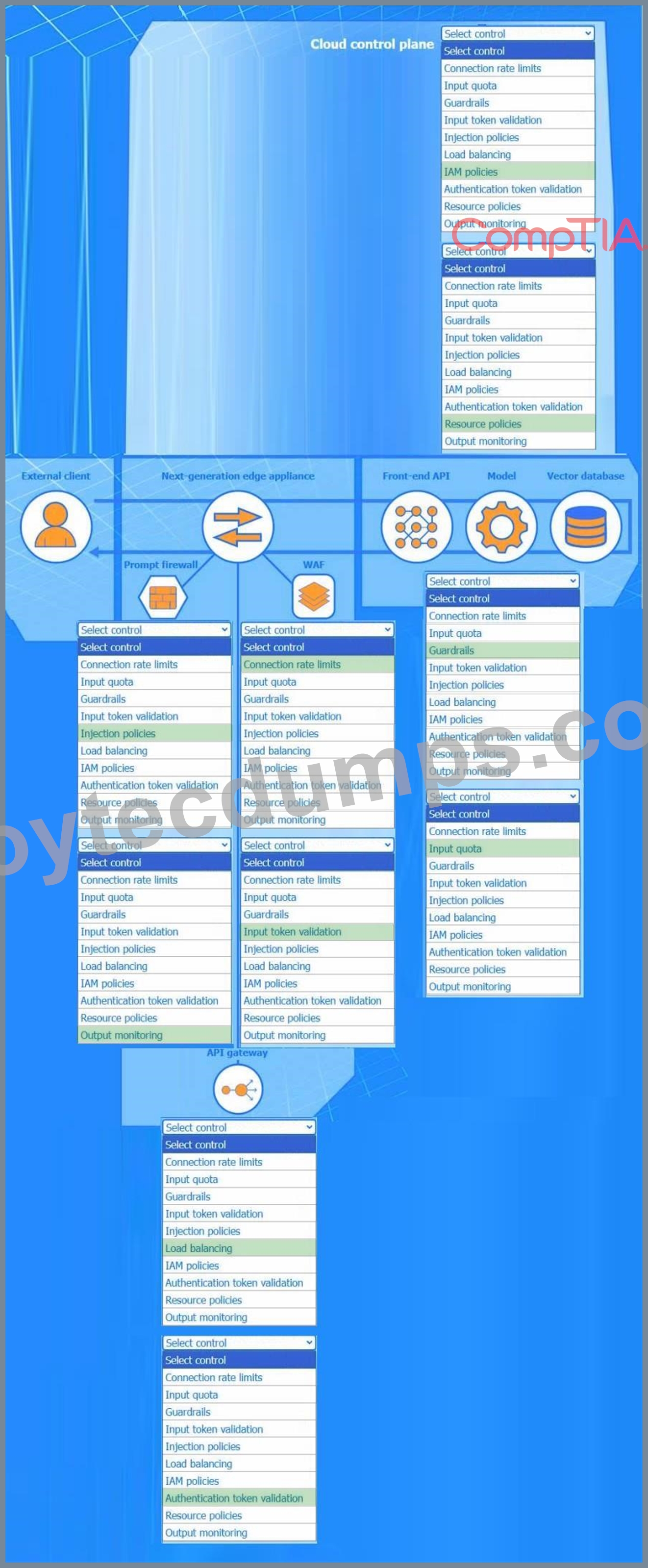
Explanation:
Cloud control plane: IAM policies, Resource policies
Prompt firewall: Injection policies, Output monitoring
WAF: Connection rate limits, Input token validation
Front-end API + Model + Vector database: Guardrails, Input quota
API gateway: Load balancing, Authentication token validation
Cloud control plane relies on IAM and resource policies to enforce centralized identity and access management as well as usage restrictions.
Prompt firewall protects against malicious input via injection policies and ensures outputs are monitored for compliance and safety.
WAF controls connection rate to mitigate DoS and validates input tokens to stop unauthorized access attempts.
Front-end API, Model, and Vector database share guardrails to restrict unsafe behaviors and input quotas to prevent overuse, making them consistent and efficient security points.
API gateway enforces load balancing for availability and validates authentication tokens at the entry point, providing secure and scalable access.
NEW QUESTION # 72
......
Download CY0-001 Exam Dumps Questions to get 100% Success: https://www.troytecdumps.com/CY0-001-troytec-exam-dumps.html
Check the Available CY0-001 Exam Dumps with 102 QA's: https://drive.google.com/open?id=101ATCXh0wXiWcTaRklhNHjCuufcv3KKZ