

Sep-2021 Latest TroytecDumps AZ-304 Exam Dumps with PDF and Exam Engine Free Updated Today!
Following are some new AZ-304 Real Exam Questions!
NEW QUESTION 110
You have an existing implementation of Microsoft SQL Server Integration Services (SSIS) packages stored in an SSISDB catalog on your on-premises network. The on-premises network does not have hybrid connectivity to Azure by using Site-to-Site VPN or ExpressRoute.
You want to migrate the packages to Azure Data Factory.
You need to recommend a solution that facilitates the migration while minimizing changes to the existing packages. The solution must minimize costs.
What should you recommend? To answer, select the appropriate options in the answer area.
NOTE: Each correct selection is worth one point.
Answer:
Explanation:
Explanation:
Box 1: Azure SQL database
You can't create the SSISDB Catalog database on Azure SQL Database at this time independently of creating the Azure-SSIS Integration Runtime in Azure Data Factory. The Azure-SSIS IR is the runtime environment that runs SSIS packages on Azure.
Box 2: Azure-SQL Server Integration Service Integration Runtime and self-hosted integration runtime The Integration Runtime (IR) is the compute infrastructure used by Azure Data Factory to provide data integration capabilities across different network environments. Azure-SSIS Integration Runtime (IR) in Azure Data Factory (ADF) supports running SSIS packages.
Self-hosted integration runtime can be used for data movement in this scenario.
Reference:
https://docs.microsoft.com/en-us/azure/data-factory/create-azure-integration-runtime
https://docs.microsoft.com/en-us/sql/integration-services/lift-shift/ssis-azure-connect-to-catalog-database
NEW QUESTION 111
You have 500 Azure web apps in the same Azure region. The apps use a premium Azure Key vault for authentication. A developer reports that some authentication requests are being throttled.
You need 10 recommend a solution to increase the available throughput of the key vault the solution must minimize costs. What should you recommend?
- A. Increase me number of key vaults in the subscription
- B. Change the pacing tier.
- C. Configure load balancing for the apps.
- D. Configure geo-replication.
Answer: A
Explanation:
Explanation
To maximize your Key Vault through put rates, here are some recommended guidelines/best practices for maximizing your throughput:
* Ensure you have throttling in place. Client must honor exponential back-off policies for 429's and ensure you are doing retries as per the guidance below.
* Divide your Key Vault traffic amongst multiple vaults and different regions. Use a separate vault for each security/availability domain. If you have five apps, each in two regions, then we recommend 10
* vaults each containing the secrets unique to app and region.
Reference:
https://docs.microsoft.com/en-us/azure/key-vault/general/overview-throttling
NEW QUESTION 112
Note: This question is part of a series of questions that present the same scenario. Each question in the series contains a unique solution that might meet the stated goals. Some question sets might have more than one correct solution, while others might not have a correct solution.
After you answer a question in this section, you will NOT be able to return to it. As a result, these questions will not appear in the review screen.
Your company plans to deploy various Azure App Service instances that will use Azure SQL databases. The App Service instances will be deployed at the same time as the Azure SQL databases.
The company has a regulatory requirement to deploy the App Service instances only to specific Azure regions.
The resources for the App Service instances must reside in the same region.
You need to recommend a solution to meet the regulatory requirement.
Solution: You recommend creating resource groups based on locations and implementing resource locks on the resource groups.
Does this meet the goal?
- A. No
- B. Yes
Answer: A
Explanation:
Explanation
Resource locks are not used for compliance purposes. Resource locks prevent changes from being made to resources.
Reference:
https://docs.microsoft.com/en-us/azure/azure-resource-manager/management/lock-resources
NEW QUESTION 113
You plan to store data in Azure Blob storage for many years. The stored data will be accessed rarely.
You need to ensure that the data in Blob storage is always available for immediate access. The solution must minimize storage costs.
Which storage tier should you use?
- A. Archive
- B. Cool
- C. Hot
Answer: B
Explanation:
Explanation
Azure cool tier is equivalent to the Amazon S3 Infrequent Access (S3-IA) storage in AWS that provides a low cost high performance storage for infrequently access data.
Note: Azure's cool storage tier, also known as Azure cool Blob storage, is for infrequently-accessed data that needs to be stored for a minimum of 30 days. Typical use cases include backing up data before tiering to archival systems, legal data, media files, system audit information, datasets used for big data analysis and more.
The storage cost for this Azure cold storage tier is lower than that of hot storage tier. Since it is expected that the data stored in this tier will be accessed less frequently, the data access charges are high when compared to hot tier. There are no additional changes required in your applications as these tiers can be accessed using APIs in the same manner that you access Azure storage.
References:
https://cloud.netapp.com/blog/low-cost-storage-options-on-azure
NEW QUESTION 114
Note: This question Is part of a series of questions that present the same scenario. Each question in the series contains a unique solution that might meet the stated goals. Some question sets might have more than one correct solution, while others might not have a correct solution.
After you answer a question In this section, you will NOT be able to return to It As a result, these questions will not appear In the review screen.
You have an on-premises Hyper-V cluster that hosts 20 virtual machines. Some virtual machines run Windows Server 2016 and some run Linux.
You plan to migrate the virtual machines to an Azure subscription.
You need to recommend a solution to replicate the disks of the virtual machines to Azure. The solution must ensure that the virtual machines remain available during the migration of the disks.
Solution: You recommend implementing an Azure Storage account that has a file service and a blob service, and then using the Data Migration Assistant Does this meet the goal?
- A. No
- B. Yes
Answer: A
Explanation:
Data Migration Assistant is used to migrate SQL databases.
Instead use Azure Site Recovery.
References:
https://docs.microsoft.com/en-us/azure/site-recovery/site-recovery-overview
NEW QUESTION 115
Your company identifies the following business continuity and disaster recovery objectives for virtual machines that host sales, finance, and reporting application in the company's on-premises data center.
* The finance application requires that data be retained for seven years. In the event of a disaster, the application must be able to run from Azure. The recovery in objective (RTO) is 10 minutes,
* The reporting application must be able to recover point in-time data al a daily granularity. The RTO is eight hours.
* The sales application must be able to fail over to second on-premises data center.
You need to recommend which Azure services meet the business community and disaster recovery objectives. The solution must minimize costs.
What should you recommend for each application? To answer, drag the appropriate services to the correct application. Each service may be used owe. More than once not at an You may need to drag the spin bar between panes or scroll 10 view content.
Answer:
Explanation:
NEW QUESTION 116
You have 500 Azure web apps in the same Azure region. The apps use a premium Azure Key vault for authentication. A developer reports that some authentication requests are being throttled.
You need 10 recommend a solution to increase the available throughput of the key vault the solution must minimize costs. What should you recommend?
- A. Configure load balancing for the apps.
- B. Increase me number of key vaults in the subscription
- C. Configure geo-replication.
- D. Change the pacing tier.
Answer: D
NEW QUESTION 117
You need to design a solution for securing access to the historical transaction data.
What should you include in the solution? To answer, select the appropriate options in the answer area.
NOTE: Each correct selection is worth one point.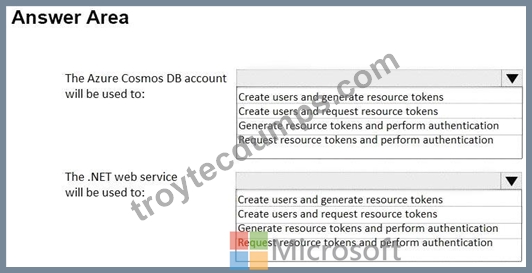
Answer:
Explanation:
Explanation
NEW QUESTION 118
You have an Azure subscription that contains 300 Azure virtual machines that run Windows Server 2016.
You need to centrally monitor all warning events in the System logs of the virtual machines.
What should you include in the solutions? To answer, select the appropriate options in the answer area.
NOTE: Each correct selection is worth one point.
Answer:
Explanation:
References:
https://docs.microsoft.com/en-us/azure/azure-monitor/platform/data-sources-windows-events
https://docs.microsoft.com/en-us/azure/azure-monitor/platform/agent-windows
NEW QUESTION 119
You plan to run an image rendering workload in Azure. The workload uses parallel compute processes.
What is the best service to use to run the workload? More than one answer choice may achieve the goal Select the BEST answer
- A. an Azure virtual machine scale set
- B. Azure Kubernetes Service (AKS)
- C. Azure Batch
- D. Azure function App
Answer: C
Explanation:
Azure Batch works well with intrinsically parallel (also known as "embarrassingly parallel") workloads. Intrinsically parallel workloads are those where the applications can run independently, and each instance completes part of the work. When the applications are executing, they might access some common data, but they do not communicate with other instances of the application. Intrinsically parallel workloads can therefore run at a large scale, determined by the amount of compute resources available to run applications simultaneously.
Reference:
https://docs.microsoft.com/en-us/azure/batch/batch-technical-overview
NEW QUESTION 120
You need to ensure that users managing the production environment are registered for Azure MFA and must authenticate by using Azure MFA when they sign in to the Azure portal. The solution must meet the authentication and authorization requirements.
What should you do? To answer, select the appropriate options in the answer area.
NOTE: Each correct selection is worth one point.
Answer:
Explanation:
Explanation
Graphical user interface, text, application Description automatically generated
Box 1: Azure AD Identity Protection
Azure AD Identity Protection helps you manage the roll-out of Azure AD Multi-Factor Authentication (MFA) registration by configuring a Conditional Access policy to require MFA registration no matter what modern authentication app you are signing in to.
Scenario: Users that manage the production environment by using the Azure portal must connect from a hybrid Azure AD-joined device and authenticate by using Azure Multi-Factor Authentication (MFA).
Box 2: Sign-in risk policy...
Scenario: The Litware.com tenant has a conditional access policy named capolicy1. Capolicy1 requires that when users manage the Azure subscription for a production environment by using the Azure portal, they must connect from a hybrid Azure AD-joined device.
Identity Protection policies we have two risk policies that we can enable in our directory.
* Sign-in risk policy
* User risk policy
Reference:
https://docs.microsoft.com/en-us/azure/active-directory/identity-protection/howto-identity-protection-configure-m
https://docs.microsoft.com/en-us/azure/active-directory/identity-protection/howto-identity-protection-configure-r
NEW QUESTION 121
You need to deploy resources to host a stateless web app in an Azure subscription. The solution must meet the following requirements:
* Provide access to the full .NET framework.
* Provide redundancy if an Azure region fails.
* Grant administrators access to the operating system to install custom application dependencies.
Solution: You deploy a virtual machine scale set that uses autoscaling.
Does this meet the goal?
- A. No
- B. Yes
Answer: A
Explanation:
Instead, you should deploy two Azure virtual machines to two Azure regions, and you create a Traffic Manager profile.
NEW QUESTION 122
You have an Azure web app named App1 and an Azure key vault named KV1.
App1 stores database connection strings in KV1.
App1 performs the following types of requests to KV1:
Get
List
Wrap
Delete
Unwrap
Backup
Decrypt
Encrypt
You are evaluating the continuity of service for App1.
You need to identify the following if the Azure region that hosts KV1 becomes unavailable:
To where will KV1 fail over?
During the failover, which request type will be unavailable?
What should you identify? To answer, select the appropriate options in the answer area.
NOTE: Each correct selection is worth one point.
Answer:
Explanation:
Explanation:
Box 1: A server in the same paired region
The contents of your key vault are replicated within the region and to a secondary region at least 150 miles away, but within the same geography to maintain high durability of your keys and secrets.
Box 2: Delete
During failover, your key vault is in read-only mode. Requests that are supported in this mode are:
List certificates
Get certificates
List secrets
Get secrets
List keys
Get (properties of) keys
Encrypt
Decrypt
Wrap
Unwrap
Verify
Sign
Backup
Reference:
https://docs.microsoft.com/en-us/azure/key-vault/general/disaster-recovery-guidance
NEW QUESTION 123
You plan to deploy an application that will run at a Linux-based Docker container You need to recommend a solution to host the application in Azure. The solution must meet the following requirements:
* Support a custom domain name and an associated SSL certificate.
* Scale-out automatically based on demand
* Minimize administrative effort and costs.
What should you Include in the recommendation?
- A. Azure Kubemetes Service (AKS)
- B. an Azure virtual machine
- C. Azure Container instances
- D. Azure App Service
Answer: A
Explanation:
App Service not only adds the power of Microsoft Azure to your application, such as security, load balancing, autoscaling, and automated management. You can also take advantage of its DevOps capabilities, such as continuous deployment from Azure DevOps, GitHub, Docker Hub, and other sources, package management, staging environments, custom domain, and TLS/SSL certificates.
Key features of App Service include:
Containerization and Docker - Dockerize your app and host a custom Windows or Linux container in App Service.
Scale up or out manually or automatically. Host your apps anywhere in Microsoft's global datacenter infrastructure, and the App Service SLA promises high availability.
App Service can also host web apps natively on Linux for supported application stacks. It can also run custom Linux containers (also known as Web App for Containers).
Reference:
https://docs.microsoft.com/en-us/azure/app-service/overview
NEW QUESTION 124
A company plans to implement an HTTP-based API to support a web app. The web app allows customers to check the status of their orders.
The API must meet the following requirements:
* Implement Azure Functions
* Provide public read-only operations
* Do not allow write operations
You need to recommend configuration options.
What should you recommend? To answer, configure the appropriate options in the dialog box in the answer area.
NOTE: Each correct selection is worth one point.
Answer:
Explanation:
Explanation
Allowed authentication methods: GET only
Authorization level: Anonymous
The option is Allow Anonymous requests. This option turns on authentication and authorization in App Service, but defers authorization decisions to your application code. For authenticated requests, App Service also passes along authentication information in the HTTP headers.
This option provides more flexibility in handling anonymous requests.
References:
https://docs.microsoft.com/en-us/azure/app-service/overview-authentication-authorization
NEW QUESTION 125
You have an Azure subscription that contains the SQL servers shown in the following table.
The subscription contains the storage accounts shown in the following table.
You create the Azure SQL databases shown in the following table.

Answer:
Explanation:
Explanation
Box 1: Yes
Be sure that the destination is in the same region as your database and server.
Box 2: No
Box 3: No
Reference:
https://docs.microsoft.com/en-us/azure/sql-database/sql-database-auditing
NEW QUESTION 126
You have an Azure subscription. The subscription contains Azure virtual machines that run Windows Server 2016 and Linux.
You need to use Azure Log Analytics design an alerting strategy for security-related events.
Which Log Analytics tables should you query? To answer, drag the appropriate tables to the correct log types. Each value may be used once, more than once, or not at all. You may need to drag the split bar between panes or scroll to view content.
NOTE: Each correct selection is worth one point.
Answer:
Explanation:
https://docs.microsoft.com/en-us/azure/azure-monitor/platform/log-analytics-agent Windows Event logs --> Information sent to the Windows event logging system. Syslog --> Information sent to the Linux event logging system.
NEW QUESTION 127
You are developing a sales application that will contain several Azure cloud services and will handle different components of a transaction Different cloud services will process customer orders balling, payment inventory, and stopping You need to recommend a solution to enable the cloud services to asynchronously communicate transaction information by using REST messages.
What should you include in the recommendation?
- A. Azure Service Fabric
- B. Azure Data Lake
- C. Azure Traffic Manager
- D. Azure Queue storage
Answer: A
Explanation:
Reference:
https://docs.microsoft.com/en-us/azure/service-fabric/service-fabric-reliable-services-quick-start
NEW QUESTION 128
You have .NeT web service named service1 that has the following requirements.
* Must read and write to the local file system.
* Must write to the Windows Application event log.
You need to recommend a solution to host Service1 in Azure . The solution must meet the following requirements:
* Minimize maintenance overhead.
* Minimize costs.
What should you include in the recommendation?
- A. an Azure web app
- B. an Azure virtual machine scale set
- C. an App service Environment
- D. Azure function
Answer: B
NEW QUESTION 129
......
Resources From:
- 2021 Latest TroytecDumps AZ-304 Exam Dumps (PDF & Exam Engine) Free Share: https://www.troytecdumps.com/AZ-304-troytec-exam-dumps.html
Free Resources from TroytecDumps, We Devoted to Helping You 100% Pass All Exams!